
Apdf
What Apdf is
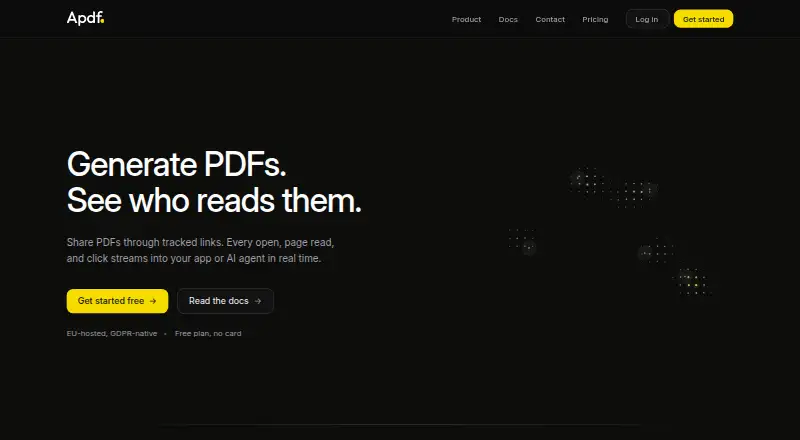
Apdf generates and tracks PDFs through an API, sending reader activity to apps or AI agents. Its operations include HTML-to-PDF generation, merging, splitting, compression, watermarking, OCR, and password security. Analytics can report document opens, page reads, time spent, downloads, prints, and other events. Tokenized recipient links connect activity to a named reader and can be revoked. Recipients use a hosted browser viewer to read tracked PDFs, annotate them, or submit form fields; captured form data is delivered in structured form. Event-based automations can send webhooks to external endpoints. The site describes MCP connections for Claude, ChatGPT, Cursor, and Gemini, along with webhook examples involving Slack, HubSpot, Pipedrive, and S3. Apdf says data is EU-hosted, encrypted in transit and at rest, and handled in a GDPR-compliant manner. The free Hobby plan includes 3 tracked documents and 500 PDF operations per month. Pro costs $39 a month. The API lists a 100 MB upload limit and 60-minute storage for generated PDFs.
Who it suits
Apdf is aimed at app builders, workflow operators, and AI-native teams using agents. It may suit teams that need to create PDFs through an API and track recipient activity.
What it does well
- Covers PDF conversion, OCR, merging, and splitting.
- Reports opens, page reads, time, downloads, and prints.
- Recipient links identify viewers and can be revoked.
- Hosted viewer supports annotations and PDF form fields.
- Customer documents and reader behavior are not used for training.
What to know first
- API limit is 3 requests per second and 60 per minute.
- Uploads are limited to 100 MB.
- Generated PDFs are stored for 60 minutes.
- Pro costs $39 a month.
Limits
The free Hobby plan includes 3 tracked documents, 500 PDF operations per month, 14-day event history, and 25 recipient links per document. The API documentation lists a limit of 3 requests per second and 60 per minute, a 100 MB upload limit, and 60-minute storage for generated PDFs.
Plans
| Plan | Billed and limits | Price |
|---|---|---|
| Hobby | $0 / mo · 3 tracked documents · 500 PDF operations / mo · 14-day event history · 25 recipient links per document | Free |
| Business | $149 / mo · 300 tracked documents · 20,000 PDF operations / mo · 12-month event history · 1,000 recipient links per document | $149 a month |
| Pro | $39 / mo · 50 tracked documents · 2,500 PDF operations / mo · 90-day event history · 250 recipient links per document | $39 a month |
As apdf.io lists them, read 30 Sept 2026. The maker's own page has the final word.
Getting started
- Open https://apdf.io/.
- Choose the web or API route for using the service.
- Start with the free Hobby plan, or select a paid plan; the pricing note includes a 14-day trial.
- Use the API for PDF operations and tracked documents.
- Connect event automations to external endpoints if needed.
Apdf is a cloud PDF API that combines document processing with recipient-level tracking and workflow automation. It is best suited to app builders and teams connecting document activity to apps or AI agents. Its broad PDF toolkit and event stream are compelling, but operation quotas and 60-minute storage for generated PDFs need to fit the workload.
Overview
Apdf handles PDF generation and processing through an API, while reporting how recipients interact with documents. The service covers HTML-to-PDF generation, merging, splitting, compression, watermarking, OCR and password security. That range can consolidate common document tasks for software teams; it is less suited to someone seeking a standalone PDF editor.
Reader analytics go beyond opens: Apdf reports page reads, time spent, downloads, prints and other events. Tokenized recipient links tie activity to named readers and can be deactivated or revoked. Recipients use a hosted browser viewer without installing an app or plugin, and can annotate PDFs or submit form fields. Responses arrive as structured data, making the viewer useful for collecting information as well as tracking readership.
Key features
When/filter/then automations can send event-driven webhooks to external endpoints, so teams can route document activity into workflows. Apdf describes MCP connections for Claude, ChatGPT, Cursor and Gemini, with webhook examples involving Slack, HubSpot, Pipedrive and S3. This integration approach suits teams already building around APIs and agents, though it presumes a workflow where events and external systems matter.
Apdf states that data is hosted in the EU, handled in a GDPR-compliant manner and encrypted in transit and at rest. The company says customer documents and reader behavior are not used as training data, and that data can be exported on demand. Support handles questions, billing requests, feedback and API problems by email.
The API documentation sets limits of 3 requests per second and 60 per minute, a 100 MB upload maximum, and 60 minutes of storage for generated PDFs. Those constraints deserve attention in workflows that need sustained request volume, large uploads or longer-lived generated files.
Pricing
Apdf has a free Hobby plan and two monthly paid plans. Hobby costs nothing (billed $0 / mo) and includes 3 tracked documents, 500 PDF operations per month, 14-day event history and 25 recipient links per document. It is a sensible starting point for a small integration or light usage, but the document and operation caps leave little room for a growing workflow.
Pro costs $39 a month (billed $39 / mo) and raises the limits to 50 tracked documents, 2,500 PDF operations per month, 90-day event history and 250 recipient links per document. It is the more practical tier for a working app or team that needs more recipients and longer analytics history, though the monthly operation ceiling still matters for frequent processing.
Business costs $149 a month (billed $149 / mo) and includes 300 tracked documents, 20,000 PDF operations per month, 12-month event history and 1,000 recipient links per document. It fits higher-volume workflows that need more durable event history and substantially larger quotas. Apdf also offers a 14-day trial; the plan limits and storage window should be checked against the intended workload before committing.
Platforms
Apdf is available through an API and the web, and uses a cloud deployment model. That makes it a fit for software integrations and browser-based administration rather than an installed desktop or mobile application.
Who it's for
Apdf makes the most sense for app builders who need PDF generation and processing inside a product, operators who want reader events to trigger connected workflows, and AI-native teams using agents. Named-recipient tracking, structured form responses and webhooks are valuable when document activity needs to feed another system. A team that only needs occasional conversion or OCR may find the tracking and automation emphasis unnecessary.
Pros and cons
- Pros: A broad set of PDF operations, from HTML generation through OCR and security, can support several document tasks through one API.
- Pros: Recipient-level links, detailed reader events, annotations and structured form responses connect document viewing to measurable activity and data capture.
- Pros: Event-driven webhooks and described MCP connections suit app and agent workflows that need to act on document events.
- Cons: Generated PDFs are stored for only 60 minutes, which may not suit processes that depend on retaining generated files.
- Cons: The 3 requests-per-second and 60-per-minute limits, plus monthly operation quotas, constrain throughput and require capacity planning.
- Cons: The free plan is capped at 3 tracked documents and 500 PDF operations per month, making it a limited basis for production use.
Alternatives
easyPDF Cloud API is worth considering when broad device and operating-system coverage matters; its free Guest tier includes REST API trial access, but is limited to one stored file, 2 MB maximum upload and one file at a time.
OCR.space is a stronger candidate for OCR-focused work, with a free tier of 25,000 requests per month but a 1 MB file limit, three PDF pages and a searchable-PDF watermark.
PDF4me API may fit buyers who prefer a one-time call pack: its Pack 1,000 includes 1,000 API calls for free, with calls that never expire while the account remains active.
Zamzar API is another freemium option for conversion workflows; its Test plan provides 100 conversion credits, with a 1 MB file limit and one-day file storage.
HTML2PDF Rocket may suit a narrower HTML-to-PDF need: its free plan grants 200 credits per month, with a 5 Mb per-PDF limit and credit use tied to network traffic for larger PDFs.
CraftMyPDF is an alternative for template-based PDF generation, with a free tier of 50 PDFs or images per month, three templates, and REST API, Zapier, Make.com and Bubble.io access.
DocRaptor offers a simpler document-volume comparison: its free plan covers five documents per month, while its Basic plan covers 125 documents per month for $15 a month.
DynamicPDF Cloud API may be preferable for a page-based free allowance, offering 1,000 pages per day, 10 MB cloud storage and community support, with an output watermark on its free plan.
Browse more options in PDF API Software.
Verdict
Choose Apdf if your app or workflow needs both PDF operations and recipient-level activity that can trigger downstream actions. The combination of document processing, named-reader tracking, structured responses and webhooks is its clearest advantage. Look elsewhere if your workload needs longer generated-file retention, higher sustained request rates, or only a focused conversion or OCR tool without tracking and automation.
Verdict
Apdf brings PDF operations, recipient tracking, and event-driven integrations together through an API. Consider its documented request, upload, and generated-file storage limits when assessing whether it fits a workflow.
Questions
Does Apdf have a free plan?
Yes. Hobby costs nothing and includes 3 tracked documents and 500 PDF operations per month.
How much do the paid plans cost?
Pro costs $39 a month, billed $39 / mo. Business costs $149 a month, billed $149 / mo.
Is there a free trial?
Yes. The pricing note lists a 14-day trial.
Which platforms does Apdf support?
The listed platforms are API and web.
What can readers do with a tracked PDF?
They can view it in a hosted browser viewer, annotate it, and submit PDF form fields.
Which integrations are described?
The site describes MCP connections for Claude, ChatGPT, Cursor, and Gemini, along with webhook action examples involving Slack, HubSpot, Pipedrive, and S3.
Facts from Apdf's own pages
- Annotations and forms
- Recipients can annotate PDFs and submit PDF form fields, with captured information delivered as structured data. · apdf.io, 30 Sept 2026
- API limits
- The API documentation lists a limit of 3 requests per second and 60 per minute, a 100 MB upload limit, and 60-minute storage for generated PDFs. · apdf.io, 30 Sept 2026
- Automations
- When/filter/then automations can send event-driven webhooks to external endpoints. · apdf.io, 30 Sept 2026
- Data use
- The company says customer documents and reader behavior are never used as training data and that data can be exported on demand. · apdf.io, 30 Sept 2026
- Integrations
- The site describes MCP connections for Claude, ChatGPT, Cursor, and Gemini, and examples of webhook actions involving Slack, HubSpot, Pipedrive, and S3. · apdf.io, 30 Sept 2026
- Intended users
- Apdf describes its audience as app builders, operators connecting workflows, and AI-native teams using agents. · apdf.io, 30 Sept 2026
- PDF operations
- Its PDF operations include HTML-to-PDF generation, merging, splitting, compression, watermarking, OCR, and password security. · apdf.io, 30 Sept 2026
- Product
- Apdf provides PDF generation and tracking through an API, with reader interactions streamed to apps or AI agents. · apdf.io, 30 Sept 2026
- Reader analytics
- The service reports document opens, page reads, time spent, downloads, prints, and other reader events. · apdf.io, 30 Sept 2026
- Recipient links
- Per-recipient tokenized links attribute viewer events to a named reader, and links can be deactivated or revoked. · apdf.io, 30 Sept 2026
- Security and privacy
- Apdf states that data is hosted in the EU, handled in a GDPR-compliant manner, and encrypted in transit and at rest. · apdf.io, 30 Sept 2026
- Support
- Support accepts questions, billing requests, feedback, and API problems by email. · apdf.io, 30 Sept 2026
- Viewer
- Recipients view tracked PDFs in a hosted browser viewer without installing an app or plugin. · apdf.io, 30 Sept 2026
Where Apdf stands on Freedom251
- PDF API Software#2 of 35