Freedom251 › Query Engine Software

Amazon Athena
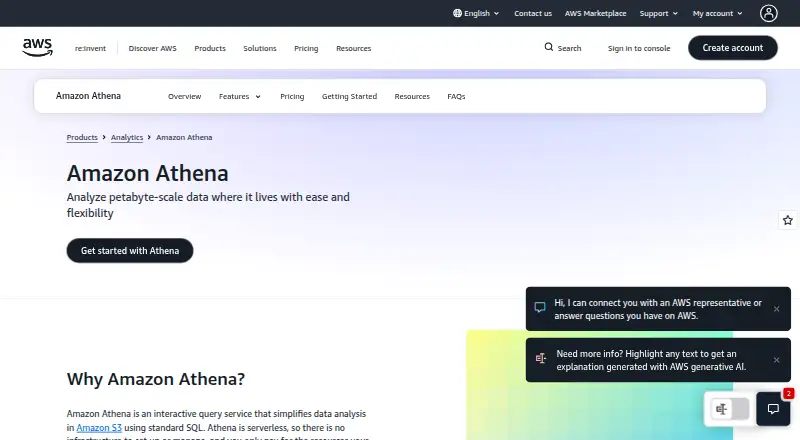
What Amazon Athena is
Amazon Athena is a serverless cloud service for interactive SQL analysis of data in Amazon S3. It can also query sources across other clouds and on-premises environments, and scales execution automatically while running queries in parallel. Its SQL engine is based on Trino and Presto and supports ANSI SQL features such as large joins, window functions, and arrays. Supported formats include CSV, JSON, ORC, Avro, and Parquet. Users can submit queries through the console, API, CLI, AWS SDK, or supported BI and SQL development tools using JDBC or ODBC. Athena integrates with AWS Glue and provides connectors to 30 data stores. SQL queries can invoke models deployed on Amazon SageMaker for inference. Workgroups can separate workloads, impose processing limits, and track costs; access controls include IAM policies, access control lists, and S3 bucket policies. Listed SQL query pricing is $5 a month, billed at $5 per TB scanned; additional S3, Glue Data Catalog, and Lambda charges may apply. S3 storage, requests, and transfers also have standard S3 charges. AWS was incorporated in 1994 and lists its principal corporate offices in Seattle, Washington.
Who it suits
Athena suits people exploring or querying data in S3 with SQL, including teams connecting other cloud and on-premises sources. Workgroups and access controls may help organize queries and govern data access.
What it does well
- Runs interactive SQL queries on S3 data
- Supports CSV, JSON, ORC, Avro, and Parquet
- Queries can invoke SageMaker models
- Workgroups can set limits and track costs
What to know first
- No free plan
- S3 and other service charges may apply separately
- SQL query pricing is based on data scanned
Limits
SQL queries are billed at $5.00 per TB of data scanned, while Capacity Reservations cost $0.30 per DPU-hour and Apache Spark costs $0.35 per DPU-hour. S3 storage, requests, transfer, Glue Data Catalog, and other applicable service charges can add to usage costs.
Plans
| Plan | Billed and limits | Price |
|---|---|---|
| SQL queries with Capacity Reservations | $0.30 per DPU-hour; usage-based · Capacity-based pricing; S3 and other service charges may apply separately | $0.30 a month |
| Apache Spark | $0.35 per DPU-hour; usage-based · S3 charges for storing and reading data and results apply separately | $0.35 a month |
| SQL queries | $5 per TB of data scanned; usage-based · S3, Glue Data Catalog, and Lambda charges may apply separately | $5 a month |
As aws.amazon.com lists them, read 3 Oct 2026. The maker's own page has the final word.
Getting started
- Open the Athena website and AWS console
- Prepare data in Amazon S3 or connect another supported source
- Choose the web console, API, CLI, SDK, or JDBC/ODBC application
- Select SQL queries, capacity reservations, or Apache Spark usage
- Configure workgroups, access policies, and processing limits
- Run queries against supported formats and sources
Verdict
Athena offers several ways to submit SQL queries and supports a broad set of data formats and connectors. Account for scanned-data pricing and separate storage, catalog, and related service charges when estimating use.
Questions
How much does Amazon Athena cost?
The listed usage prices are $5.00 per TB scanned for SQL queries, $0.30 per DPU-hour for SQL queries with Capacity Reservations, and $0.35 per DPU-hour for Apache Spark.
Does Athena have a free plan?
No. Amazon Athena is listed as a paid service.
Which platforms support Athena?
Athena is available through API and web access, plus its console, CLI, SDK, and JDBC or ODBC connections.
What data can Athena query?
It supports object, relational, non-relational, cloud, on-premises, and custom data sources, with formats including CSV, JSON, ORC, Avro, and Parquet.
Does Athena provide row-level security?
Yes. Row-level security is listed, alongside IAM policies, access-control lists, and S3 bucket policies.
Facts from Amazon Athena's own pages
- Additional charges
- S3 storage, requests, and data transfer are billed at standard S3 rates, and use of the AWS Glue Data Catalog incurs its standard rates. · aws.amazon.com, 3 Oct 2026
- Compliance
- AWS documentation says third-party auditors assess security and compliance under AWS programs including SOC, PCI, and FedRAMP; customer compliance responsibility depends on their data and obligations. · docs.aws.amazon.com, 3 Oct 2026
- Data formats
- Supported formats include CSV, JSON, ORC, Avro, and Parquet. · aws.amazon.com, 3 Oct 2026
- Integrations
- Athena integrates with AWS Glue and offers built-in connectors to 30 data stores, including Amazon Redshift, Amazon DynamoDB, Google BigQuery, Azure Synapse, Snowflake, and SAP Hana. · aws.amazon.com, 3 Oct 2026
- Intended use
- AWS describes Athena as suited to interactive SQL queries and data exploration across S3, other clouds, and on-premises sources. · aws.amazon.com, 3 Oct 2026
- Machine learning
- Athena SQL queries can invoke machine-learning models deployed on Amazon SageMaker for inference. · aws.amazon.com, 3 Oct 2026
- Maker
- Amazon.com, Inc. was incorporated in 1994 and lists its principal corporate offices in Seattle, Washington. · ir.aboutamazon.com, 3 Oct 2026
- Purpose
- Amazon Athena is a serverless interactive query service for analyzing data in Amazon S3 with standard SQL. · aws.amazon.com, 3 Oct 2026
- Query access
- Athena queries can be run from its console, API, CLI, AWS SDK, and supported BI and SQL development applications using JDBC or ODBC drivers. · aws.amazon.com, 3 Oct 2026
- Scale
- Athena automatically scales and runs queries in parallel, including on large datasets and complex queries. · aws.amazon.com, 3 Oct 2026
- Security
- Access to data can be controlled with IAM policies, access control lists, and S3 bucket policies, and Athena supports querying encrypted S3 data and writing encrypted results. · aws.amazon.com, 3 Oct 2026
- SQL engine
- Athena for SQL is based on Trino and Presto and supports ANSI SQL features including large joins, window functions, and arrays. · aws.amazon.com, 3 Oct 2026
- Workgroups
- Workgroups can separate users, teams, applications, or workloads, set per-query or group data processing limits, and track costs. · aws.amazon.com, 3 Oct 2026
Where Amazon Athena stands on Freedom251
- Query Engine Software#17 of 28
- OLAP Software#23 of 32