Freedom251 › Artifact repository software
Amargo
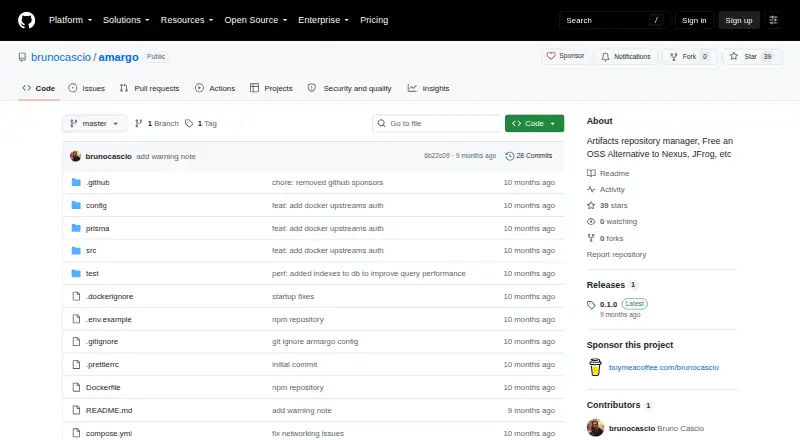
What Amargo is
Amargo is a free, open-source artifact repository manager for self-hosted deployments and APIs. It supports npm, PyPI, Docker, Maven, NuGet, and Go modules, and caches upstream artifacts when requested. Time-to-live settings can be configured for repositories and individual artifacts. Supported object-storage backends include MinIO, AWS S3, Google Cloud Storage, and Azure Blob Storage. The project is designed for horizontal scaling and distributed deployments, with storage limited by the configured backend rather than a built-in artifact size limit. Amargo tracks package downloads and usage statistics. It sets ETags from SHA256 checksums, sends HTTP cache headers, and exposes X-Amargo-Cache HIT or MISS markers. Deployment materials include Docker Compose and production Docker image instructions. Setup requires Node.js 20+, Docker and Docker Compose, PostgreSQL 16, and MinIO or S3-compatible storage. Local setup exposes an API at http://localhost:3000 and a health check at /health. The project uses the MIT License.
Who it suits
It suits teams wanting a self-hosted repository for container and package artifacts with configurable caching and object storage. Operators should be comfortable with the listed infrastructure requirements.
What it does well
- Free MIT-licensed software
- Supports six package formats
- Configurable pull-through caching
- Multiple object-storage backends
- Designed for horizontal scaling
What to know first
- Still in development
- Requires several infrastructure components
- Self-hosted deployment required
- Use is at the user's own risk
Plans
| Plan | Billed and limits | Price |
|---|---|---|
| Free and open source | MIT licensed · unlimited artifact storage stated | Free |
As github.com lists them, read 11 Oct 2026. The maker's own page has the final word.
Verdict
Amargo provides package caching, storage flexibility, analytics, and deployment options for self-hosted environments. Its development status and infrastructure requirements deserve attention before production use.
Facts from Amargo's own pages
- Analytics
- Amargo tracks package downloads and usage statistics. · github.com, 11 Oct 2026
- API
- The local setup instructions expose the application API at http://localhost:3000 and a health check at /health. · github.com, 11 Oct 2026
- Artifact capacity
- The README says there are no size limits and storage is limited by the configured object storage capacity. · github.com, 11 Oct 2026
- Caching headers
- It sets ETags based on SHA256 checksums and HTTP cache headers, and exposes an X-Amargo-Cache HIT or MISS header. · github.com, 11 Oct 2026
- Deployment
- The project provides Docker Compose setup and instructions for building a production Docker image. · github.com, 11 Oct 2026
- Development status
- The repository warns that Amargo is still in development and should be used at the user's own risk. · github.com, 11 Oct 2026
- License
- Amargo is released under the MIT License. · github.com, 11 Oct 2026
- Package formats
- It supports npm, PyPI, Docker, Maven, NuGet, and Go modules. · github.com, 11 Oct 2026
- Pull-through cache
- It caches artifacts on demand and supports configurable time-to-live settings at repository and artifact levels. · github.com, 11 Oct 2026
- Purpose
- Amargo is an open-source artifact repository manager with pull-through caching. · github.com, 11 Oct 2026
- Requirements
- The setup instructions list Node.js 20+, Docker and Docker Compose, PostgreSQL 16, and MinIO or S3-compatible storage. · github.com, 11 Oct 2026
- Scaling
- The project describes Amargo as designed for horizontal scaling and distributed deployments. · github.com, 11 Oct 2026
- Storage
- Supported object storage backends include MinIO, AWS S3, Google Cloud Storage, and Azure Blob Storage. · github.com, 11 Oct 2026
Where Amargo stands on Freedom251
- Artifact repository software#6 of 64