Freedom251 › API Analytics Software

AI Nazar
What AI Nazar is
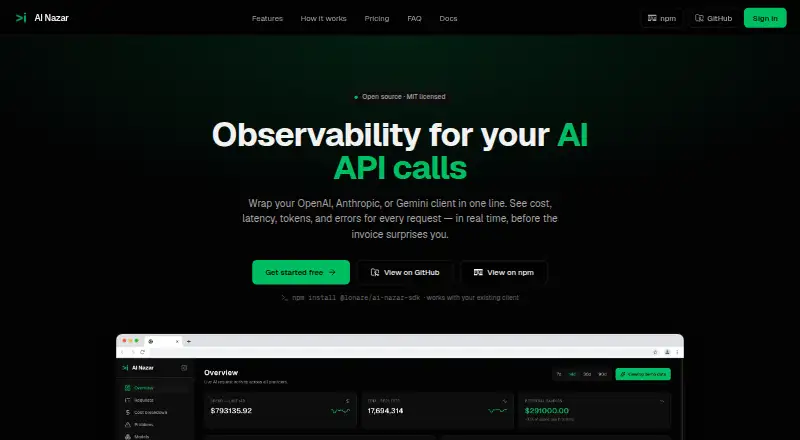
AI Nazar provides observability for large language model API calls, with a dashboard for cost, latency, token counts, and errors. It supports OpenAI, Anthropic, and Gemini through wrappers around their official clients. The dashboard can show costs by request and model, track latency and errors, flag spend anomalies, and compare providers. Users can inspect prompts, responses, token counts, latency, and cost, then filter requests by model, provider, or status. Its TypeScript-first SDK offers a drop-in OpenAI client wrapper with streaming, function calling, and tool use. AI Nazar says telemetry is sent asynchronously and adds zero latency to API calls. The SDK and dashboard are open source under the MIT license. It can be hosted or self-hosted, with SQLite, Postgres, or Postbase storage for self-hosted deployments. The SDK sends request metadata by default; prompt and response text are sent only when content logging is enabled. The hosted free tier retains event data for 30 days on a rolling basis. Dashboard cost, latency, and usage figures are estimates, so provider billing records remain the authoritative cost reference.
Who it suits
AI Nazar suits developers and teams monitoring API calls to OpenAI, Anthropic, or Gemini. It may fit users who want a hosted dashboard or prefer to keep self-hosted event data within their own infrastructure.
What it does well
- Tracks cost, latency, tokens, and errors.
- Supports OpenAI, Anthropic, and Gemini.
- Requests can be filtered by model, provider, and status.
- Self-hosted deployments support SQLite, Postgres, or Postbase.
- SDK and dashboard are open source under MIT.
What to know first
- Hosted free-tier event data is retained for 30 days.
- Prompt and response text are sent if content logging is enabled.
- Dashboard figures are estimates, not authoritative billing records.
Limits
The hosted free tier retains event data for 30 days on a rolling basis. Cost, latency, and usage figures in the dashboard are estimates, so provider billing records are the authoritative source for costs.
Plans
| Plan | Billed and limits | Price |
|---|---|---|
| Hosted | To get started — no card required · Zero infra · Managed storage and backups · Same dashboard and full feature set as self-hosting | Free |
| Self-hosted | Forever free · Unlimited requests and API keys · SQLite, Postgres, or Postbase storage · Full dashboard, no feature gates | Free |
As ainazar.com lists them, read 5 Oct 2026. The maker's own page has the final word.
Getting started
- Open the AI Nazar website.
- Choose the hosted or self-hosted plan; both are free.
- For self-hosting, choose SQLite, Postgres, or Postbase storage.
- Use the TypeScript-first SDK as a wrapper around the OpenAI client.
- Enable content logging if prompts and responses should be sent for inspection.
AI Nazar is an observability tool for large language model API calls, with a TypeScript SDK and a dashboard for request-level activity. It is best suited to teams building with OpenAI, Anthropic, or Gemini that want hosted convenience or control over self-hosted data.
Overview
The product brings cost, latency, token, and error monitoring together with inspection of individual requests. Its mix of a drop-in OpenAI wrapper, multi-provider comparisons, and self-hosting makes it a focused option for engineering teams tracking LLM usage across providers.
The SDK supports streaming, function calling, and tool use, and reports telemetry asynchronously. That is useful when instrumentation should not add latency to calls. The dashboard’s cost, latency, and usage figures are estimates, however, so they should not replace provider billing records for authoritative costs.
Key features
Monitoring and inspection
The dashboard tracks cost per request and model, latency, errors, and spend anomalies, and can compare providers. Request records can include prompts, responses, token counts, latency, and cost, with filters for model, provider, and status. This gives teams ways to investigate individual calls as well as broader usage patterns.
SDK, privacy, and deployment
The TypeScript-first SDK wraps the official OpenAI client and supports streaming, function calling, and tool use. OpenAI, Anthropic, and Gemini are supported through wrappers around their official clients. The SDK and dashboard are open source under the MIT license.
By default, the SDK sends request metadata; prompt and response text are sent only when content logging is enabled. The privacy policy describes TLS encryption in transit, encryption of sensitive data at rest, need-to-know production access controls, and hashed API keys. Self-hosted event data stays within the operator’s infrastructure, with SQLite, Postgres, or Postbase storage options. Teams that need hosted management can instead use the hosted deployment, but its free-tier event data is retained for 30 days on a rolling basis.
Pricing
Both plans are free, with no free trial. Hosted costs nothing and requires no card to get started; it includes managed storage and backups, zero infrastructure, and the same dashboard and feature set as self-hosting. It suits teams who prefer not to operate storage, with the trade-off of rolling 30-day event retention.
Self-hosted costs nothing, billed forever, and includes unlimited requests and API keys, the full dashboard, and no feature gates. It is the stronger fit for teams that want event data to remain in their own infrastructure and can manage deployment themselves. Unlike the hosted option, the plan specifies no request cap; it offers a choice of SQLite, Postgres, or Postbase.
Platforms
AI Nazar is available through an API, as a self-hosted deployment, and on the web. Its hybrid deployment model lets teams choose between hosted management and infrastructure they operate.
Who it's for
AI Nazar suits developers and teams monitoring LLM API calls across OpenAI, Anthropic, and Gemini, particularly those who value request-level inspection or want to keep event data within their own infrastructure. It is less suitable as a source of definitive billing totals, since its dashboard figures are estimates, or for users who need a provider beyond the three supported.
Pros and cons
- Pros: Both deployment options are free, and the self-hosted plan includes unlimited requests and API keys without feature gates.
- Pros: Request inspection combines prompt and response content, token counts, latency, and cost with practical filters.
- Pros: Metadata is sent by default while prompt and response logging is opt-in; self-hosted event data remains within the operator’s infrastructure.
- Cons: Hosted event data has a rolling 30-day retention period, which may not suit teams needing a longer history.
- Cons: Dashboard usage, cost, and latency figures are estimates, so billing decisions still need provider records.
- Cons: Provider support centers on OpenAI, Anthropic, and Gemini, and the stated SDK is TypeScript-first.
Alternatives
For a broader comparison of tools in the category, see API Analytics Software.
- API Analytics is another free option across API, self-hosted, and web platforms. Its free plan stores up to 1 million requests per user, replacing older requests with new ones; choose it if that explicit storage cap suits your needs.
- Apirelio is a freemium web option with a 14-day free trial of Growth at $19 a month afterward. Growth includes 2M events/month, 5 projects, 30-day retention, and 5 members; consider it if those project and team limits fit better.
- BetterMeter offers a free plan with 30-day event retention on API and web platforms; it may suit readers seeking another freemium option in those environments.
- Clavio is a web-based freemium product whose free plan offers sample datasets and file uploads, core analysis and charting, and limited saved analyses. It is oriented toward analysis and charting rather than the LLM-call monitoring described for AI Nazar.
- Helicone is a freemium option available via API, self-hosted, and web, and describes itself as open source. Consider it if you want to compare another open-source product with those platform options.
- KeepRouter offers a free API and web plan billed at $0 per input and output token, described as best-effort for testing, prototyping, and evaluation. It may fit those uses better than a monitoring-focused tool.
- Langfuse is freemium across API, self-hosted, and web platforms; its Hobby plan includes 50k units/month, 30 days of data access, 2 users, and GitHub community support. Choose it if those published usage and team limits suit your requirements.
- Moesif is freemium and supports API, self-hosted, and web platforms. Consider it if you want to compare another option in those deployment environments.
Verdict
AI Nazar is a strong fit for engineering teams that want free, open-source LLM request monitoring with a choice between managed hosting and self-hosted data. Its inspection and provider-comparison tools are the main reasons to choose it; look elsewhere if you need longer hosted retention or authoritative cost reporting from the dashboard.
Verdict
AI Nazar offers request inspection and usage monitoring for three listed LLM providers, with hosted and self-hosted options. Consider its data handling and the estimated nature of dashboard figures when deciding how to use it.
Questions
Is AI Nazar free?
Yes. The Hosted and Self-hosted plans are each listed as free.
Is there a free trial?
No free trial is listed; the plans are free.
Which providers does it support?
AI Nazar says it supports OpenAI, Anthropic, and Gemini through wrappers around their official clients.
Can I self-host AI Nazar?
Yes. Self-hosted deployments can use SQLite, Postgres, or Postbase, and event data stays within the operator’s infrastructure.
Is AI Nazar open source?
Yes. Its SDK and dashboard are open source under the MIT license.
What data does the SDK send?
Request metadata is sent by default. Prompt and response text are sent only if content logging is enabled.
Facts from AI Nazar's own pages
- Estimate limits
- The terms say dashboard cost, latency, and usage figures are estimates and advise consulting LLM providers’ billing records for authoritative costs. · ainazar.com, 5 Oct 2026
- Features
- The dashboard includes cost per request and model, latency and error tracking, spend anomaly detection, and multi-provider comparisons. · ainazar.com, 5 Oct 2026
- Hosted retention
- The privacy policy says event data on the free hosted tier is retained for 30 days on a rolling basis. · ainazar.com, 5 Oct 2026
- Latency
- The site says telemetry is reported asynchronously and adds zero latency to API calls. · ainazar.com, 5 Oct 2026
- Open source
- AI Nazar says its SDK and dashboard are open source under the MIT license. · ainazar.com, 5 Oct 2026
- Privacy
- The privacy policy says the SDK sends request metadata by default, while prompt and response text are sent only if content logging is enabled. · ainazar.com, 5 Oct 2026
- Providers
- The site says it supports OpenAI, Anthropic, and Gemini through wrappers around their official clients. · ainazar.com, 5 Oct 2026
- Purpose
- AI Nazar provides observability for large language model API calls, including a real-time dashboard for cost, latency, tokens, and errors. · ainazar.com, 5 Oct 2026
- Request inspection
- The site says requests can be inspected with prompt, response, token counts, latency, and cost, and filtered by model, provider, and status. · ainazar.com, 5 Oct 2026
- SDK
- The TypeScript-first SDK provides a drop-in OpenAI client wrapper and says it supports streaming, function calling, and tool use. · ainazar.com, 5 Oct 2026
- Security
- The privacy policy describes TLS encryption in transit, encryption of sensitive data at rest, need-to-know production access controls, and hashed API keys. · ainazar.com, 5 Oct 2026
- Storage
- Self-hosted deployments can use SQLite, Postgres, or Postbase, and the maker says self-hosted event data stays within the operator’s infrastructure. · ainazar.com, 5 Oct 2026
- Support
- The privacy policy directs privacy inquiries to [email protected] and says it aims to respond within five business days. · ainazar.com, 5 Oct 2026
Where AI Nazar stands on Freedom251
- API Analytics Software#3 of 16