Freedom251 › Customs Management Software

AEB Customs Management
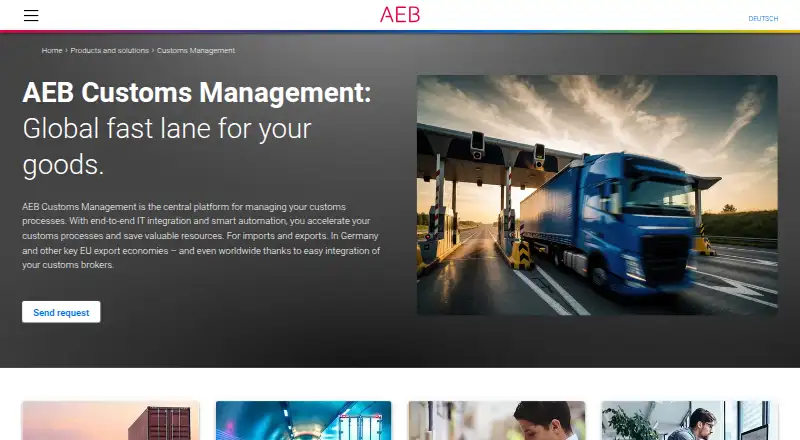
What AEB Customs Management is
AEB Customs Management centralizes customs processes for imports and exports, with modules for filing declarations, managing warehouse records, and coordinating with brokers. Filing can be automated across one or more countries and integrated with a host system. The customs warehouse module supports stock balancing, tracking, and reconciliation, and can produce administrative records and audit reports. Broker workflows include API-based data exchange, data enrichment, and status and result overviews. Product classification offers automated and manual options, with customs tariffs from more than 150 countries. Origin and preferences tools calculate preferential origin and manage supplier declarations. AEB describes integration with SAP ECC and S/4HANA, including public cloud, private cloud, and on-premises systems. Listed capabilities include declaration filing, HS classification, compliance records, API access, and sanctions screening. The service is cloud-based and available through web and API. AEB is headquartered in Stuttgart, Germany. The pricing note says from €129/mo, while the named plan is quote-based; components can be used separately or combined.
Who it suits
The platform suits businesses managing import and export declarations across multiple countries. It is also relevant to teams needing customs warehouse, broker, classification, or SAP workflows.
What it does well
- Automates filings for one or multiple countries.
- Tariffs cover more than 150 countries.
- Supports SAP ECC and S/4HANA environments.
- Broker collaboration includes API data exchange.
- Warehouse tools include tracking and reconciliation.
What to know first
- The named plan requires a quote.
- Pricing note starts at €129/mo.
Limits
Pricing starts from €129/mo, while the named plan requires a quote. Individual components can be used separately or combined.
Plans
| Plan | Billed and limits | Price |
|---|---|---|
| AEB Customs Management | Quote requested from AEB; individual components can be used separately or combined | On request |
As aeb.com lists them, read 7 Oct 2026. The maker's own page has the final word.
Getting started
- Visit the AEB Customs Management website.
- Request a quote for the named plan or its components.
- Use the web platform or API access.
Overview
AEB Customs Management is a cloud system for businesses coordinating import and export customs operations. It is most compelling for teams that need several customs workflows connected across countries, especially SAP users. Its broad scope is a strength, though buyers should weigh that scope against a custom quote.
Key features
Import and export filing modules automate declarations in one or multiple countries and integrate with a host system. That can reduce the need to treat filing as a disconnected task, while multi-country support suits companies handling customs activity across markets. AEB also supports API access, compliance records, and sanctions screening.
The customs warehouse module creates administrative records and audit reports, and supports stock balancing, tracking, and reconciliation. Those functions make the product more relevant to businesses managing customs inventory as well as declarations; teams seeking only a classification tool may be paying for breadth they do not need.
Broker collaboration brings automatic data exchange through an API, data enrichment, and status and result overviews. Product classification offers automated and manual options, with customs tariffs from more than 150 countries. Origin and preferences features calculate preferential origin and manage supplier declarations, extending coverage to related trade-compliance work.
AEB describes integration with SAP ECC and S/4HANA across public cloud, private cloud, and on-premises environments. This is a meaningful fit for SAP-centered operations, but does not establish integration with other enterprise systems. The product is available via web and API.
AEB says its German data centers are operated by the company and hold ISO 27001 certification. It describes redundant cloud systems, encrypted offsite tape backups, firewalls, anti-malware tools, and recurring penetration tests, and says it complies with EU GDPR and the German Federal Data Protection Act. AEB reports renewed ISO 27001 certification in 2024 and integration of ISO 27018 cloud data protection into its information security management system. These controls may matter to organizations evaluating data handling, but they do not replace a buyer's own security review.
Support resources include a Help Center, product documentation and downloads, API documentation, a community forum, and cloud status information. AEB's SAP page cites more than 45 years of company experience and over 25 years of cloud expertise, useful context for buyers considering a long-term customs platform.
Pricing
AEB's pricing model is paid, with a starting point of From €129/mo. The AEB Customs Management plan itself has custom pricing: request a quote from AEB. Individual components can be used separately or combined, giving buyers a way to scope the purchase to particular workflows or assemble broader coverage. The starting figure does not establish the cost of a particular component mix, so teams should confirm the quote against their required countries, modules, and integration needs.
The plan supports declaration filing, HS classification, compliance records, API access, and sanctions screening, with multi-country coverage and cloud deployment. No seat allowance, filing quota, trial period, or renewal terms are provided, so those terms should be settled during pricing discussions. There is no stated free plan to compare against; organizations looking for a no-cost starting point may prefer a freemium alternative.
Platforms
AEB supports web and API access and uses cloud deployment. That combination suits teams connecting customs processes to other systems or working through a browser, while buyers requiring a different deployment model should look elsewhere.
Who it's for
AEB is a strong candidate for organizations managing several customs processes across countries: filings, warehouse records, broker coordination, classification, and origin management. Its SAP ECC and S/4HANA integration is particularly relevant to SAP users. A business with a narrow need, such as occasional classification or screening alone, may find the platform's wider workflow coverage unnecessary.
Pros and cons
- Pros: Multiple customs workflows sit within one platform, from filing and warehouse records to broker coordination and origin management, which can suit teams trying to coordinate related processes.
- Pros: Multi-country support and tariffs from more than 150 countries give internationally active teams broad geographic coverage for filings and classification.
- Pros: SAP ECC and S/4HANA integration, including cloud and on-premises environments, is a concrete advantage for SAP-based operations.
- Cons: The named plan is custom pricing despite a From €129/mo starting point, so buyers cannot infer the cost of their chosen modules from that figure alone.
- Cons: The breadth may be unnecessary for teams that only need one task, such as classification, and the published price does not clarify which component mix fits their budget.
Alternatives
For a free classification starting point, CustomsLogIQ offers a free plan with three monthly credits, single and vision classification, and manual one-item entry; after signup, credits cost $1 each. Its narrower described scope may suit a small-volume user, while AEB covers broader customs workflows. GetRegNex offers free access with full Pro access and early pricing, making it an option for readers who want to begin with that access model rather than AEB's quoted paid platform.
Quickcode has an Always Free plan capped at 10 classifications per month, plus a Broker Partner Program at $749 a month, billed monthly, with 500 classifications and unlimited seats. It is a more direct fit for teams focused on classification or broker-partner volume, rather than AEB's wider customs operations. Descartes Visual Compliance is worth considering when online, batch, and dynamic screening, search tuning, allow/block lists, automated recordkeeping, and a seven-year audit trail are the priority.
e2open Global Trade Management is another paid web-based option for readers prepared to talk to an expert about a broader global trade management product. Borderline Genius and Centrade are paid API and web alternatives. For a modular alternative, Descartes Global EASE lets buyers purchase modules independently or combine them into an integrated suite, with demo-based pricing.
Readers comparing wider categories can also explore Trade Management Software and Customs Management Software.
Verdict
Choose AEB Customs Management if your organization needs multi-country customs processes spanning filings, brokers, inventory records, classification, and origin, particularly in an SAP environment. Its main case is breadth tied to existing systems; its main drawback is that the custom quote makes the cost of the required configuration something to establish before deciding. Teams with a single narrow need or a firm preference for a free plan should compare alternatives first.
Verdict
AEB Customs Management covers customs filings alongside warehouse, broker, classification, and origin workflows. The pricing note gives a starting point, but the named plan is quote-based.
Questions
What does AEB Customs Management cost?
Pricing starts from €129/mo. The named plan is quote-based, and individual components can be used separately or combined.
Which platforms does it support?
It is available through web and API access.
Can it handle customs work in multiple countries?
Yes. Its filing modules support one or multiple countries, and the product has multi-country coverage.
Does it integrate with SAP?
AEB describes integration with SAP ECC and S/4HANA, including public cloud, private cloud and on-premises systems.
Does it support sanctions screening?
Yes, sanctions screening is supported.
Where is AEB based?
AEB is headquartered in Stuttgart, Germany.
Facts from AEB Customs Management's own pages
- Broker integration
- The product supports customs broker collaboration, automatic data exchange via API, data enrichment, and status and result overviews. · aeb.com, 7 Oct 2026
- Certifications
- AEB reports renewed ISO 27001 certification in 2024 and integration of ISO 27018 cloud data protection into its information security management system. · aeb.com, 7 Oct 2026
- Cloud security
- AEB says its data centers are in Germany, are operated by AEB, and are ISO 27001 certified. · aeb.com, 7 Oct 2026
- Company age
- AEB's SAP page states that the company has more than 45 years of experience and more than 25 years of cloud expertise. · aeb.com, 7 Oct 2026
- Customs warehouse
- The customs warehouse module generates administrative records and audit reports and supports stock balancing, tracking, and reconciliation. · aeb.com, 7 Oct 2026
- Export and import
- Its export and import filing modules automate declarations, support one or multiple countries, and integrate with a host system. · aeb.com, 7 Oct 2026
- Founded
- 1979 · aeb.com, 28 Sept 2026
- Headquarters
- Stuttgart, Germany · aeb.com, 28 Sept 2026
- Origin and preferences
- The origin and preferences features calculate preferential origin and preferences and manage supplier declarations. · aeb.com, 7 Oct 2026
- Privacy
- AEB states that it complies with the EU GDPR and German Federal Data Protection Act (BDSG). · aeb.com, 7 Oct 2026
- Product classification
- Product classification supports automated and manual options and provides customs tariffs from more than 150 countries. · aeb.com, 7 Oct 2026
- Purpose
- AEB Customs Management is a central platform for managing customs processes for imports and exports. · aeb.com, 7 Oct 2026
- SAP integration
- AEB describes integration with SAP ECC and S/4HANA, including public cloud, private cloud, and on-premises systems. · aeb.com, 7 Oct 2026
- Security measures
- AEB describes redundant cloud systems, encrypted offsite tape backups, firewalls, anti-malware tools, and recurring penetration tests. · aeb.com, 7 Oct 2026
- Support
- AEB provides a Help Center, product documentation and downloads, API documentation, a community forum, and cloud status information. · aeb.com, 7 Oct 2026
Where AEB Customs Management stands on Freedom251
- Customs Management Software#4 of 22