PC Slower Than It Used to Be?
A free scan shows the junk files, broken settings and background clutter dragging Windows down - then fixes them in one click.Free scan · Windows 10 & 11Outdated Drivers Are Slowing You Down
One free scan finds every outdated or missing driver and matches the right update for your exact hardware.Free scan · exact hardware matchThere is no single best Olympus film camera: the right choice depends on whether you want an interchangeable-lens SLR, a pocketable compact, autofocus convenience, or half-frame economy. For most photographers who want an SLR, the OM-2N is a versatile choice because it offers aperture-priority automation and manual exposure; choose an OM-1N if you want mechanical operation and full manual control. For a compact, the XA offers the most focusing control in a pocketable body, while the Trip 35 is simpler to use. These are recommendations based on design and buying considerations, not hands-on test results. Since all are discontinued, an individual camera’s condition and service history matter more than its reputation.
Here, “analog” means film cameras. Olympus made several distinct kinds, so this guide compares them by how they are used rather than treating an SLR and a point-and-shoot as direct competitors.
Quick picks: which Olympus film camera suits you?
| Use case | Model | Why it fits | Check before buying |
|---|---|---|---|
| Versatile SLR | OM-2N | Aperture-priority exposure plus manual control in the OM system | Metering, automatic exposure, long exposures, and electronics |
| Mechanical, manual SLR | OM-1N | Direct manual operation and interchangeable OM lenses | Meter solution and accuracy, prism, seals, shutter |
| Advanced metering | OM-4 or OM-4Ti | Spot-metering control for photographers who want to manage difficult contrast | Electronic operation, service history, and price |
| Beginner OM SLR | OM-20 / OM-G, or OM-10 with Manual Adapter | Approachable route into the OM system | The OM-10 needs the separate adapter for full manual operation |
| Pocketable compact with precise focusing | XA | Coupled rangefinder-style focusing and aperture-priority exposure | Rangefinder patch, meter, shutter, batteries, sliding cover |
| Simple travel camera | Trip 35 | Straightforward, compact operation without a replaceable battery for its standard metering concept | Selenium meter and scale focus |
| Autofocus point-and-shoot | Mju II / Stylus Epic | Small body with automatic focus and exposure | Autofocus, flash, motor, lens cover, display, and seals |
| Half-frame shooting | PEN EE-2 or EE-3 | Two frames in the space of a standard 35mm frame | Selenium meter, transport, and whether half-frame suits your output |
Vintage listings and prices vary by country, condition, testing, included lens, accessories, and demand. A market guide can show relative differences among models, but it is not a fixed price list: Olympus used-camera market guide.
What counts as an Olympus analog camera?
Olympus’s film range includes 35mm SLRs such as the OM-1 and OM-2, fixed-lens compacts such as the XA and Trip 35, autofocus compacts such as the Mju line, and half-frame PEN cameras. They are different tools, not steps on one ladder of quality. An OM SLR takes interchangeable lenses and offers more exposure control; an XA is a fixed-lens compact with rangefinder-style focusing; a Mju is designed for automatic snapshots.
#1 Best Overall
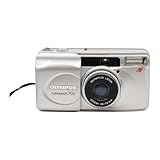
- Versatile 38–70mm Zoom Lens – Capture everything from wide-angle shots to portraits with sharp Olympus optics
- Autofocus System – Easy point-and-shoot operation ensures clear, well-focused images every time
- Built-In Flash – Automatic flash for low-light conditions with multiple shooting modes
- Fully Automatic Operation – Auto exposure, motorized film advance & rewind for effortless use
- Compact & Lightweight Design – Perfect everyday carry for travel, street photography, and casual shooting
The OM SLR system began in 1972. Olympus introduced the Trip 35 in 1968 and the XA in 1979, as its historical material records. See Olympus’s OM history and Olympus product history. The modern OM SYSTEM OM-1 is a digital interchangeable-lens camera, not the original film OM-1.
Best Olympus OM SLR cameras
Choose an OM body if you want interchangeable lenses and a viewfinder-based shooting experience. The OM system is known for its compact SLR design and Zuiko lens family; its history is outlined by Vintage Olympus’s OM system guide. Body and lens condition should be assessed separately, even when they are sold together.
| Model | Exposure approach | Best suited to | Main consideration |
|---|---|---|---|
| OM-1 / OM-1N | Manual | Photographers who want mechanical operation and hands-on exposure control | Meter battery solution, meter accuracy, prism, and seals |
| OM-2 / OM-2N | Aperture priority and manual | Those who want automation without giving up manual control | Electronics, meter, and automatic exposure require testing |
| OM-3 | Manual, advanced metering | Specialist users seeking high-control operation | Scarcity and price can exceed more practical alternatives |
| OM-4 / OM-4Ti | Automatic and manual exposure with advanced metering | Photographers who will use spot-metering control | Complexity, repair risk, and premium-market pricing |
| OM-10 | Primarily aperture priority; manual with accessory | Beginners who want a simple entry into OM | Full manual operation requires the separate Manual Adapter |
| OM-20 / OM-G | Consumer SLR operation | Buyers seeking an often-overlooked OM alternative | Search both names: OM-G was the US name for OM-20 |
| OM-40 | More automated consumer-body operation | Buyers who prefer added automation in an OM body | Choose for its features and condition, not name recognition |
OM-1 and OM-1N: the mechanical choice
The OM-1 launched in 1972 and helped establish Olympus’s compact SLR approach. It offers full manual exposure and a mechanically operated shutter across most speeds, making it a strong fit for someone who wants direct controls rather than automatic exposure. Its meter is a separate concern: the original OM-1 used a mercury battery system, so verify whether a particular body has been converted, uses an appropriate voltage solution, or has had its meter recalibrated. Do not assume a modern battery is a direct, accurate replacement.
The shutter may fire even if the meter is dead or inaccurate. Inspect the prism as well: deteriorating foam can damage it. If an OM-1N and original OM-1 are similarly priced and comparably tested, the OM-1N is a reasonable preference, but condition and documented service matter more than the suffix. Olympus’s history gives the launch context at its OM lecture page.
Recommended Free Tools
OM-2N: the versatile all-round SLR
The OM-2 followed the OM-1 in 1975. It adds aperture-priority automatic exposure while retaining manual operation, a useful combination for photographers who want to concentrate on composition in changing situations but still take control when needed. That balance makes the OM-2N a strong all-round recommendation, not an objective winner for every user.
Unlike a purely mechanical body, the OM-2 depends more on electronics. Ask the seller to demonstrate both automatic exposure and manual operation, including long exposures, rather than showing only that the shutter releases. A broad comparison of OM-1, OM-2, and OM-10 trade-offs is available from Vintage Camera Hut.
Rank #2

- Classic 35mm Film Camera – Capture vibrant photos with authentic film texture using this easy-to-use Olympus Superzoom 105G.
- Versatile Zoom Lens – Features a sharp 38–105mm Olympus zoom lens, ideal for portraits, landscapes, and everyday shots.
- Built-In Auto Flash – Automatically adjusts lighting for clear, well-exposed images in any condition
- Reliable Autofocus & Auto Exposure – Perfect for beginners and casual film photographers — just point, shoot, and enjoy.
- Compact & Lightweight Design – Fits easily in your hand or pocket; perfect for travel, street, and vacation photography.
OM-4 and OM-4Ti: for metering control
The OM-4 family suits photographers who specifically want sophisticated spot-metering control for backlit scenes or difficult contrast. The OM-4Ti is often treated as a premium model, but that does not make it the best value or easiest first film camera. Both are more complex electronic purchases than an OM-1, and a fault can make a premium body an expensive liability. Consider one if its metering features matter to your work and the particular example has credible testing or service documentation.
OM-10, OM-20 / OM-G, and OM-40: entry alternatives
The OM-10 is approachable because it primarily offers aperture-priority shooting. It is not fully manual as sold: that operation requires the separate Manual Adapter. Readers in the US should also search for the OM-20 as the OM-G, its regional name. These less celebrated bodies can be better purchases than a famous model when a tested example is in better condition or better suits the buyer. The OM-40 is another consumer-body option for those who want more automation, but it is not an automatic upgrade for every photographer.
Do these 3 things before closing this tab:
1Repair Windows errors before they cause bigger problems2Scan for outdated or missing drivers - takes under a minute3Clear out junk files and repair common Windows errorsBest Olympus compact cameras
XA: the pocketable photographer’s compact
The XA combines a pocketable body with coupled rangefinder-style focusing, aperture-priority exposure, and a fixed 35mm f/2.8 lens. KEH lists its leaf-shutter range as 1/500 second to 10 seconds on its XA product page. Its focusing control makes it more suitable than a simple snapshot camera for deliberate street, travel, and everyday photography.
The trade-off is scale: the controls are small, and the lens is fixed, so it is not an interchangeable-lens rangefinder. Check that the rangefinder patch is clear and responds, and test the meter, shutter, battery compartment, and sliding cover. If you want more focusing precision in a compact than a scale-focus design provides, the XA is the strongest pick in this group.
XA2, XA3, and XA4: related, but not interchangeable
The XA2 uses scale focusing, trading the XA’s coupled rangefinder-style focus for a simpler arrangement. That can suit casual use, but it asks the photographer to estimate subject distance. The XA3 is a later variant in the compact family. The XA4 is notable for close-focus capability and a different focusing scale from the XA2’s three-position approach. These distinctions are described in PetaPixel’s 35mm camera guide. Pick the XA2 for simple operation, the XA for more precise focusing control, and the XA4 when its close-focus use is specifically useful.
Trip 35: simple, low-fuss travel shooting
Introduced in 1968, the Trip 35 is a compact camera with straightforward automatic exposure and scale focusing. Its standard metering concept does not rely on a replaceable electronic battery, which is useful for travelers, but the selenium meter still needs to work. A weak or failed meter can leave the camera looking usable while its exposure decisions are unreliable.
The Tool Desk
Outbyte Driver Updater FREEFix the driver behind crashes, sound loss and screen glitchesFind Drivers →Outbyte PC Repair FREERepair Windows errors before they cause bigger problemsFix Now →Rank #3

- 38-115mm Integrated zoom lens provides fabulous opportunities for close-ups, wide-angle or telephoto shots
- Fully automatic exposure, film loading & rewinding for user-friendly picture taking
- Amazing new 11-point multi-wide autofocus for ultra-precise picture focusing
- High-performance 3x zoom lens with ED glass
- Ultra-compact metal body designed to survive the elements
The Trip 35 is not the right pick for learning full manual exposure: control is limited, and focusing requires distance estimates. It is a strong choice for simple family and travel photographs if the meter and transport are verified. KEH lists it as a 35mm camera with a fixed 40mm f/2.8 D.Zuiko lens on its Trip 35 page.
Mju II / Stylus Epic: autofocus convenience with a condition premium
The Mju II, called the Stylus Epic in the US, is a compact autofocus camera for buyers who want automatic exposure and quick snapshots rather than manual control. Its popularity has also made price and condition important: a fashionable model is not automatically a better value than an XA, Trip 35, or 35 RC.
Test autofocus, flash, motorized film advance, lens-cover mechanism, display, and seals individually. A seller’s word “tested” is only useful if you know what was tested; power-up and shutter release alone do not establish that all functions work. The broader Olympus compact families and their differences are discussed in Vintage Camera Hut’s Olympus guide.
35 RC and 35 SP: enthusiast fixed-lens options
The 35 RC is worth considering if you want a smaller fixed-lens camera with more manual intervention than a basic point-and-shoot. The 35 SP is a more advanced rangefinder-style option for enthusiasts, but it is larger and more specialized than an XA or Trip 35. As with any vintage camera, prioritize verified function over a model’s reputation.
Best Olympus half-frame cameras
A half-frame camera records two images in the area normally used for one standard 35mm frame. That makes a roll go further and suits visual diaries, travel, and paired images, but each image has less negative area than a standard 35mm frame. Half-frame negatives and prints also produce the PEN family’s distinctive vertical composition when held in the usual orientation.
The PEN EE-2 and EE-3 are sensible casual choices for economical shooting, provided their selenium meters and film transport work. The PEN F is a historically significant half-frame SLR with an interchangeable-lens system; it is better approached as a specialist or collector purchase than as a budget alternative to a PEN EE. Used listings show substantial variation between basic PEN EE models and more collectible variants, so compare the actual condition and completeness rather than assuming all PEN cameras occupy one price tier: market guide.
Rank #4

- Fully Automatic Operation: Experience effortless film photography with automatic exposure control that adjusts to lighting conditions, eliminating the need for manual settings and making it perfect for photographers of all skill levels who want to focus on capturing moments rather than technical adjustments
- Motorized Convenience: Enjoy hassle-free shooting with automatic film loading, advancing, and rewinding features that handle all film management tasks for you, allowing continuous shooting without manual winding and ensuring you never miss a spontaneous moment
- Built-In Flash: Capture clear images in various lighting conditions with the integrated flash system that automatically provides illumination for indoor scenes and low-light situations, ensuring your photos turn out well-exposed whether shooting family gatherings or evening events
- Compact Portable Design: Take your film photography anywhere with this lightweight silver-bodied camera that easily fits in bags or pockets, making it an ideal companion for travel adventures, daily outings, and spontaneous photography opportunities without the bulk of larger camera systems
- Fixed-Focus Simplicity: Achieve consistently sharp results with the fixed-focus lens optimized for daylight and casual indoor photography, delivering reliable image quality for family snapshots, travel memories, and everyday moments without the complexity of manual focusing
Choose by shooting style, not reputation
- Want interchangeable lenses and exposure practice? Start with an OM body. Choose an OM-1N for mechanical manual shooting or an OM-2N for aperture-priority plus manual control.
- Want an approachable SLR? Consider a tested OM-20 / OM-G or an OM-10 with its Manual Adapter if full manual operation matters to you.
- Want a camera small enough for a pocket? Choose the XA for coupled focusing control, or the XA2 if simpler scale focusing is acceptable.
- Want uncomplicated automatic snapshots? Consider the Trip 35 for simple operation, or a tested Mju II / Stylus Epic if autofocus is the priority.
- Want more frames from each roll? A PEN EE-2 or EE-3 offers half-frame economy, with smaller negatives as the trade-off.
- Want to meter difficult light deliberately? An OM-4 or OM-4Ti is worth considering only if its advanced metering features justify the extra complexity and expense.
Exposure mode and focusing method both affect how a camera feels. Manual SLR focusing gives control through the viewfinder and lens; rangefinder-style focusing provides a focusing aid in a fixed-lens compact; scale focusing is fast when distance estimates are reliable; autofocus is convenient but depends on ageing electronics and motors. Camera body alone does not determine image quality: lens condition, film, exposure, development, and scanning all contribute.
What to check before buying a used Olympus
“Fires” or “powers on” is not the same as fully functional. Confirm each relevant function separately, and favor a seller who can describe the tests performed. A recent service receipt is useful only if it specifies the work: cleaning, light-seal replacement, and a full functional service are not equivalent.
Questions to ask the seller
- Has the camera been tested with film, and can the seller describe the results?
- Does the meter respond at different light levels, and has its accuracy been checked against a known scene or meter?
- Do all shutter speeds operate, including the slowest and fastest settings?
- Does aperture-priority, programmed exposure, or other automatic mode work where applicable?
- Do the self-timer and flash work, if fitted?
- Are the lens elements clear of fungus, haze, separation, and excessive dust? Do focus and aperture move smoothly?
- Are battery contacts clean, with no corrosion in the compartment?
- Has the prism been inspected, and have the light seals been replaced?
- Is there a return period or warranty, and what does it cover?
Inspect the body and lens
- Look for shutter-curtain damage, sluggish mirror movement, and a mirror that fails to return.
- Check the film advance and rewind, take-up spool, pressure plate, and film-door seals.
- Look through the viewfinder for dirt or damage; on XA and other rangefinder models, check patch contrast and alignment where possible.
- Check the lens mount and lock, focusing helicoid, aperture movement, filter threads, and signs of impact damage, corrosion, or missing screws.
- For SLRs, check foam around the mirror box and film door; degraded foam can cause light leaks, and in some OM bodies foam deterioration can harm the prism.
Test an SLR in a sensible sequence
- Install the correct battery or a verified meter solution for that model; do not assume compatibility from physical fit alone.
- Confirm that the meter responds using the model’s normal activation method.
- Test the fastest and slowest shutter speeds, then several intermediate speeds for obvious irregularity.
- With the back open, observe curtain movement while firing the shutter. Avoid touching the curtain.
- Advance the lever through its full stroke and confirm that the shutter cocks and releases repeatedly.
- Mount a lens and check that its aperture closes and reopens smoothly as controls are operated.
- Compare the meter with a known scene or handheld meter where possible, and verify automatic exposure separately from shutter release.
- If you can, shoot a roll to check for light leaks, frame spacing, exposure consistency, and film-transport problems.
Controls differ by model, so use the manual for the exact camera rather than assuming a universal test sequence. Olympus manuals and model information may be available through Olympus support; availability varies by model.
Budget for the whole camera, not just the body
A low asking price does not necessarily mean a low-cost camera. Factor in film, processing, scanning, batteries, light seals, servicing, and—if you choose an SLR—a suitable lens. A serviced OM-10 or OM-20 may make more sense than an untested OM-1 if you want a ready-to-use camera; conversely, a low-cost body that needs a meter repair or lens work can become the more expensive choice.
For an OM system, a normal lens is a practical starting point. Add a wide-angle, short telephoto or portrait lens, or macro lens only when your subjects call for one. Inspect the lens independently for fungus, haze, oil on aperture blades, stiff focus, and damaged filter threads. A camera-and-lens kit is two condition decisions, even when sold as one item.
Dealer listings can offer clearer condition descriptions and return terms than anonymous listings, but do not assume every dealer camera has received a full professional service. Inventory changes frequently, and the scope of testing, warranty, battery solution, and return policy should be checked on the specific listing. Examples of live dealer pages include KEH’s OM-1 listing, its XA page, and Vintage Olympus’s OM inventory and compact-camera inventory. Availability and listing details can change.
Which Olympus film camera should you buy?
For an all-round SLR, the OM-2N is a strong choice if you want automatic exposure and manual control; choose the OM-1N if mechanical operation and manual exposure matter more. For a pocketable compact with focusing control, choose the XA. Pick the Trip 35 for uncomplicated travel shooting, a tested Mju II / Stylus Epic for autofocus, and a PEN EE-2 or EE-3 if half-frame economy is the point. The OM-4Ti is best reserved for photographers who will use its advanced metering and accept the complexity of an older electronic camera.
Whichever model appeals, buy the verified example rather than the famous name: working metering, exposure, film transport, lens condition, and clear service terms are what make a vintage camera useful.
Quick Recap
Product prices and availability are accurate as of the date/time indicated and are subject to change. Any price and availability information displayed on Amazon at the time of purchase will apply.




