Freedom251 › AI Song Cover Generators
xinxin-song
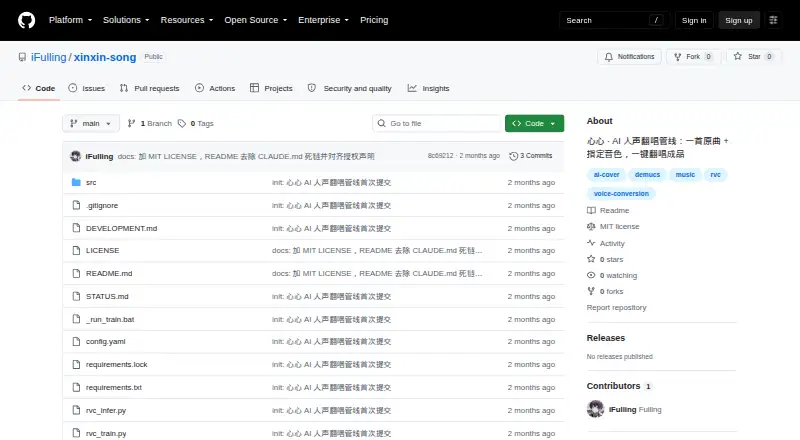
What xinxin-song is
xinxin-song is a free, open-source local pipeline for creating an AI vocal cover from an original song and a selected voice model. Its documented process separates vocals and accompaniment with Demucs, converts the vocals through RVC, and mixes the result back with the accompaniment. You can provide already separated vocals and instrumental audio to skip Demucs; UVR5 is suggested for preparing vocals externally. The V1 workflow performs inference for one song at a time and does not train voices. Voice-model training is handled separately in RVC WebUI. The Windows-oriented command line includes pitch shifting, selectable F0 methods, RVC index tuning, denoising choices, and WAV or MP3 export. FFmpeg applies loudness normalization and a limiter during mixing. Each song normally receives an output directory containing intermediate audio, the finished cover, a parameter snapshot, and a run log. Setup requires two Python environments, FFmpeg, RVC assets, and a trained model; the documented RVC setup uses Python 3.12 and CUDA 12.8, with an RTX 5070 Ti as the development target. The code is MIT licensed. The README advises authorization before public sharing and warns against impersonation.
Who it suits
It suits Windows users comfortable with Python environments, RVC assets, and command-line audio processing. Users must handle voice and copyright permissions before sharing covers.
What it does well
- Local inference pipeline
- WAV and MP3 export
- Pitch and denoising controls
- Accepts externally separated vocals
- MIT-licensed code
What to know first
- V1 processes one song at a time
- Voice training is separate
- Requires two Python environments and FFmpeg
- Documented setup targets CUDA 12.8
Verdict
xinxin-song provides a focused local workflow for turning songs into AI vocal covers with configurable inference controls. Its setup requirements and rights guidance make it better suited to technically prepared users.
Facts from xinxin-song's own pages
- Audio controls
- The CLI supports pitch shifting, selectable F0 methods, RVC index tuning, denoising options, and WAV or MP3 output. · github.com, 11 Oct 2026
- Dependencies
- The setup instructions call for Python environments for the pipeline and RVC, FFmpeg, RVC models, and a trained voice model. · github.com, 11 Oct 2026
- External audio
- Users can provide externally separated vocals and accompaniment, allowing them to skip Demucs separation. · github.com, 11 Oct 2026
- External vocals
- Users can provide externally separated vocals to skip Demucs, with UVR5 given as an example tool for manual separation. · github.com, 11 Oct 2026
- Hardware target
- The development document names an RTX 5070 Ti with CUDA 12.8 and PyTorch cu128 as its hardware target. · github.com, 11 Oct 2026
- Inference only
- The V1 pipeline handles inference for one song; voice-model training is done separately with the RVC WebUI. · github.com, 11 Oct 2026
- Integrations
- The documented pipeline uses Demucs, RVC, and ffmpeg, and accepts vocals prepared separately with UVR5. · github.com, 11 Oct 2026
- License
- The repository says its code is released under the MIT License. · github.com, 11 Oct 2026
- Mixing
- The documented mixing stage uses FFmpeg loudness normalization and a limiter to help manage loudness and clipping. · github.com, 11 Oct 2026
- Output files
- By default, each song gets its own output directory containing intermediate audio, the final cover, a parameter snapshot, and a run log. · github.com, 11 Oct 2026
- Processing
- Its pipeline separates vocals and accompaniment with Demucs, converts the vocals with RVC, then mixes the converted vocals with the accompaniment. · github.com, 11 Oct 2026
- Purpose
- xinxin-song is a local AI vocal-cover pipeline that takes an original song and a specified voice model to produce a cover. · github.com, 11 Oct 2026
- Requirements
- Setup requires two Python virtual environments, ffmpeg, RVC model assets, and a trained voice model; the documented RVC setup specifies Python 3.12 and CUDA 12.8. · github.com, 11 Oct 2026
- Rights guidance
- The README says cover distribution is subject to voice and copyright rights, advises getting authorization before public sharing, and warns against impersonation. · github.com, 11 Oct 2026
- Scope limit
- The documented V1 scope is inference for one song at a time; the development document says batch processing is not included in V1. · github.com, 11 Oct 2026
- Security and privacy
- The maker describes the pipeline as locally deployed and documents local output files and logs; the pages opened make no security certification or compliance claim. · github.com, 11 Oct 2026
- Voice training
- The project handles inference only; voice-model training is done separately using RVC’s WebUI. · github.com, 11 Oct 2026
- Windows setup
- The documented setup uses Windows commands, including `winget` for FFmpeg and Windows virtual-environment activation paths. · github.com, 11 Oct 2026
Where xinxin-song stands on Freedom251
- AI Song Cover Generators#54 of 56