Freedom251 › Error Monitoring Software
Warnly
What Warnly is
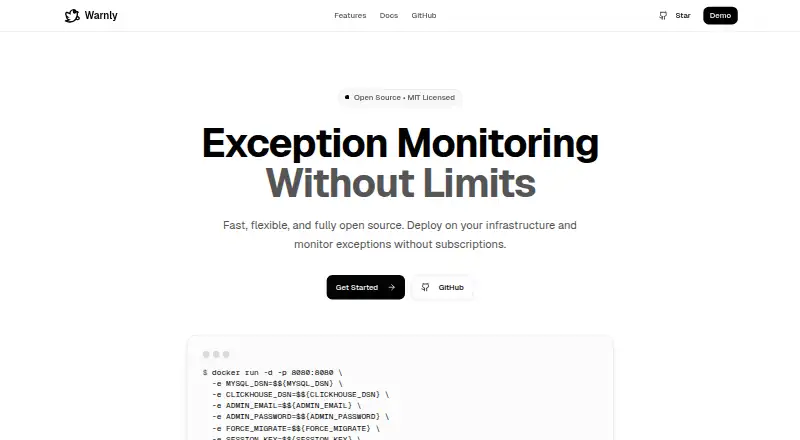
Warnly is an open-source exception monitoring platform for development teams that want to deploy on their own infrastructure. It accepts error events through an HTTP API and supports the Sentry envelope format for Sentry clients. Similar events are grouped into issues by fingerprints and comparisons of error details, stack traces, messages, and context. Events can include environment and release details, user and device context, timestamps, and unique identifiers. Projects have individual API keys, and teams or users can be assigned access to their issues. Authentication supports local accounts and external providers such as OIDC. Deployments can use Docker, Kubernetes, or bare metal; the documented setup uses MySQL and ClickHouse. Server configuration supports OpenTelemetry tracing and an optional Prometheus metrics endpoint. The free and open-source plan costs nothing, with no premium features or usage limits. Warnly supports release tracking, but frontend exception monitoring is listed as not implemented.
Who it suits
Warnly suits development teams seeking self-hosted exception monitoring and control over where error data is kept. It is also relevant to teams using Sentry clients or tracking releases.
What it does well
- Self-hosted deployment supports Docker, Kubernetes, or bare metal.
- Sentry envelope format is supported through an HTTP API.
- Groups similar events into issues.
- Project API keys and assigned access help manage issue access.
- Free plan has no premium features or usage limits.
What to know first
- Frontend exception monitoring is not implemented.
- Setup uses MySQL and ClickHouse.
- Building from source requires Go 1.25 or later.
Plans
| Plan | Billed and limits | Price |
|---|---|---|
| Free and open source | No premium features or usage limits · self-hosted | Free |
As warnly.io lists them, read 9 Oct 2026. The maker's own page has the final word.
Getting started
- Visit https://warnly.io/ and consult the online documentation for setup guidance.
- Choose Docker, Kubernetes, or bare-metal deployment on your infrastructure.
- For the recommended quickstart, prepare Docker and Docker Compose.
- Set up MySQL 8.0 or compatible and ClickHouse 24 or later.
- Configure projects and their API keys, then send error events through the HTTP API or a Sentry-compatible client.
- Set up local account or OIDC authentication for users.
Verdict
Warnly provides self-hosted exception grouping and release tracking, with integrations for Sentry clients and observability configuration. Teams needing frontend monitoring should note that it is not implemented.
Questions
How much does Warnly cost?
The Free and open source plan is free. It has no premium features or usage limits.
Where does Warnly run?
It is self-hosted and can be deployed with Docker, Kubernetes, or on bare metal.
Does Warnly work with Sentry clients?
It accepts events through an HTTP API and supports the Sentry envelope format for compatibility with Sentry clients.
Does Warnly support frontend monitoring?
No. Frontend exception monitoring is marked as not implemented.
What does the documented deployment use for storage?
It uses MySQL for primary data and ClickHouse for analytics and event storage.
How can users authenticate?
Users can authenticate with local accounts or external providers such as OIDC.
Facts from Warnly's own pages
- Authentication
- Users can authenticate with local accounts or external providers such as OIDC. · docs.warnly.io, 9 Oct 2026
- Data control
- The maker says self-hosting keeps data on your infrastructure and gives you control over sensitive error information. · warnly.io, 9 Oct 2026
- Error grouping
- Warnly groups similar error events into issues using fingerprints and similarity matching across error characteristics, stack traces, messages, and context. · docs.warnly.io, 9 Oct 2026
- Event details
- Events can include an error message and stack trace, environment and release information, user and device context, timestamps, and unique identifiers. · docs.warnly.io, 9 Oct 2026
- Integrations and infrastructure
- The documented setup uses MySQL for primary data storage and ClickHouse for analytics and event storage. · docs.warnly.io, 9 Oct 2026
- Limits and roadmap
- The repository roadmap marks mobile and frontend exception monitoring, swappable storage, and SLO and flexible alerting rules as not implemented. · github.com, 9 Oct 2026
- Observability
- The server configuration supports OpenTelemetry tracing and an optional Prometheus metrics endpoint. · docs.warnly.io, 9 Oct 2026
- Product
- Warnly is an open-source exception monitoring platform designed for development teams. · docs.warnly.io, 9 Oct 2026
- Project access
- Projects have their own API keys, and teams and users can be assigned to projects to manage access to issues. · docs.warnly.io, 9 Oct 2026
- Requirements
- The quickstart lists Docker and Docker Compose as recommended, Go 1.25 or later for building from source, MySQL 8.0 or compatible, and ClickHouse 24 or later. · docs.warnly.io, 9 Oct 2026
- Security and compliance
- The maker describes Warnly as self-hosted and says data stays on your infrastructure; the opened pages did not state a compliance certification. · warnly.io, 9 Oct 2026
- Self-hosting
- Warnly is designed to run on your infrastructure, with Docker, Kubernetes, or bare-metal deployment listed on its site. · warnly.io, 9 Oct 2026
- Sentry compatibility
- Warnly accepts error events through an HTTP API and supports the Sentry envelope format for compatibility with Sentry clients. · docs.warnly.io, 9 Oct 2026
- Support and community
- The site links to GitHub for contributions and community, and to online documentation for setup guidance. · warnly.io, 9 Oct 2026
Where Warnly stands on Freedom251
- Error Monitoring Software#19 of 30