Freedom251 › GPU Cluster Management Software
Voda Scheduler
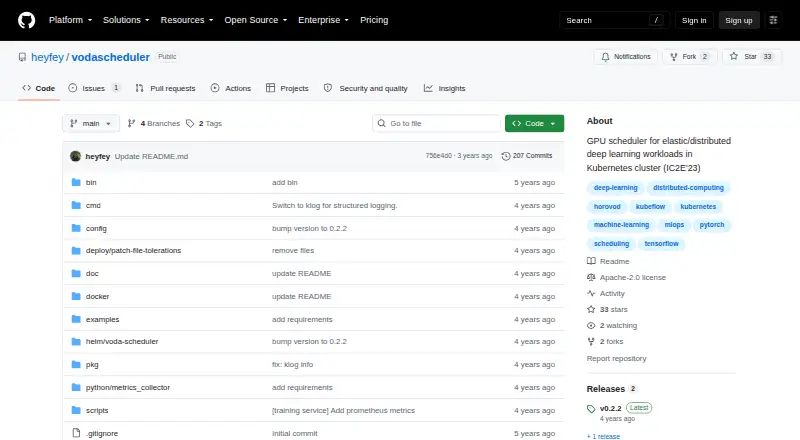
What Voda Scheduler is
Voda Scheduler is free, open-source software for scheduling GPU resources for elastic deep learning workloads in Kubernetes. Built around Kubernetes, Kubeflow Training Operator, and Horovod, it can scale distributed training jobs up or down while they run. Scheduling options include FIFO, Elastic-FIFO as the default, SRJF, Elastic-SRJF, Tiresias, Elastic-Tiresias, FfDL Optimizer, and AFS-L. Topology-aware scheduling and worker migration can consolidate resources to improve cluster throughput. The scheduler tracks node additions and removals, works with an existing autoscaler, and is designed to tolerate failing nodes and spot instances that may come and go. The project describes deployment on cloud or on-premise Kubernetes clusters able to schedule GPUs. Its documentation links to API endpoints and Prometheus metrics. The repository lists an Apache-2.0 license. The README says it was tested with Kubernetes v1.20 and warns that the project is experimental and may change significantly at any time.
Who it suits
It is intended for users running elastic or distributed deep learning workloads on GPU-capable Kubernetes clusters. It may suit teams that need runtime scaling and can work with experimental software.
What it does well
- Scales distributed training jobs while running
- Offers eight scheduling algorithms
- Tracks node additions and removals
- Works with an existing autoscaler
- Apache-2.0 license
What to know first
- Project is experimental and may change significantly
- Tested with Kubernetes v1.20
Limits
The README says the scheduler was tested with Kubernetes v1.20. The project cautions that everything is experimental and may change significantly at any time.
Getting started
- Review the project at https://github.com/heyfey/vodascheduler.
- Prepare a Kubernetes cluster able to schedule GPUs.
- Follow the project’s getting-started steps and API endpoint documentation.
- Use its Kubernetes, Kubeflow Training Operator, and Horovod components as appropriate.
- Consult the Prometheus metrics documentation for scheduler monitoring.
Verdict
Voda Scheduler targets GPU-based distributed training, with runtime scaling, topology-aware scheduling, and several algorithms. Its experimental status and stated Kubernetes v1.20 testing are important considerations for deployment.
Questions
Is Voda Scheduler free?
Yes. It is listed as free and open source under an Apache-2.0 license.
What does Voda Scheduler schedule?
It schedules GPU resources for elastic deep learning workloads in Kubernetes, including distributed training jobs that can scale at runtime.
Which Kubernetes version was tested?
The README says it was tested with Kubernetes v1.20.
Can it run on cloud and on-premise clusters?
The project describes deployment in any cloud or on-premise Kubernetes cluster that can schedule GPUs.
What scheduling algorithms does it include?
The listed options are FIFO, Elastic-FIFO, SRJF, Elastic-SRJF, Tiresias, Elastic-Tiresias, FfDL Optimizer, and AFS-L. Elastic-FIFO is the default.
Is Voda Scheduler production-stable?
The README warns that everything is experimental and may change significantly at any time.
Facts from Voda Scheduler's own pages
- API
- The project documentation links to API endpoints as part of its getting-started steps. · github.com, 8 Oct 2026
- Changing nodes
- The scheduler is aware of node additions and deletions, works with an existing autoscaler, and is designed to tolerate failing nodes and spot instances that may come and go. · github.com, 8 Oct 2026
- Compatibility
- The project says it was tested with Kubernetes v1.20. · github.com, 8 Oct 2026
- Deployment
- The project says Voda Scheduler is designed to deploy in any Kubernetes cluster, on-cloud or on-premise, that can schedule GPUs. · github.com, 8 Oct 2026
- Elastic training
- It supports dynamically scaling distributed training jobs up or down at runtime without interrupting training. · github.com, 8 Oct 2026
- Fault tolerance
- The project lists fault tolerance as a feature. · github.com, 8 Oct 2026
- Intended users
- The stated use case is elastic or distributed deep learning workloads running in a Kubernetes cluster. · github.com, 8 Oct 2026
- License
- The GitHub repository identifies an Apache-2.0 license. · github.com, 8 Oct 2026
- License and maturity
- The repository lists an Apache-2.0 license and warns that everything is experimental and may change significantly at any time. · github.com, 8 Oct 2026
- Maturity
- The README warns that everything is experimental and may change significantly at any time. · github.com, 8 Oct 2026
- Monitoring
- The README links to documentation for Prometheus metrics exposed by the scheduler. · github.com, 8 Oct 2026
- Node changes
- It is aware of node additions and deletions, works with an existing autoscaler, and tolerates failing nodes. · github.com, 8 Oct 2026
- Prerequisite
- The README says the scheduler was tested with Kubernetes v1.20. · github.com, 8 Oct 2026
- Purpose
- Voda Scheduler is a GPU scheduler for elastic deep learning workloads built on Kubernetes, Kubeflow Training Operator, and Horovod. · github.com, 8 Oct 2026
- Related tools
- The README names Kubeflow Training Operator, Kubeflow MPI Operator, Horovod, and a Prometheus NVIDIA SMI exporter among related projects. · github.com, 8 Oct 2026
- Resource allocation
- The scheduler aims to use idle resources and allocate resources efficiently when a cluster is heavily loaded. · github.com, 8 Oct 2026
- Scheduling algorithms
- The listed algorithms include FIFO, Elastic-FIFO (the default), SRJF, Elastic-SRJF, Tiresias, Elastic-Tiresias, FfDL Optimizer, and AFS-L. · github.com, 8 Oct 2026
- Topology awareness
- Topology-aware scheduling and worker migration can consolidate resources to maximize cluster throughput. · github.com, 8 Oct 2026
Where Voda Scheduler stands on Freedom251
- GPU Cluster Management Software#18 of 21