Freedom251 › Continuous Integration Software
Vela
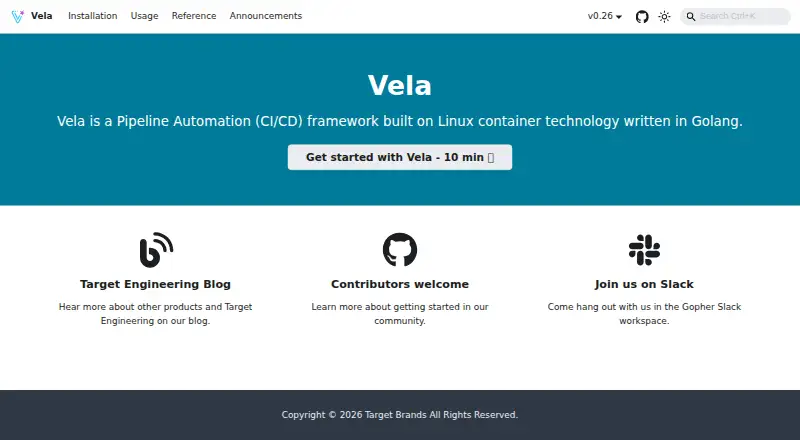
What Vela is
Vela is a free, open-source pipeline automation framework for CI/CD. Written in Go and built on Linux container technology, it runs pipeline tasks in ephemeral Docker containers. Each step is isolated, and tasks can run concurrently on one machine. Pipelines support sequential steps, parallel stages, reusable templates, and matrix-build templates. Rulesets control whether containers run according to events, branches, and other conditions. Docker-based plugins handle tasks such as deployment, artifact publishing, and notifications, while users can create plugins of their own. Repository webhooks connect source control; the documented SCM driver is GitHub, and repository activation requires administrator access to add webhooks. Base pipelines can use YAML, Go, or Starlark. Vela masks internal secrets in logs, supports short-lived OpenID Connect tokens for supported cloud services, and offers local CLI execution without access to stored secrets. It supports web, API, Linux, macOS, Windows, and self-hosted deployments.
Who it suits
Vela suits teams needing open-source CI/CD with self-hosted runners, pull request checks, YAML configuration, and artifact or dependency caching. It also fits organizations that can manage repository webhooks, Docker-based workers, and server deployment.
What it does well
- Free and open source
- Ephemeral containers isolate pipeline steps
- Sequential, parallel, and matrix workflows
- Custom Docker plugins supported
- Pull request checks and self-hosted runners
What to know first
- GitHub admin access required for repository activation
- Local CLI runs cannot access stored secrets
- Merge queues require GitHub SCM
- Kubernetes runtime lacks artifact collection
Verdict
Vela combines containerized pipeline execution, reusable workflow features, plugins, and secret controls in a self-hosted framework. Its GitHub activation requirements and deployment responsibilities matter when assessing fit.
Facts from Vela's own pages
- Artifact storage
- Artifacts require object storage, and the Kubernetes runtime does not support artifact collection. · go-vela.github.io, 11 Oct 2026
- Build formats
- Repository base pipelines can use YAML, Go, or Starlark formats. · go-vela.github.io, 11 Oct 2026
- Build workflow
- Vela’s server manages application resources, receives SCM webhooks to create builds, queues workloads, and stores build state reported by workers. · go-vela.github.io, 11 Oct 2026
- CLI platforms
- The Vela CLI installation instructions cover macOS, Linux, and Windows. · go-vela.github.io, 11 Oct 2026
- Cloud authentication
- Vela can issue short-lived ID tokens through OpenID Connect for builds to authenticate with cloud services that support and validate Vela tokens. · go-vela.github.io, 11 Oct 2026
- Deployment
- Vela documents deployment strategies for installing and running its server, including Docker. · go-vela.github.io, 11 Oct 2026
- Headquarters
- Minneapolis, Minnesota · go-vela.github.io, 28 Sept 2026
- Integrations
- Vela connects to source control through repository webhooks, and activating a repository requires SCM admin access to add those webhooks. · go-vela.github.io, 11 Oct 2026
- Local execution
- The Vela CLI can execute a pipeline locally from a terminal, but that execution does not have access to secrets stored in Vela or attached secret stores. · go-vela.github.io, 11 Oct 2026
- Maker
- GitHub identifies Vela as Target's official Pipeline Automation Framework and lists its location as Minneapolis, Minnesota. · github.com, 11 Oct 2026
- Merge queue limit
- Merge queue functionality is available only for Vela installations using GitHub as the source control management system. · go-vela.github.io, 11 Oct 2026
- Pipeline execution
- Vela runs pipeline tasks inside ephemeral Docker containers, isolating steps and allowing concurrent tasks on the same machine. · go-vela.github.io, 11 Oct 2026
- Pipelines
- A steps pipeline runs tasks sequentially, with each step executing commands in a container image. · go-vela.github.io, 11 Oct 2026
- Pipeline types
- Vela supports sequential steps, parallel stages, and reusable templates, including templates for matrix builds. · go-vela.github.io, 11 Oct 2026
- Plugins
- Vela pipelines can use Docker container plugins for predefined tasks, and anyone can create a plugin. · go-vela.github.io, 11 Oct 2026
- Product
- Vela is a pipeline automation (CI/CD) framework built on Linux container technology and written in Go. · go-vela.github.io, 11 Oct 2026
- Queue integration
- The worker queue uses Redis to manage workloads supplied by the server. · go-vela.github.io, 11 Oct 2026
- Runtime integration
- The worker runtime can use Docker to create and manage runtime resources. · go-vela.github.io, 11 Oct 2026
- SCM integration
- The documented SCM driver is GitHub, and repository activation requires admin access to configure webhooks. · go-vela.github.io, 11 Oct 2026
- Secret plugins
- Secret plugins write secret data to the Vela workspace, and administrators configure an allowlist of available secret plugin images during installation. · go-vela.github.io, 11 Oct 2026
- Secrets
- Vela supports repository, organization, and shared native secrets, with allowlists available for organization and shared secrets. · go-vela.github.io, 11 Oct 2026
- Secrets protection
- Vela masks internal secret values in step and service logs, and internal secrets are not enabled for pull request events by default. · go-vela.github.io, 11 Oct 2026
- Security configuration
- The server requires an AES key to encrypt and decrypt values stored in its database. · go-vela.github.io, 11 Oct 2026
- Support and community
- The project directs users to its community resources and invites them to join its Slack community. · go-vela.github.io, 11 Oct 2026
Where Vela stands on Freedom251
- Continuous Integration Software#57 of 58