Freedom251 › Cloud-Native Application Protection Platforms

Upwind CNAPP
What Upwind CNAPP is
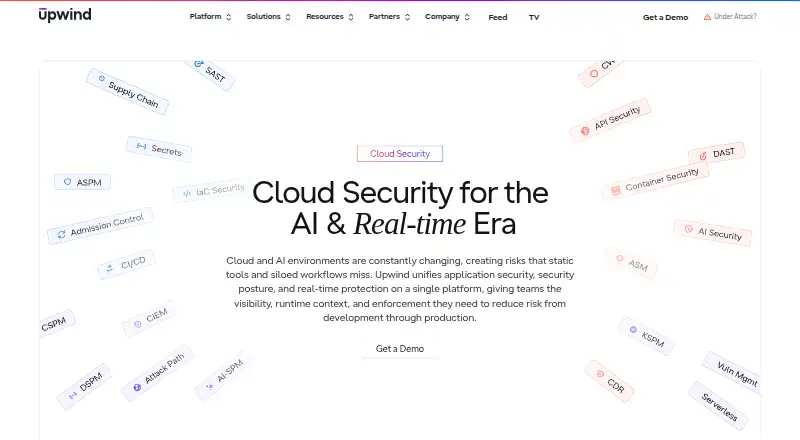
Upwind CNAPP brings application security, cloud security posture, and real-time workload protection together across development and production. Founded in 2022 and headquartered in San Francisco, Upwind combines agentless cloud scanners with runtime sensors to build live inventory, identify exposures, and protect running workloads. Its listed capabilities include CSPM, CIEM, DSPM, AI-SPM, attack path analysis, vulnerability management, Kubernetes and serverless security, API security, DAST, and cloud detection and response. The platform supports AWS, Google Cloud, Microsoft Azure, and Oracle Cloud, with web and API access. Its integrations directory includes tools such as Jira, Slack, GitHub Actions, Azure DevOps, Bitbucket, Argo CD, CircleCI, and GitLab, plus AI services including ChatGPT, xAI Grok, OpenAI Enterprise, and Anthropic Enterprise. Upwind describes high-signal exposure prioritization and live inventory as platform capabilities. The company says it was founded by the team behind Spot.io, which was acquired by NetApp. Pricing is on request, and prospective customers can request a demo.
Who it suits
Upwind describes the platform for security teams working across development, cloud, runtime, and SOC workflows. It may suit teams responsible for cloud environments on AWS, Google Cloud, Azure, or Oracle Cloud.
What it does well
- Combines agentless scanners with runtime sensors
- Covers application security, posture, and runtime protection
- Supports AWS, Google Cloud, Azure, and Oracle Cloud
- Lists integrations with development and AI tools
What to know first
- Pricing is available only on request
- Prospective customers are directed to request a demo
- Cloud security responsibilities are shared with providers
Getting started
- Visit the Upwind CNAPP website.
- Request a demo through the CNAPP page.
- Review cloud integrations for AWS, Google Cloud, Microsoft Azure, or Oracle Cloud.
- Choose a deployment approach; the Outpost model runs cloud scanners inside the customer’s AWS environment.
- Use the web or API platform and consult documentation for support.
Upwind CNAPP is a broad cloud and application security platform for teams that need posture management, code-to-cloud coverage, and runtime protection across several providers. It fits security organizations coordinating development, cloud, and SOC work; its strongest case is the combination of live runtime context and wide control coverage.
Overview
Founded in 2022 by the team behind Spot.io, Upwind brings application security, cloud security posture, and real-time workload protection into one service. Agentless cloud scanners and runtime sensors build a live inventory, surface exposures, and protect workloads as they run. That architecture is useful when configuration findings need to be connected to what is actually deployed and active.
The scope is extensive. Upwind lists CSPM, CIEM, DSPM, AI-SPM, vulnerability management, attack path analysis, Kubernetes and serverless security, API security, DAST, cloud detection and response, and managed detection and response. Such breadth can reduce the number of separate consoles a security team must coordinate, but it also means buyers should establish which modules replace existing products and which are complementary.
Key features
Posture, identity, and data
CSPM addresses cloud configuration, CIEM focuses on permissions and entitlements, and DSPM covers data-security concerns. AI-SPM extends the posture model to AI environments. Together with attack-path analysis and vulnerability management, these capabilities are aimed at prioritizing exposures by their relationship to identities, assets, and reachable paths rather than presenting an undifferentiated alert queue.
Application and workload protection
Code-to-cloud coverage includes DAST, API security, container and Kubernetes security, serverless security, and cloud detection and response. Runtime sensors add production context to the agentless scans, while real-time intelligence is intended to support immediate workload protection. This is a strong fit for teams that want development findings connected to runtime risk; organizations seeking only basic posture reporting may not need the full range.
Integrations and operations
The integrations directory includes Jira, Slack, GitHub Actions, AWS CloudTrail, Azure DevOps, Bitbucket, Argo CD, CircleCI, GitLab, and other tools. It also lists ChatGPT, xAI Grok, OpenAI Enterprise, Anthropic Enterprise, and Claude integrations. These connections can place findings in engineering and collaboration workflows, though the practical value depends on the depth of each integration in your environment.
Upwind documents 24/7 support through live chat in the management console, email, or a shared Slack channel. Its Outpost deployment runs cloud scanners inside the customer’s AWS environment, an option for teams that want scanning to remain within that cloud boundary.
Pricing
Upwind uses paid, custom pricing, with prospective customers directed to request a demo. There is no published free plan, trial term, seat allowance, or quota. That sales-led model is reasonable for a multi-cloud platform with optional deployment and broad modules, but it prevents a low-risk self-service evaluation and makes a detailed scoping conversation essential. Ask for the commercial basis of each capability, expected usage assumptions, renewal terms, and any limits before signing.
Platforms
The service is delivered through web and API access. It supports AWS, Google Cloud, Microsoft Azure, and Oracle Cloud, giving multi-cloud teams a single coverage target. Runtime protection, code-to-cloud security, identity security, and Kubernetes security are all part of its stated scope. Upwind describes a shared-responsibility model covering controls inherited from cloud providers and customer security duties, so ownership boundaries should be reviewed during procurement.
Data in transit is protected with TLS and HSTS; stored data uses encryption, access controls, and authentication. The Trust Center lists SOC 2 Type 2, ISO/IEC 27001:2022, and GDPR among its compliance items.
Who it's for
Upwind is aimed at security teams spanning development, cloud engineering, runtime operations, and SOC workflows. It is particularly suitable for organizations running workloads across multiple clouds or needing one exposure view that follows assets from build to production. Smaller teams with a narrow, single-cloud requirement may find the platform’s breadth and custom-sales process disproportionate.
Pros and cons
- Pro: Agentless scanners plus runtime sensors connect inventory, exposure, and live workload context.
- Pro: Coverage includes posture, identity, data, application, Kubernetes, API, and detection capabilities across four major cloud providers.
- Pro: Broad engineering and AI-tool integrations can link security work to existing delivery and collaboration systems.
- Con: Custom pricing and a demo-first buying path make cost and capacity planning difficult without a sales engagement.
- Con: The shared-responsibility model requires customers to clarify which controls remain theirs.
Alternatives
Qualys TotalCloud is a better starting point when a free evaluation matters: its TotalCloud Free license costs nothing with limited API calls, and a free trial is offered. Choose Sysdig Secure when host-based licensing and Linux, macOS, Windows, self-hosted, API, and web coverage match your estate; licensing is based on hosts. FortiCNAPP suits buyers who prefer Standard entitlements per vCPU on one- or three-year terms. Pick AccuKnox for freemium, pay-as-you-go purchasing and modular or bundled CNAPP coverage. Wiz Defend offers modular, quote-based licensing without a free plan. Palo Alto Networks Cortex Cloud API Security is an alternative for API-focused deployments. Cortex Cloud provides a web-based alternative with listed XSOAR editions. OpenCNAPP is a free, self-hosted option.
Verdict
Choose Upwind CNAPP if your security program needs one multi-cloud view spanning application risk, posture, identity, and runtime protection, especially where live context can improve prioritization. Look elsewhere if you require transparent pricing, a self-service free tier, or a narrowly focused control set without a sales-led evaluation.
Verdict
Upwind CNAPP spans cloud posture, application security, and runtime protection, with capabilities across the listed cloud providers. Teams should review its shared-responsibility model and request a demo and pricing details.
Questions
How is Upwind CNAPP priced?
Pricing is available on request. The CNAPP page directs prospective customers to request a demo.
Which cloud providers does it support?
Upwind lists AWS, Google Cloud, Microsoft Azure, and Oracle Cloud.
What security capabilities are included?
Listed capabilities include CSPM, CIEM, DSPM, AI-SPM, vulnerability management, attack path analysis, Kubernetes and serverless security, CDR, API security, DAST, and MDR.
What integrations are listed?
The directory includes Jira, Slack, GitHub Actions, Azure DevOps, Bitbucket, Argo CD, CircleCI, GitLab, ChatGPT, xAI Grok, OpenAI Enterprise, Anthropic Enterprise, and Claude.
What compliance items does Upwind list?
Its Trust Center lists SOC 2 Type 2, ISO/IEC 27001:2022, and GDPR among its compliance items.
How can customers contact support?
Documentation describes 24/7 support through live chat in the management console, email, or a shared Slack channel.
Facts from Upwind CNAPP's own pages
- AI integrations
- The integrations directory lists ChatGPT, xAI Grok, OpenAI Enterprise, Anthropic Enterprise, and Claude integrations. · upwind.io, 2 Oct 2026
- Cloud platforms
- The site links to AWS, Google Cloud, Microsoft Azure, and Oracle Cloud partner pages. · upwind.io, 2 Oct 2026
- Cloud support
- Its documentation describes cloud integrations for AWS, Microsoft Azure, Google Cloud, and Oracle Cloud. · docs.upwind.io, 3 Oct 2026
- CNAPP
- Upwind unifies application security, security posture, and real-time protection on one platform to reduce risk from development through production. · upwind.io, 2 Oct 2026
- Company
- Upwind says it was founded by the team behind Spot.io, which was acquired by NetApp. · upwind.io, 2 Oct 2026
- Compliance
- Upwind’s Trust Center lists SOC 2 Type 2, ISO/IEC 27001:2022, and GDPR among its compliance items. · trust.upwind.io, 3 Oct 2026
- Coverage
- Its listed capabilities include CSPM, CIEM, DSPM, vulnerability management, attack path analysis, container and Kubernetes security, API security, and cloud detection and response. · upwind.io, 3 Oct 2026
- Data protection
- Upwind says data in transit is protected with TLS and HSTS, while stored data is protected with encryption, access controls, and authentication. · docs.upwind.io, 3 Oct 2026
- Deployment
- The Outpost deployment model runs cloud scanners inside the customer’s AWS environment. · docs.upwind.io, 3 Oct 2026
- Detection
- The platform combines agentless cloud scanners with runtime sensors and real-time intelligence. · upwind.io, 3 Oct 2026
- Founded
- 2022 · upwind.io, 28 Sept 2026
- Headquarters
- San Francisco, California, United States · upwind.io, 28 Sept 2026
- Integrations
- The integrations page lists Jira, Slack, GitHub Actions, and AWS CloudTrail among its popular integrations. · upwind.io, 3 Oct 2026
- Intended users
- Upwind describes the platform as serving security teams across development, cloud, runtime, and SOC workflows. · upwind.io, 3 Oct 2026
- Lifecycle coverage
- The platform covers application security, cloud security posture, and real-time protection across the cloud lifecycle. · upwind.io, 2 Oct 2026
- Pricing model
- Upwind says its full CNAPP is included in one price, with CSPM, runtime sensor, code scanning, and data security included. · upwind.io, 2 Oct 2026
- Prioritization
- Upwind describes live inventory and high-signal exposure prioritization as platform capabilities. · upwind.io, 3 Oct 2026
- Product
- Upwind unifies application security, security posture, and real-time protection on one platform for cloud and AI environments. · upwind.io, 3 Oct 2026
- Runtime context
- Upwind combines agentless cloud scanners and runtime sensors to provide live inventory, identify exposures, and protect workloads in real time. · upwind.io, 2 Oct 2026
- Sales path
- The CNAPP page directs prospective customers to request a demo. · upwind.io, 2 Oct 2026
- Security capabilities
- Listed capabilities include CSPM, CIEM, DSPM, AI-SPM, attack path analysis, vulnerability management, Kubernetes and serverless security, CDR, API security, DAST, and MDR. · upwind.io, 2 Oct 2026
- Security responsibility
- Upwind describes a shared responsibility model for controls inherited from its cloud service providers and security responsibilities to customers. · upwind.io, 2 Oct 2026
- SOC 2
- Upwind's security trust center displays a SOC 2 image under its security commitment section. · upwind.io, 2 Oct 2026
- Support
- The documentation offers 24/7 support through live chat in the management console, email, or a shared Slack channel. · docs.upwind.io, 3 Oct 2026