Freedom251 › Status page services
UptimeSignal
What UptimeSignal is
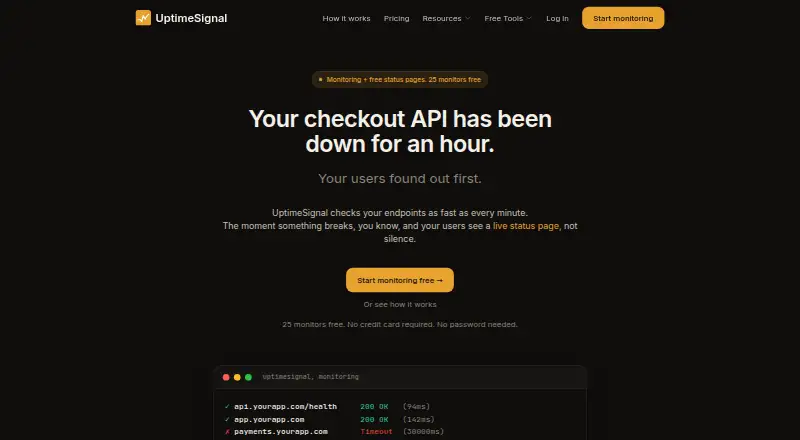
UptimeSignal is a synthetic monitoring service for developers who need to check websites, APIs, webhooks, and other HTTP endpoints from outside their own infrastructure. Its checks measure response time and inspect HTTP status and response body, along with SSL certificates, DNS resolution, and TLS handshakes. Email, Slack, Discord, Telegram, and webhook alerts are available on every plan, including notifications when a service recovers. To reduce false alarms, UptimeSignal waits for two consecutive failures before alerting.
Each plan includes unlimited public status pages with incident timelines, component groups, and uptime history bars. Webhooks can update component status, open incidents, and resolve issues; named integrations include GitHub Actions, GitLab CI, Jenkins, and PagerDuty. A REST API and MCP server let compatible AI agents create monitors, check uptime, and manage alerts and status pages. The free plan allows commercial use and has no credit card requirement. Pro adds faster checks, 90-day uptime history, priority support, custom domains, and the option to remove UptimeSignal branding. It also includes lightweight error and event tracking sent by JSON HTTP request; the maker describes this as distinct from a full APM or tracing suite.
Who it suits
UptimeSignal suits developers who want external checks for websites, APIs, webhooks, or other HTTP endpoints, alongside public status pages and multi-channel alerts. Its free commercial plan can fit smaller monitoring needs, while Pro is for users who need more monitors, faster intervals, custom domains, or event tracking.
What it does well
- Checks response time, HTTP content, SSL, DNS, and TLS.
- Alerts include email, Slack, Discord, Telegram, and webhooks.
- Two consecutive failures are required before an alert.
- Unlimited public status pages are included on every plan.
- Compatible AI agents can use its REST API and MCP server.
What to know first
- Free is limited to 25 monitors and five-minute intervals.
- Free status pages use a UptimeSignal subdomain and retain its branding.
- Pro costs $10 a month, billed annually at $120/year.
Limits
Free includes 25 monitors with five-minute check intervals, and its status pages use a UptimeSignal subdomain with UptimeSignal branding. Pro is billed annually at $120/year and includes unlimited monitors, one-minute intervals, and 90-day uptime history.
Plans
| Plan | Billed and limits | Price |
|---|---|---|
| Free | 25 monitors · 5-minute checks · 7-day history · unlimited status pages · email, Slack, Discord, Telegram, and webhook alerts · commercial use allowed | Free |
| Pro | Billed annually at $120/year · Unlimited monitors · 1-minute checks · 90-day history · unlimited status pages · events and issue tracking · priority support | $10 a month |
As uptimesignal.io lists them, read 7 Oct 2026. The maker's own page has the final word.
Getting started
- Open https://uptimesignal.io/.
- Choose the Free plan or Pro plan.
- Use the web service or API to create monitors for endpoints.
- Set up email, Slack, Discord, Telegram, or webhook alerts.
- Create a public status page; choose Pro for a custom domain or removal of UptimeSignal branding.
Verdict
Choose UptimeSignal if you want endpoint monitoring and unlimited public status pages, with alert channels included even on the free plan. Pro is the route to unlimited monitors, one-minute checks, custom domains, and lightweight event tracking. The free plan has 25 monitors and five-minute intervals, and its status pages use a UptimeSignal subdomain with branding.
Questions
Is UptimeSignal free?
Yes. The Free plan costs nothing, billed free forever, and requires no credit card. It includes 25 monitors, five-minute check intervals, and unlimited status pages.
How much does Pro cost?
Pro is $10 a month, billed annually at $120/year. It includes unlimited monitors and status pages, one-minute check intervals, and 90-day uptime history.
Which platforms does UptimeSignal support?
The listed platforms are web and API.
Can I use a custom domain for a status page?
Custom domains and removal of UptimeSignal branding are Pro features. Free status pages use a UptimeSignal subdomain.
What alerts and integrations are available?
Email, Slack, Discord, Telegram, and webhook alerts are available on every plan. Status page webhooks can update component status, create incidents, and resolve issues; examples include GitHub Actions, GitLab CI, Jenkins, and PagerDuty.
Facts from UptimeSignal's own pages
- AI agent support
- Its REST API and MCP server let compatible AI agents create monitors, check uptime, and manage alerts and status pages. · uptimesignal.io, 7 Oct 2026
- Alerts
- Email, Slack, Discord, Telegram, and webhook alerts are available on every plan, with recovery notifications. · uptimesignal.io, 7 Oct 2026
- Checks
- Its checks measure response time and validate HTTP status, response body, SSL certificates, DNS resolution, and TLS handshakes. · uptimesignal.io, 7 Oct 2026
- Custom domain
- Yes · uptimesignal.io, 21 Sept 2026
- Data handling
- The privacy policy says UptimeSignal does not sell user data and that Stripe processes Pro payments without UptimeSignal storing card details. · uptimesignal.io, 7 Oct 2026
- Data security
- The privacy policy says data is encrypted in transit and at rest and account authentication uses time-limited magic links. · uptimesignal.io, 7 Oct 2026
- Event key security
- Event ingest keys are write-only and scoped to event submission, with per-account rate limits and payload caps. · uptimesignal.io, 7 Oct 2026
- Event tracking
- Pro includes lightweight error and event tracking via a JSON HTTP request, without an SDK; the maker says it is not a full APM or tracing suite. · uptimesignal.io, 7 Oct 2026
- Failure verification
- UptimeSignal verifies an issue with two consecutive failures before alerting to reduce false positives. · uptimesignal.io, 7 Oct 2026
- Free plan
- Yes · uptimesignal.io, 21 Sept 2026
- Incident updates
- Yes · uptimesignal.io, 21 Sept 2026
- Integrations
- Status page webhooks can update component status, create incidents, and resolve issues, and the page names GitHub Actions, GitLab CI, Jenkins, and PagerDuty as examples. · uptimesignal.io, 7 Oct 2026
- Intended users
- The maker describes the service as built for developers and says its free plan allows commercial use. · uptimesignal.io, 7 Oct 2026
- Maintenance scheduling
- Yes · uptimesignal.io, 21 Sept 2026
- Purpose
- UptimeSignal provides synthetic monitoring that checks websites, APIs, webhooks, and other HTTP endpoints from outside a user's infrastructure. · uptimesignal.io, 7 Oct 2026
- Paid from
- 10 · uptimesignal.io, 21 Sept 2026
- Status page limits
- The free plan hosts status pages on a UptimeSignal subdomain; custom domains and removal of UptimeSignal branding are Pro features. · uptimesignal.io, 7 Oct 2026
- Status pages
- Every plan includes unlimited public status pages with incident timelines, component groups, and uptime history bars. · uptimesignal.io, 7 Oct 2026
- Subscriber channels
- multi-channel · uptimesignal.io, 21 Sept 2026
- Support
- The Pro plan includes priority support. · uptimesignal.io, 7 Oct 2026
Where UptimeSignal stands on Freedom251
- Status page services#20 of 31
- Status Page Software#22 of 31