Freedom251 › Online Voting Software
TrueVote
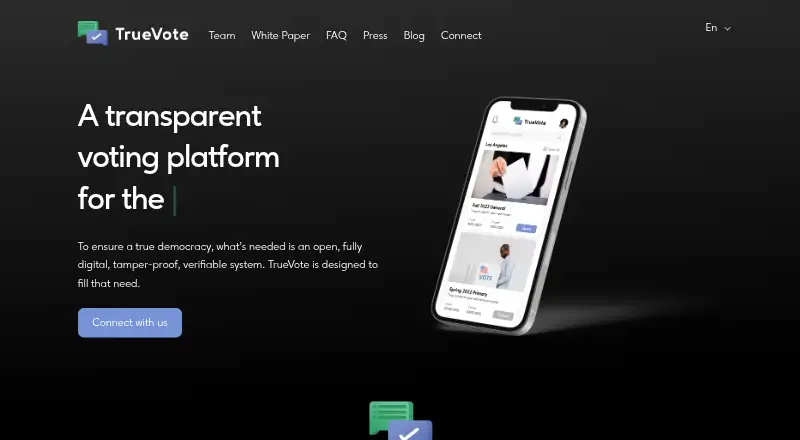
What TrueVote is
TrueVote is a digital voting platform for casting ballots and checking their inclusion in an election’s aggregate count. Its public Ballot Explorer lets voters verify their ballot, while the Election Administration Portal is designed for election commissioners to create and maintain elections and ballots. The service says voting data is anonymized and unlinked, with a voter’s name association visible only to that voter. Non-identifiable data can be downloaded for reporting, audits, and analysis.
TrueVote’s design encrypts ballot data at rest and requires multi-factor authentication at registration; the private key needed to access elections stays on the voter’s device. The white paper describes periodic recording of election-data Merkle roots on Bitcoin, and the site says voting data is hashed onto the blockchain to make votes immutable. Every voter has an account, and eligibility is based on jurisdiction and registration status. The core code is open source under the MIT license, and the product supports many languages. Its stated initial rollout targets private elections, with beta testing for selected public elections. The platform is free and lists Android, iOS, web, and API availability.
Who it suits
TrueVote may suit organizations seeking a free, open-source platform for administering elections and giving voters a way to verify ballot inclusion. Its described rollout is aimed first at private elections, with selected public-election beta testing; voters without smartphones can use existing analog methods.
What it does well
- Free platform with core code under the MIT license.
- Voters can check ballot inclusion in a public explorer.
- Anonymized, unlinked voting data; voters alone see their name association.
- Encrypted ballot data at rest and multi-factor registration authentication.
- Non-identifiable data can be downloaded for reporting and auditing.
What to know first
- Voters need an account, with eligibility tied to jurisdiction and registration status.
- Voters without smartphones must use existing analog voting methods.
- Public APIs and registration-database integrations are described as future plans.
Limits
Voters without smartphones participate through existing analog methods, whose totals authorities add to election counts. The initial rollout is for private elections, with beta testing for selected public elections; public APIs and registration-database integrations are later plans.
Getting started
- Visit https://truevote.org/.
- Choose a listed Android, iOS, or web platform.
- Create a voter account and complete multi-factor authentication at registration.
- Use the election access key kept on your device to access eligible elections.
Verdict
Consider TrueVote if you need a free voting platform with ballot verification, election administration tools, and open-source code. Its described initial rollout focuses on private elections, while public-election testing is limited to selected beta settings; smartphone-free participation relies on existing analog voting.
Questions
Is TrueVote free?
Yes. The listed pricing model is free, and the core code is open source under the MIT license.
Which platforms are listed?
Android, iOS, web, and API are listed.
Can voters verify their ballots?
Yes. The public Ballot Explorer lets voters check whether their ballot was included in the aggregate count.
How is ballot privacy described?
Voting data is described as anonymized and unlinked. Only voters can see their name associated with a ballot.
How are voters authenticated and deemed eligible?
The design requires multi-factor authentication at registration. Eligibility is determined by jurisdiction and registration status.
Can someone vote without a smartphone?
Yes. They can use existing analog voting methods, with authorities adding those totals to the election count.
Facts from TrueVote's own pages
- Authentication
- The white paper says the design requires multi-factor authentication at registration and keeps the private key needed to access elections on the voter's device. · truevote.org, 11 Oct 2026
- Ballot verification
- Its white paper says voters can check whether their ballot was included in the aggregate count using a public Ballot Explorer. · truevote.org, 11 Oct 2026
- Bitcoin anchoring
- The white paper says TrueVote periodically stamps Merkle roots of election data onto the Bitcoin blockchain. · truevote.org, 11 Oct 2026
- Bitcoin verification
- The site says voting data is hashed into the Bitcoin blockchain to make votes immutable. · truevote.org, 11 Oct 2026
- Commercial services
- The FAQ says custom election services, including voter-roll data migrations and integrations, may be commercialized in the future. · truevote.org, 11 Oct 2026
- Election administration
- The Election Administration Portal is described as a configurable portal for creating and maintaining elections and ballots. · truevote.org, 11 Oct 2026
- Founded
- 2021 · truevote.org, 28 Sept 2026
- Headquarters
- Los Angeles, California, United States · truevote.org, 28 Sept 2026
- Integration plans
- The site lists integration with local, city, county, and state registration databases as a later milestone. · truevote.org, 11 Oct 2026
- Intended rollout
- The site says the initial mobile app and administration portal rollout is for private elections and beta testing for select public elections. · truevote.org, 11 Oct 2026
- Languages
- The site says support for many languages is part of the product. · truevote.org, 11 Oct 2026
- Limit
- The FAQ says voters without smartphones can still participate through existing methods, with analog totals added to election counts by the authorities. · truevote.org, 11 Oct 2026
- Offline voting
- The FAQ says voters without smartphones can participate through existing analog voting, with authorities adding those totals to election counts. · truevote.org, 11 Oct 2026
- Open source
- The site says its core code is open source on GitHub under the MIT license. · truevote.org, 11 Oct 2026
- Planned API
- The white paper says TrueVote will have public REST and GraphQL APIs for the Ballot Explorer. · truevote.org, 11 Oct 2026
- Planned integrations
- The timeline lists integration with local, city, county, and state registration databases as a later milestone. · truevote.org, 11 Oct 2026
- Privacy
- The site says voting data is anonymized and unlinked, and only voters can see their name associated with a ballot. · truevote.org, 11 Oct 2026
- Product stage
- The site timeline describes the current phase as company launch and white paper release, with mobile app and administration portal versions listed as later milestones. · truevote.org, 11 Oct 2026
- Public data
- The site says non-user-identifiable data can be downloaded for reporting, auditing, and analysis. · truevote.org, 11 Oct 2026
- Purpose
- TrueVote describes itself as a digital voting platform for casting and verifying ballots. · truevote.org, 11 Oct 2026
- Security design
- The white paper describes encrypted ballot data at rest and multi-factor authentication upon registration. · truevote.org, 11 Oct 2026
- Support
- The white paper says Designated Election Commissioners are publicly identified and provide an accountable human for election support issues. · truevote.org, 11 Oct 2026
- Voter accounts
- Each voter has a TrueVote account, and eligibility for each election is determined by jurisdiction and registration status. · truevote.org, 11 Oct 2026
Where TrueVote stands on Freedom251
- Online Voting Software#27 of 31