Freedom251 › Reverse Engineering Tools
Triton
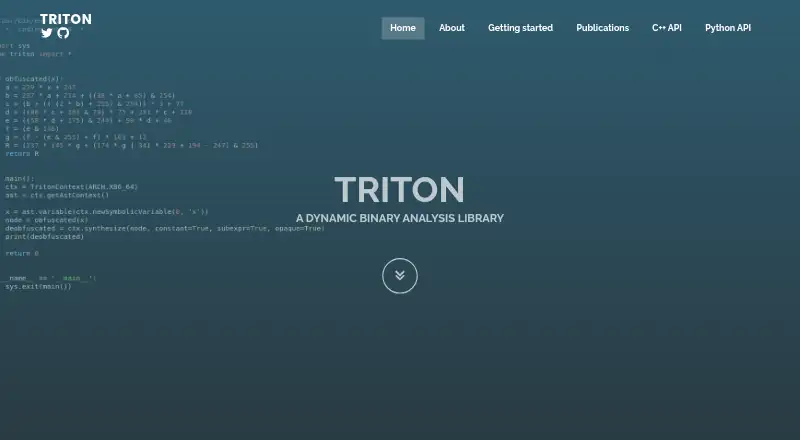
What Triton is
Triton is a free, open-source dynamic binary analysis library for building program-analysis tools, reverse-engineering workflows, software verification, and code emulation. It provides dynamic symbolic execution and dynamic taint analysis. Its abstract syntax tree represents instruction semantics for x86, x86-64, ARM32, AArch64, and RISC-V 32/64. Triton includes interfaces to the Z3 and Bitwuzla SMT solvers, expression synthesis, SMT simplification passes, and lifting between LLVM and Z3. Written in C++, it offers C++ and Python APIs with Python bindings. The library runs on Linux, Windows, and OS X under the Apache-2.0 license. Installation is documented through the triton-library pip package, source compilation, or vcpkg. Capstone is required for source builds; Boost, Python, Z3, Bitwuzla, and LLVM are optional. Python examples are provided, and related tools include Ponce, QSynthesis, Pimp, Exrop, TritonDSE, and Titan.
Who it suits
Triton suits developers and researchers building binary-analysis, reverse-engineering, verification, or emulation tools. Its C++ and Python interfaces support projects targeting the listed processor architectures.
What it does well
- Free and open source
- Dynamic symbolic execution and taint analysis
- Supports multiple processor architectures
- C++ and Python APIs
- Z3 and Bitwuzla solver interfaces
What to know first
- LLVM and Bitwuzla interfaces need CMake options
- Source builds require Capstone
- Project is described as part-time
Verdict
Triton provides a broad set of dynamic binary-analysis capabilities across major architectures. Its free license, language APIs, solver connections, and documented installation paths make it suitable for building specialized analysis tools.
Facts from Triton's own pages
- APIs
- The library is developed in C++ and provides C++ and Python APIs, including Python bindings. · triton-library.github.io, 8 Oct 2026
- Availability
- Triton is open source, and its source code can be compiled from the GitHub repository. · triton-library.github.io, 8 Oct 2026
- Examples
- The project links to bootstrapped Python examples for getting started. · triton-library.github.io, 8 Oct 2026
- Expression and solver features
- The listed capabilities include expression synthesis, SMT simplification, lifting to LLVM and Z3, and solver interfaces for Z3 and Bitwuzla. · triton-library.github.io, 9 Oct 2026
- Installation
- The repository documents installation with pip using the package name triton-library, from source, and through vcpkg. · github.com, 9 Oct 2026
- Instruction sets
- Its AST represents instruction semantics for x86, x86-64, ARM32, AArch64, and RISC-V 32/64. · triton-library.github.io, 8 Oct 2026
- Integrations and examples
- The site lists tools using Triton including Ponce, QSynthesis, Pimp, Exrop, TritonDSE, and Titan. · triton-library.github.io, 9 Oct 2026
- Intended use
- The site presents Triton for program analysis, reverse engineering, software verification, and emulation; listed projects include tools for deobfuscation and ROP chain generation. · triton-library.github.io, 9 Oct 2026
- License
- The project’s GitHub repository identifies its license as Apache-2.0. · github.com, 9 Oct 2026
- Optional dependencies
- The source build lists Boost, Python, Z3, Bitwuzla, and LLVM as optional dependencies, and Capstone as a dependency. · github.com, 9 Oct 2026
- Other analysis features
- Features include expression synthesis, SMT simplification passes, and lifting to LLVM and Z3 and back. · triton-library.github.io, 8 Oct 2026
- Platform support
- The official site describes Triton as compatible with Linux, Windows, and OS X. · triton-library.github.io, 9 Oct 2026
- Programming interfaces
- Triton is developed in C++ and provides both C++ and Python APIs, including Python bindings. · triton-library.github.io, 9 Oct 2026
- Project caveat
- The repository describes Triton as a part-time project and asks users to report issues or contribute pull requests if it is not fully reliable. · github.com, 9 Oct 2026
- Purpose
- Triton is a dynamic binary analysis library for building program analysis tools, automating reverse engineering, software verification, and code emulation. · triton-library.github.io, 9 Oct 2026
- Related tools
- The site lists Ponce, QSynthesis, Pimp, Exrop, TritonDSE, and Titan as tools and libraries that use Triton. · triton-library.github.io, 8 Oct 2026
- Solver configuration
- The installation documentation says LLVM and Bitwuzla are not compiled by default and provides CMake options to enable their interfaces. · github.com, 9 Oct 2026
- Solver support
- Triton provides an SMT solver interface to Z3 and Bitwuzla. · triton-library.github.io, 8 Oct 2026
- Supported instruction architectures
- Its AST represents instruction semantics for x86, x86-64, ARM32, AArch64, and RISC-V 32/64. · triton-library.github.io, 9 Oct 2026
- Supported operating systems
- The library is compatible with Linux, Windows, and OS X. · triton-library.github.io, 8 Oct 2026
- Symbolic execution
- Triton provides dynamic symbolic execution and dynamic taint analysis. · triton-library.github.io, 9 Oct 2026
- Taint analysis
- The library provides dynamic taint analysis. · triton-library.github.io, 8 Oct 2026
- Windows installation note
- The repository says precompiled Windows artifacts are available through AppVeyor and may require Visual C++ Redistributable packages for Visual Studio 2012. · github.com, 9 Oct 2026
Where Triton stands on Freedom251
- Reverse Engineering Tools#43 of 73