Freedom251 › Physics Simulation Software
TransiFlow
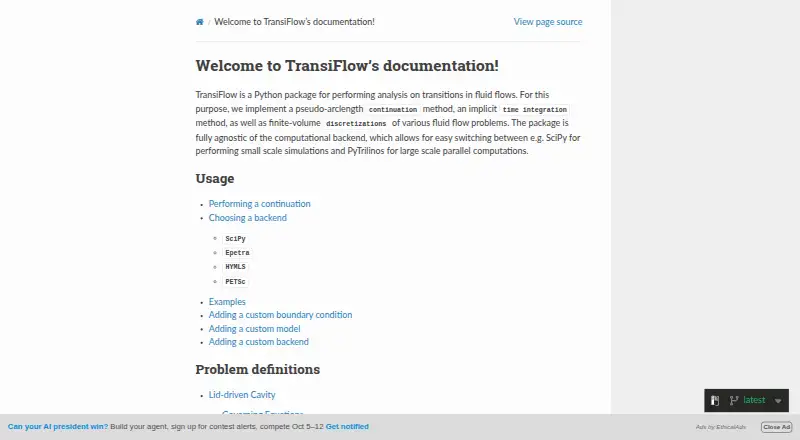
What TransiFlow is
TransiFlow is a free Python package for analyzing transitions in fluid flows, aimed at developers and science or research users. It combines finite-volume discretizations, implicit time integration and pseudo-arclength continuation with adaptive step sizing for bifurcation diagrams. Computational backends include SciPy, Epetra, HYMLS and PETSc, and users can define custom boundary conditions and models. SciPy is feature complete for model development and problems below 1 million unknowns. HYMLS targets large parallel calculations; its documented preconditioner scales to 4096 cores and more than 500 million unknowns. Epetra and PETSc lack a parallel preconditioner and eigenvalue solver and are described as unsuitable for large problems. An interface to JaDaPy computes eigenvalues that can help identify bifurcation points, but JaDaPy must be installed separately or placed on PYTHONPATH. Examples cover cavity flows, Rayleigh-Bénard and Taylor-Couette convection, double-gyre circulation and Atlantic Meridional Ocean Circulation. Installation is available through PyPI or an editable source checkout, and PyPI lists Apache License 2.0.
Who it suits
TransiFlow suits developers and scientific or engineering researchers modeling fluid-flow transitions. It supports both small model-development problems and documented large parallel computations.
What it does well
- Adaptive continuation for bifurcation diagrams
- Supports four computational backends
- Custom boundary conditions and models
- Examples span multiple fluid-flow problems
- Available through PyPI
What to know first
- SciPy is suited below 1 million unknowns
- Epetra and PETSc unsuitable for large problems
- JaDaPy installation is separate
- Large parallel work requires HYMLS
Verdict
TransiFlow offers continuation, time integration and multiple solver backends for fluid-flow research. Backend capabilities differ substantially, and eigenvalue workflows require the separate JaDaPy dependency.
Facts from TransiFlow's own pages
- Authoring tools
- Yes · transiflow.readthedocs.io, 24 Sept 2026
- Backend choice
- The package supports SciPy, Epetra, HYMLS, and PETSc computational backends. · transiflow.readthedocs.io, 11 Oct 2026
- Backend limits
- The Epetra and PETSc backends lack a parallel preconditioner and eigenvalue solver, so the documentation says they cannot solve large problems. · transiflow.readthedocs.io, 11 Oct 2026
- Backends
- The default SciPy backend is feature complete and suited to model development and problems with fewer than 1 million unknowns. · transiflow.readthedocs.io, 11 Oct 2026
- Continuation
- It implements pseudo-arclength continuation with adaptive arclength step size for computing bifurcation diagrams. · github.com, 11 Oct 2026
- Custom models
- Users can add custom boundary conditions and custom models. · transiflow.readthedocs.io, 11 Oct 2026
- Delivery mode
- desktop · transiflow.readthedocs.io, 24 Sept 2026
- Distribution
- The package is installable from PyPI with pip and is also available from its source repository for editable installation. · pypi.org, 11 Oct 2026
- Eigenvalue dependency
- The PyPI project page says JaDaPy must be installed or included in PYTHONPATH to compute eigenvalues. · pypi.org, 11 Oct 2026
- Eigenvalues
- It provides an interface to JaDaPy for computing eigenvalues that can help detect bifurcation points; JaDaPy must be installed separately or included in PYTHONPATH. · github.com, 11 Oct 2026
- Example problems
- Documented problem examples include lid-driven cavity, Rayleigh-Bénard convection, Taylor-Couette flow, and Atlantic Meridional Ocean Circulation. · transiflow.readthedocs.io, 11 Oct 2026
- Free plan
- Yes · transiflow.readthedocs.io, 24 Sept 2026
- Installation
- The project README describes installing TransiFlow in a Python virtual environment and running its examples from the source directory. · github.com, 11 Oct 2026
- Intended users
- PyPI classifies the package for developers and science or research, and describes its topic as scientific and engineering software. · pypi.org, 11 Oct 2026
- Lesson library
- No · transiflow.readthedocs.io, 24 Sept 2026
- License
- PyPI lists the package under Apache License 2.0. · pypi.org, 11 Oct 2026
- Numerical methods
- It implements pseudo-arclength continuation, implicit time integration, and finite-volume discretizations. · transiflow.readthedocs.io, 11 Oct 2026
- Other backend limits
- The Epetra and PETSc backends lack a parallel preconditioner or eigenvalue solver and are stated as unsuitable for solving large problems. · transiflow.readthedocs.io, 11 Oct 2026
- Parallel backend
- The HYMLS backend is intended for large-scale parallel computations and is reported to have scaled to 4096 cores and over 500 million unknowns. · transiflow.readthedocs.io, 11 Oct 2026
- Parallel computing
- The HYMLS backend is intended for large parallel computations and its preconditioner is documented as scaling to 4096 cores and over 500 million unknowns. · transiflow.readthedocs.io, 11 Oct 2026
- Problem examples
- Documented examples cover lid-driven and differentially heated cavities, Rayleigh-Bénard convection, Taylor-Couette flow, double-gyre circulation, and Atlantic Meridional Ocean Circulation. · transiflow.readthedocs.io, 11 Oct 2026
- Purpose
- TransiFlow is a Python package for analyzing transitions in fluid flows. · transiflow.readthedocs.io, 11 Oct 2026
- Release publishing
- PyPI reports that the 1.0.1 release was published through GitHub Actions with a verified publish attestation. · pypi.org, 11 Oct 2026
- SciPy limit
- The default SciPy backend is described as suitable for small problems with fewer than 1 million unknowns. · transiflow.readthedocs.io, 11 Oct 2026
Where TransiFlow stands on Freedom251
- Physics Simulation Software#38 of 89