Freedom251 › Email Design Software
Templatical
What Templatical is
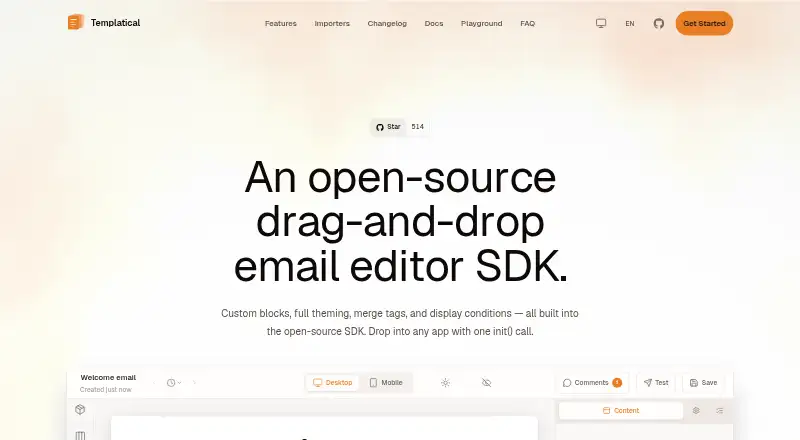
Templatical is an embeddable drag-and-drop email editor SDK for adding editing capabilities to an app. It works with React, Svelte, Angular, Vue, and vanilla JavaScript, and provides custom blocks, merge tags, display conditions, theming, and MJML output. Templates are stored as portable JSON, while generated MJML can be rendered elsewhere. Saving, loading, version history, comments, test sends, and rendering connect to the customer's own backend or infrastructure. Listed import converters cover Unlayer, BeeFree, Stripo, Topol, Chamaileon, Easy Email Pro, MJML, and HTML. The editor can use a media browser supplied by the customer, including one backed by S3, Cloudinary, or a CMS. It runs in the browser without telemetry, remote calls, or analytics, and templates stay in the app unless saved to the customer's backend. The free SDK has no usage caps or per-seat fees. Its FSL-1.1-MIT license allows commercial use, but restricts rebranding and selling it as a competing hosted email-editor SaaS. Templatical Cloud is described as in development, with no price listed.
Who it suits
Templatical suits developers adding email editing to an app built with one of its supported frameworks or JavaScript. It is also relevant to teams that want templates and storage connected to their own infrastructure.
What it does well
- Works with React, Svelte, Angular, and Vue
- Templates use portable JSON
- No usage caps or per-seat fees
- Runs without telemetry or remote calls
- Supports importing several email-editor formats
What to know first
- Saving and rendering depend on customer infrastructure
- Commercial use restricts competing hosted-SaaS rebranding
- Templatical Cloud is still in development
Limits
The free SDK has no usage caps or per-seat fees. Commercial use is restricted from rebranding Templatical to sell a competing hosted email-editor SaaS.
Plans
| Plan | Billed and limits | Price |
|---|---|---|
| Templatical editor SDK | Free to use; no usage caps or per-seat fees · FSL-1.1-MIT license · Cannot rebrand and sell as a competing hosted email-editor SaaS | Free |
| Templatical Cloud | Paid managed subscription; pricing not stated · In development · Adds infrastructure-dependent capabilities | On request |
As templatical.com lists them, read 8 Oct 2026. The maker's own page has the final word.
Getting started
- Open the Templatical website.
- Choose the free Templatical editor SDK.
- Integrate it with React, Svelte, Angular, Vue, or vanilla JavaScript.
- Connect saving, loading, and rendering to your backend or infrastructure.
- Optionally provide a media browser for the editor.
Verdict
Templatical provides an embeddable editor while leaving storage, rendering, and sending connections to the customer's infrastructure. Its free SDK has no usage or seat fees, but commercial users should note the rebranding restriction.
Questions
Is Templatical free?
Yes. The Templatical editor SDK is free to use, with no usage caps or per-seat fees.
Which platforms and frameworks does it support?
It is available for web and self-hosted use, and works with React, Svelte, Angular, Vue, and vanilla JavaScript.
Can templates be exported?
Templates use portable JSON, and the editor produces MJML that can be rendered anywhere.
What does the license allow?
The SDK uses the FSL-1.1-MIT license, and each release converts to MIT two years after shipping. Commercial use is allowed, but rebranding it to sell a competing hosted email-editor SaaS is restricted.
How do customers get support?
The FAQ directs bug reports to GitHub issues, questions and ideas to GitHub Discussions, and licensing inquiries to email.
Facts from Templatical's own pages
- Cloud status
- Templatical Cloud is described as in development and planned to add AI, MCP, real-time collaboration, hosted media, and a headless API. · cloud.templatical.com, 8 Oct 2026
- Commercial use
- Commercial use is allowed, with a restriction against rebranding Templatical and selling it as a competing hosted email-editor SaaS. · templatical.com, 8 Oct 2026
- Core features
- The SDK includes custom blocks, merge tags, display conditions, theming, and MJML output. · templatical.com, 8 Oct 2026
- Frameworks
- The editor works with React, Svelte, Angular, Vue, and vanilla JavaScript. · templatical.com, 8 Oct 2026
- Integrations
- The importers page is described as offering converters for Unlayer, BeeFree, Stripo, Topol, Chamaileon, Easy Email Pro, MJML, and HTML. · docs.templatical.com, 8 Oct 2026
- License
- The SDK uses the FSL-1.1-MIT license, and each release automatically converts to MIT two years after it ships. · templatical.com, 8 Oct 2026
- Media
- The editor can use a customer-provided media browser, including one backed by S3, Cloudinary, or a CMS. · templatical.com, 8 Oct 2026
- Product
- Templatical is an embeddable drag-and-drop email editor SDK for adding an email editor to an app. · templatical.com, 8 Oct 2026
- Security and data
- The SDK runs in the browser with no telemetry, remote calls, or analytics, and templates stay in the app unless saved to the customer's backend. · templatical.com, 8 Oct 2026
- Storage and sending
- Saving, loading, version history, comments, test sends, and rendering connect to the customer's own backend or infrastructure. · docs.templatical.com, 8 Oct 2026
- Style isolation
- The editor mounts inside a Shadow DOM by default to prevent host stylesheets from cascading into it. · templatical.com, 8 Oct 2026
- Support
- The FAQ directs bug reports to GitHub issues, questions and ideas to GitHub Discussions, and licensing inquiries to email. · templatical.com, 8 Oct 2026
- Templates
- The editor uses portable JSON templates and produces MJML that can be rendered anywhere. · docs.templatical.com, 8 Oct 2026
Where Templatical stands on Freedom251
- Email Design Software#25 of 63