SymPy
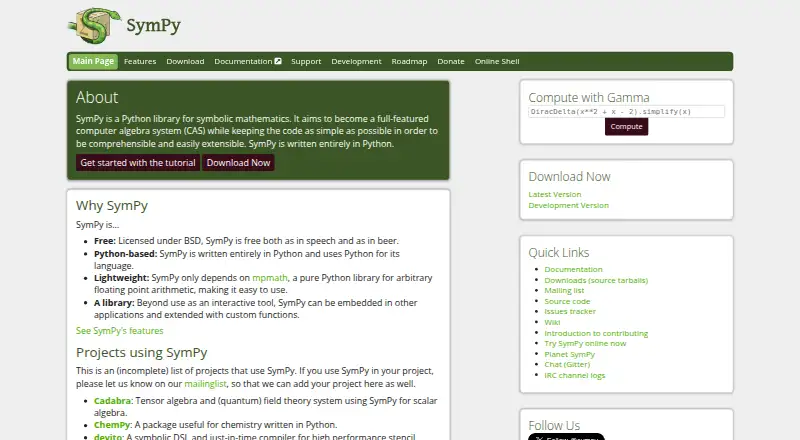
What SymPy is
SymPy is a free, open-source Python library for symbolic mathematics. It can simplify expressions, solve equations, calculate derivatives, integrals and limits, and work with matrices symbolically. Its listed mathematical capabilities also include polynomial factorization and Gröbner bases.
The library includes modules for plotting, printing, code generation, physics, statistics, combinatorics, number theory, geometry and logic. Installation options include pip, Conda, Linux package managers, nightly wheels and Git. SymPy says it can be installed on virtually any computer that supports Python, and its project site offers a way to try it online. Documentation for mechanics names SymPy Live and SymPy Gamma as online options.
The project is released under the modified BSD license and identifies mpmath as its only hard dependency. SymPy is used by projects including SageMath, Spyder, PyTorch TorchInductor and Cadabra. Its tutorial assumes readers know basic Python and have a decent mathematical background. SymEngine is available as an optional experimental backend; the documentation warns that some SymPy functions may not work correctly when it is enabled.
Who it suits
SymPy suits Python users who need symbolic calculations for algebra, calculus, matrices or the subject areas covered by its additional modules. The tutorial assumes basic Python knowledge and a decent mathematical background, so it is aimed at readers comfortable with both.
What it does well
- Free and open source under the modified BSD license.
- Handles symbolic algebra, calculus, equations and matrices.
- Includes modules across areas such as physics, statistics and geometry.
- Offers installation through pip, Conda, Linux package managers, wheels or Git.
- The project site offers an option to try it online.
What to know first
- The tutorial assumes basic Python knowledge and a decent mathematical background.
- The optional experimental SymEngine backend may cause some functions to work incorrectly.
Limits
The free plan is the Python library. Its tutorial assumes basic Python knowledge and a decent mathematical background; enabling the optional experimental SymEngine backend may prevent some functions from working correctly.
Plans
| Plan | Billed and limits | Price |
|---|---|---|
| Free | SymPy says it is free for all to use. · BSD licensed · Python library | Free |
As sympy.org lists them, read 11 Oct 2026. The maker's own page has the final word.
Getting started
- Visit the SymPy project website and choose its online try option, or select an installation route.
- Install with pip, Conda, a Linux package manager, nightly wheels or Git.
- Use SymPy on a computer that supports Python.
- Review the tutorial if you have basic Python knowledge and a decent mathematical background.
Verdict
Choose SymPy if you want a free Python library for symbolic mathematics with broad mathematical capabilities and several installation routes. Look elsewhere if you need a tool suited to users without basic Python knowledge or a mathematical background.
Questions
How much does SymPy cost?
SymPy is free to use; the listed plan is free.
What can SymPy do?
It can simplify expressions, solve equations, calculate derivatives, integrals and limits, and work with matrices symbolically. Its listed capabilities also include polynomial factorization and Gröbner bases.
Which systems can I use SymPy on?
The platform listing includes API, Linux, macOS, web and Windows. The project says it can be installed on virtually any computer that supports Python.
How can I install SymPy?
The installation guide supports pip, Conda, Linux package managers, nightly wheels and installation from Git.
Is SymPy open source?
Yes. The project releases it under the modified BSD license and identifies mpmath as its only hard dependency.
Who is SymPy for?
The tutorial assumes readers know basic Python and have a decent mathematical background.
Facts from SymPy's own pages
- Core features
- Its listed capabilities include polynomial factorization, Gröbner bases, limits, differentiation, integration, and equation solving. · sympy.org, 11 Oct 2026
- Dependencies
- SymPy's dependency guide identifies mpmath as its only hard dependency. · docs.sympy.org, 11 Oct 2026
- Installation
- The installation guide supports pip, Conda, Linux package managers, nightly wheels, and installation from Git. · docs.sympy.org, 11 Oct 2026
- Integration
- The SymPy site lists projects using it, including SageMath, Spyder, PyTorch TorchInductor, and Cadabra. · sympy.org, 11 Oct 2026
- Intended users
- The tutorial assumes readers know basic Python and have a decent mathematical background. · docs.sympy.org, 11 Oct 2026
- License
- The project says SymPy is open-source software released under the modified BSD license. · sympy.org, 11 Oct 2026
- Online use
- The project site offers an option to try SymPy online, and its mechanics documentation names SymPy Live and SymPy Gamma. · sympy.org, 11 Oct 2026
- Operating systems
- The installation guide says SymPy can be installed on virtually any computer that supports Python, and documents Linux package-manager installation. · docs.sympy.org, 11 Oct 2026
- Optional backend
- The SymEngine backend is optional and experimental, and the documentation warns that some SymPy functions may not work correctly with it enabled. · docs.sympy.org, 11 Oct 2026
- Other modules
- SymPy lists modules for plotting, printing, code generation, physics, statistics, combinatorics, number theory, geometry, and logic. · docs.sympy.org, 11 Oct 2026
- Project start
- The SymPy repository says Ondřej Čertík started the project in 2005. · github.com, 11 Oct 2026
- Symbolic computation
- It can simplify expressions, compute derivatives, integrals and limits, solve equations, and work with matrices symbolically. · docs.sympy.org, 11 Oct 2026
- What it does
- SymPy is a Python library for symbolic mathematics. · docs.sympy.org, 11 Oct 2026
Where SymPy stands on Freedom251
- Math Solver Apps#49 of 68