Freedom251 › PC Benchmark Software
STREAM
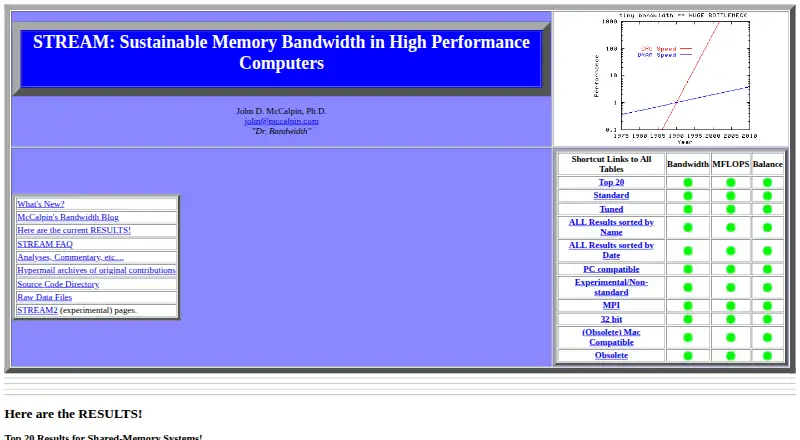
What STREAM is
STREAM is a free synthetic benchmark that measures sustainable memory bandwidth and computation rates for simple vector kernels. It repeatedly runs Copy, Scale, Add, and Triad using datasets intended to exceed available cache, helping results reflect large vector-style workloads. C and Fortran source code is available, and the standard versions include OpenMP directives; an MPI version supports cluster runs. STREAM supports Linux, macOS, and Windows, while its operating-system list also mentions DOS and Power Mac. Users can create custom profiles, automate runs from the command line, and export comma-delimited raw data files. The site provides a comparison database and tables covering bandwidth, machine balance, and equivalent MFLOPS. Standard results require 64-bit data types on production hardware and exclude simulated or significantly modified code. A tuned-results set permits code changes, including assembly language. Published standard results must follow the run rules, and modified runs must be labeled.
Who it suits
It suits developers, researchers, and administrators comparing memory bandwidth or vector-kernel performance across systems and clusters.
What it does well
- Free benchmark with source code
- C, Fortran, OpenMP, and MPI options
- Custom profiles and command-line automation
- Published comparison database
- Raw CSV-style export
What to know first
- Precompiled binaries described as obsolete
- Results require run-rule compliance
- No warranty is expressed or implied
Verdict
STREAM is a focused benchmark for sustained memory bandwidth and simple vector computations. Its source-based workflow, automation, and published result rules support repeatable comparisons when users follow the stated standards.
Facts from STREAM's own pages
- Cache-sized data
- STREAM is designed to use datasets much larger than available cache so results better reflect performance for large vector-style applications. · cs.virginia.edu, 5 Oct 2026
- CLI or automation
- Yes · cs.virginia.edu, 22 Sept 2026
- Comparison database
- Yes · cs.virginia.edu, 22 Sept 2026
- Custom test profiles
- Yes · cs.virginia.edu, 22 Sept 2026
- Free plan
- Yes · cs.virginia.edu, 22 Sept 2026
- Intended use
- It is designed to use datasets much larger than available cache, to make results more indicative of large vector style applications. · cs.virginia.edu, 5 Oct 2026
- Kernels
- The benchmark repeats four kernels: Copy, Scale, Add, and Triad. · cs.virginia.edu, 5 Oct 2026
- Maintainer
- The FAQ identifies John McCalpin as STREAM's creator and maintainer. · cs.virginia.edu, 5 Oct 2026
- Operating systems
- Linux; Windows; DOS; Power Mac · cs.virginia.edu, 22 Sept 2026
- Parallel runs
- The standard C and Fortran code includes OpenMP directives, and an MPI version is available for cluster runs. · cs.virginia.edu, 5 Oct 2026
- Project hosting
- The site says STREAM is hosted at the University of Virginia in Charlottesville, Virginia. · cs.virginia.edu, 5 Oct 2026
- Project status
- The site describes STREAM as an independent academic project hosted at the University of Virginia. · cs.virginia.edu, 5 Oct 2026
- Published results
- Results labeled as standard STREAM benchmark results must conform to the STREAM Run Rules; modified or nonconforming runs must be clearly labeled. · cs.virginia.edu, 5 Oct 2026
- Publishing results
- Published results called “STREAM benchmark results” must conform to the run rules, and modified-code results must be clearly labelled. · cs.virginia.edu, 5 Oct 2026
- Purpose
- STREAM is a synthetic benchmark that measures sustainable memory bandwidth and computation rates for simple vector kernels. · cs.virginia.edu, 5 Oct 2026
- Result export formats
- comma-delimited raw data files · cs.virginia.edu, 22 Sept 2026
- Results database
- The site publishes benchmark results in tables covering bandwidth, machine balance, and equivalent MFLOPS. · cs.virginia.edu, 5 Oct 2026
- Source code
- The site recommends compiling the benchmark from its C or Fortran source code. · cs.virginia.edu, 5 Oct 2026
- Source languages
- The maker recommends compiling the source code, which is available in C or Fortran. · cs.virginia.edu, 5 Oct 2026
- Standards
- The standard results set uses C or Fortran versions with 64-bit data types on production hardware and excludes simulated results and significantly modified code. · cs.virginia.edu, 5 Oct 2026
- Tuned results
- The tuned results set allows code modifications, including assembly language, while requiring 64-bit data types on production hardware. · cs.virginia.edu, 5 Oct 2026
- Use and redistribution
- The run rules permit use and redistribution, and permit modification for personal use including commercial use, subject to publication restrictions. · cs.virginia.edu, 5 Oct 2026
- Warranty
- The run rules state that no warranty is expressed or implied. · cs.virginia.edu, 5 Oct 2026
- Windows and Linux binaries
- The FAQ lists precompiled binaries for Windows and Linux but describes the available binaries as obsolete and recommends compiling the source. · cs.virginia.edu, 5 Oct 2026
Where STREAM stands on Freedom251
- PC Benchmark Software#57 of 73
- PC benchmark tools#60 of 70