Freedom251 › Formal Verification Tools
SPIN
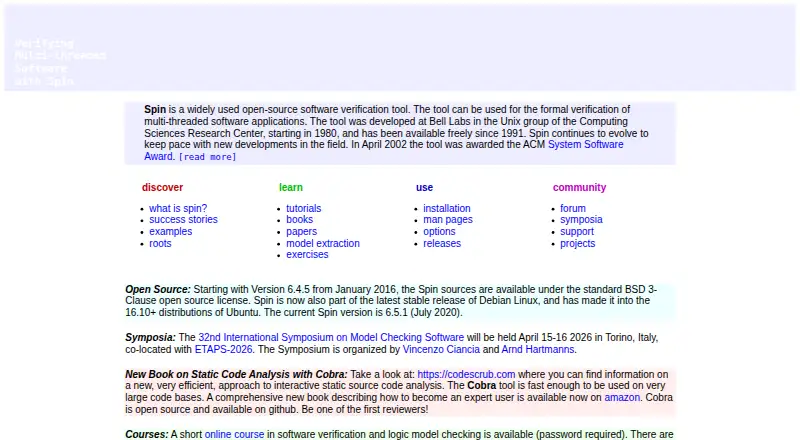
What SPIN is
SPIN is a free model-checking tool for examining whether asynchronous systems satisfy logical correctness requirements. It is aimed at systems such as distributed software and communication protocols, which users describe in Promela. The language represents asynchronous processes, nondeterministic choices, loops, and local or global variables; models can state requirements including linear temporal logic properties. SPIN can simulate system execution interactively, with guidance, or at random. For verification, it can generate C code to check requirements exhaustively or approximately. The product description says it checks for deadlocks, race conditions, incomplete specifications, and unjustified assumptions about process speeds. Partial order reduction is listed as an optimization, and the site provides guidance on multicore search algorithms and swarm methods for large state spaces. SPIN is self-hosted and runs on Linux, macOS, and Windows, among other listed systems. From version 6.4.5, its code, sources, and executables are available under the BSD 3-Clause license. Verification requires a working C compiler and preprocessor. The optional iSpin graphical interface is written in Tcl/Tk and requires Tcl/Tk.
Who it suits
SPIN suits people modeling asynchronous systems who need to check logical requirements, including temporal-logic properties. Users need Promela and, for verification, a working C compiler and preprocessor.
What it does well
- Free source and executables under BSD 3-Clause from version 6.4.5.
- Supports interactive, guided, and random simulation.
- Checks for deadlocks and race conditions.
- Supports exhaustive or approximate verification.
- Runs on Linux, macOS, and Windows.
What to know first
- Verification requires a working C compiler and preprocessor.
- Optional iSpin interface requires Tcl/Tk.
- Models must be specified in Promela.
Plans
| Plan | Billed and limits | Price |
|---|---|---|
| SPIN | Free source and executables · BSD 3-Clause license | Free |
As spinroot.com lists them, read 3 Oct 2026. The maker's own page has the final word.
Getting started
- Open the SPIN website and consult its manual pages or tutorials
- Install SPIN for Linux, macOS, or Windows
- Specify the system and correctness requirements in Promela
- Set up a working C compiler and preprocessor for verification
- Optionally install Tcl/Tk to use the iSpin graphical interface
Verdict
SPIN offers simulation and model checking for asynchronous systems, with Promela models and several verification approaches. Its compiler requirement is important for anyone planning to verify models.
Questions
How much does SPIN cost?
SPIN is free. Its free plan includes source code and executables under the BSD 3-Clause license from version 6.4.5.
Which operating systems does SPIN support?
SPIN runs on Linux, macOS, and Windows. The download instructions also name Unix and Solaris.
What language does SPIN use?
Systems are specified in Promela, which supports asynchronous processes, nondeterministic choices, loops, and local and global variables.
What does SPIN check?
It checks logical correctness requirements, including those expressed in linear temporal logic. The product description says it checks for deadlocks, race conditions, incomplete specifications, and unwarranted assumptions about process speeds.
Does SPIN provide a graphical interface?
iSpin is an optional graphical interface written in Tcl/Tk, which it requires.
What does verification require?
Verification requires a working C compiler and C preprocessor. SPIN can generate C code for exhaustive or approximate verification.
Facts from SPIN's own pages
- Build requirement
- The installation guide says SPIN requires a working C compiler and C preprocessor for verification. · spinroot.com, 3 Oct 2026
- Correctness properties
- Promela models can specify logical correctness requirements, including requirements expressed in linear temporal logic. · spinroot.com, 3 Oct 2026
- Founded
- 1980 · spinroot.com, 28 Sept 2026
- Issue detection
- The product description says SPIN checks specifications for deadlocks, race conditions, incompleteness, and unwarranted assumptions about process speeds. · spinroot.com, 3 Oct 2026
- License
- Starting with SPIN version 6.4.5, its code, sources, and executables are available under the BSD 3-Clause license. · spinroot.com, 3 Oct 2026
- Model language
- Systems are specified in Promela, which supports asynchronous processes, nondeterministic choices, loops, and local and global variables. · spinroot.com, 3 Oct 2026
- Multicore and swarm
- The binaries page links guidance for multicore DFS and BFS algorithms and for swarm methods to handle large state spaces. · spinroot.com, 3 Oct 2026
- Operating systems
- The download instructions say SPIN runs on Unix, Solaris, Linux, most Windows PCs, and Macs. · spinroot.com, 3 Oct 2026
- Optional interface
- iSpin is an optional graphical interface written in Tcl/Tk, and the guide says it requires Tcl/Tk. · spinroot.com, 3 Oct 2026
- Partial order reduction
- SPIN’s product description lists partial order reduction as an optimization for verification runs. · spinroot.com, 3 Oct 2026
- Purpose
- SPIN analyzes the logical consistency of asynchronous systems, including distributed software and communication protocols. · spinroot.com, 3 Oct 2026
- Simulation
- SPIN supports interactive, guided, and random simulations of a system’s execution. · spinroot.com, 3 Oct 2026
- Support and learning
- The site provides manual pages, tutorials, papers, books, and a forum through its homepage navigation. · spinroot.com, 3 Oct 2026
- Verification
- SPIN can generate a C program for exhaustive or approximate verification of a model’s correctness requirements. · spinroot.com, 3 Oct 2026
Where SPIN stands on Freedom251
- Formal Verification Tools#24 of 34