Freedom251 › Log Management Software
Sonic
by Sonic
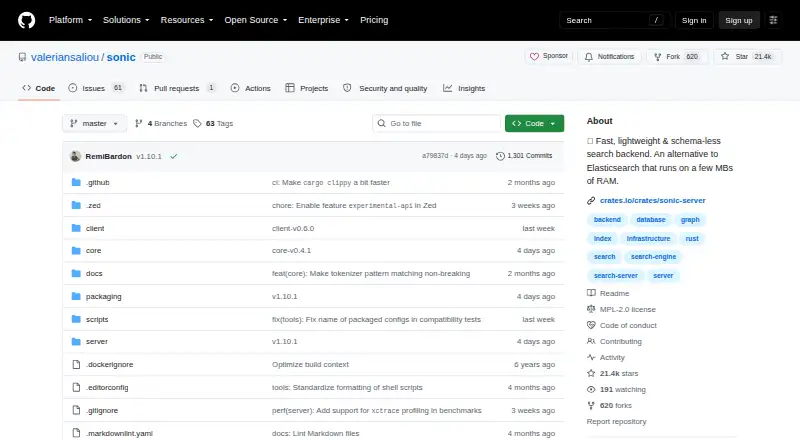
What Sonic is
Sonic is a free, open-source search backend for applications that need to find records by their text. It indexes search text alongside identifiers, then returns matching identifiers for an application to look up in an external database; it does not keep the underlying textual data in its index. Search features include natural-language query normalization, typo correction when exact matches are lacking, and real-time word completion. Its language lexer supports over 80 languages, removing stop words after language detection; unsupported languages can be indexed without that filtering. Terms are organized in collections and buckets, including buckets for user-specific indexes. Sonic runs self-hosted on Linux and uses Sonic Channel, a TCP-based protocol for search, ingestion, and object management. It has no HTTP endpoint. Official client libraries are listed for Node.js, Rust, and PHP, alongside community libraries for other languages. Installation methods include releases, Cargo, source, Docker, and Debian-based packages; official packages target 64-bit Debian 12. The project is licensed under MPL-2.0.
Who it suits
Sonic may suit developers building self-hosted search into applications that can resolve returned identifiers in an external database. Its listed language libraries include options for several common development ecosystems.
What it does well
- Free and open source under MPL-2.0.
- Normalizes queries, corrects typos, and suggests completions.
- Lexer supports over 80 languages.
- Offers official Node.js, Rust, and PHP clients.
What to know first
- Self-hosted; no hosted deployment is listed.
- No HTTP endpoint is provided.
- Official packages target 64-bit Debian 12.
- Each bucket uses a 32-bit internal identifier.
Limits
Each bucket uses a 32-bit internal identifier, theoretically allowing about 4.2 billion indexed objects. For each word, Sonic retains only the N most recently pushed results; the sliding-window width is configurable.
Plans
| Plan | Billed and limits | Price |
|---|---|---|
| Sonic | Open-source search backend · MPL-2.0 license | Free |
As github.com lists them, read 10 Oct 2026. The maker's own page has the final word.
Getting started
- Open the project at https://github.com/valeriansaliou/sonic.
- Choose a documented installation route: releases, Cargo, source, Docker, or a Debian-based package.
- Run Sonic on a supported Linux setup; official packages target 64-bit Debian 12.
- Connect through Sonic Channel, its TCP-based protocol, using an available client library.
- Organize search terms into collections and buckets, then have your application resolve matching identifiers in its external database.
Verdict
Sonic provides a focused search backend with language-aware query features and multiple integration options. Its self-hosted deployment and TCP-based protocol are important considerations for teams planning how to connect it to an application.
Questions
Does Sonic cost anything?
Sonic is free and open source under the MPL-2.0 license.
Where can Sonic run?
It is self-hosted on Linux. Official packages target 64-bit Debian 12.
Does Sonic expose an HTTP endpoint?
No. Search, ingestion, and object management use Sonic Channel, a TCP-based protocol.
What does Sonic store in its index?
It indexes search text and identifier tuples, then returns identifiers for matching documents. Applications resolve those identifiers in an external database; Sonic does not store direct textual data.
Which client libraries are available?
Official client libraries are listed for Node.js, Rust, and PHP. Community libraries include Python, Ruby, Go, Java, Deno, Bun, and .NET.
Facts from Sonic's own pages
- Deployment
- The project documents installation from releases, Cargo, source, Docker, and Debian-based packages; its official packages target 64-bit Debian 12. · github.com, 10 Oct 2026
- Headquarters
- Nantes, France · github.com, 28 Sept 2026
- Index model
- It returns identifiers for matching documents, which applications can resolve in an external database; Sonic does not store direct textual data in its index. · github.com, 10 Oct 2026
- Integrations
- The project lists official client libraries for Node.js, Rust, and PHP, plus community libraries for languages including Python, Ruby, Go, Java, Deno, Bun, and .NET. · github.com, 10 Oct 2026
- Intended use
- The project presents Sonic as a lightweight alternative to heavyweight search backends for some use cases and names Crisp and Scrumpy among its users. · github.com, 10 Oct 2026
- Language support
- Its lexing system supports over 80 languages, with stop-word removal after language detection; unsupported languages can be indexed without stop-word filtering. · github.com, 10 Oct 2026
- Maker location
- The README says Sonic was crafted in Nantes, France. · github.com, 10 Oct 2026
- Organization
- Search terms are stored in collections and buckets, including separate buckets for user-specific indexes. · github.com, 10 Oct 2026
- Protocol
- Search, ingestion, and object management use Sonic Channel, a TCP-based protocol; Sonic does not provide an HTTP endpoint. · github.com, 10 Oct 2026
- Purpose
- Sonic is a fast, lightweight, schema-less search backend that indexes search text and identifier tuples for querying. · github.com, 10 Oct 2026
- Result window
- For each word, Sonic retains only the N most recently pushed results, with the sliding-window width configurable. · github.com, 10 Oct 2026
- Search features
- It can normalize natural-language queries, correct typos when exact matches are insufficient, and suggest word completions in real time. · github.com, 10 Oct 2026
- Security
- The repository identifies its license as MPL-2.0; the reviewed project pages do not state security certifications or compliance claims. · github.com, 10 Oct 2026
- Storage limit
- Each bucket uses a 32-bit internal identifier, theoretically allowing about 4.2 billion indexed objects per bucket. · github.com, 10 Oct 2026
Where Sonic stands on Freedom251
- Log Management Software#64 of 111
- Game Mod Loaders#15 of 26
- Search Databases#19 of 30
- AI Music Generators#102 of 123
- Blogging Platforms#104 of 125