Freedom251 › Semantic Layer Software
Sidemantic
What Sidemantic is
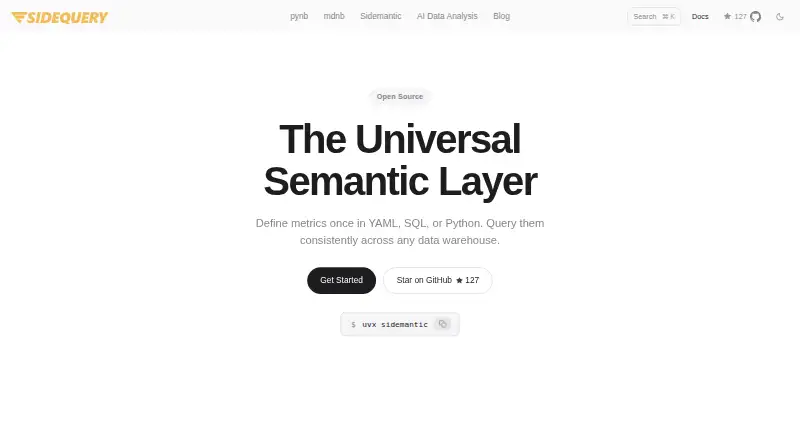
Sidemantic is an open-source semantic layer that lets teams define metrics and query them consistently across tools. It runs on top of a data warehouse; it is not a BI or ETL tool. Teams can author models in YAML, SQL, or Python, or import semantic models from more than 15 formats, including Cube, MetricFlow, LookML, Malloy, and Snowflake Cortex. Native adapters are listed for Snowflake, BigQuery, Postgres, ClickHouse, Databricks, and Spark, with additional databases supported through ADBC.
Queries are available through semantic SQL, a Python API, CLI, MCP server, or Postgres wire protocol. For cross-model queries, Sidemantic infers join paths from declared relationships, so semantic SQL does not require a JOIN keyword. Symmetric aggregates help avoid double-counting across one-to-many joins. The MCP connection also makes metrics available to LLMs, with built-in guardrails for governed access.
The website has an interactive workbench with demo data that needs no database. Sidemantic is free and self-hosted, with web and API platforms. The project is young; format conversion and its Postgres protocol server may have rough patches. Sidequery Corporation is identified as the maker, and documentation and a Discord community are available.
Who it suits
Sidemantic suits data teams that want to define governed metrics once and query them through multiple interfaces or tools. It may also suit teams exposing metrics to LLMs through MCP, provided they are comfortable running it on top of a warehouse and working with a young project.
What it does well
- Authors can define models in YAML, SQL, or Python.
- Imports semantic models from more than 15 formats.
- Native adapters include Snowflake, BigQuery, Postgres, ClickHouse, Databricks, and Spark.
- Offers semantic SQL, Python API, CLI, MCP, and Postgres wire protocol.
- Infers join paths and uses symmetric aggregates for one-to-many joins.
- Interactive workbench includes demo data without requiring a database.
What to know first
- Runs on top of a data warehouse; it is not a BI or ETL tool.
- The project notes possible rough patches in format conversion and its Postgres protocol server.
- Self-hosted deployment requires teams to run the project themselves.
Getting started
- Open the interactive workbench to explore the built-in demo data without a database.
- Choose a self-hosted, web, or API platform.
- Connect it to a supported warehouse using a native adapter or ADBC.
- Author models in YAML, SQL, or Python, or import an existing semantic model.
- Query through semantic SQL, Python API, CLI, MCP server, or Postgres wire protocol.
Verdict
Choose Sidemantic if you need a free, open-source semantic layer for governed metrics, multiple query interfaces, or MCP access for LLMs. Look elsewhere if you need a BI or ETL tool, or if the project's stated rough patches in format conversion and its Postgres protocol server are a concern.
Questions
How much does Sidemantic cost?
Sidemantic is free and open source under the AGPL-3.0 license.
Can I try it without connecting a database?
Yes. The website offers an interactive workbench with built-in demo data that does not require a database.
Which databases does it support?
Native adapters are listed for Snowflake, BigQuery, Postgres, ClickHouse, Databricks, and Spark. Additional databases are supported through ADBC.
How can I author or import models?
Models can be authored in YAML, SQL, or Python. Sidemantic imports semantic models from more than 15 formats, including Cube, MetricFlow, LookML, Malloy, and Snowflake Cortex.
What query interfaces are available?
You can query through semantic SQL, a Python API, CLI, MCP server, or the Postgres wire protocol.
Who makes Sidemantic, and where can I get support?
The site identifies Sidequery Corporation as the company. It links to documentation and a Discord community.
Facts from Sidemantic's own pages
- Aggregation correctness
- Symmetric aggregates are used to prevent double-counting across one-to-many joins. · sidemantic.com, 4 Oct 2026
- AI access
- Sidemantic can expose metrics to LLMs through MCP, with built-in guardrails for governed access. · sidequery.dev, 9 Oct 2026
- Format imports
- It imports semantic models from formats including Cube, dbt MetricFlow, LookML, Hex, Rill, Superset, Omni, Malloy, Snowflake Cortex, OSI, AtScale, GoodData, Holistics, and ThoughtSpot. · sidequery.dev, 9 Oct 2026
- Interactive demo
- The site offers an interactive workbench with built-in demo data that does not require a database. · sidemantic.com, 4 Oct 2026
- Join handling
- Cross-model queries can infer join paths from declared relationships, and symmetric aggregates are designed to prevent double-counting across one-to-many joins. · sidequery.dev, 9 Oct 2026
- Join inference
- Cross-model queries infer join paths from declared relationships without requiring a JOIN keyword in semantic SQL. · sidequery.dev, 4 Oct 2026
- License
- The GitHub repository identifies the project as open source under the AGPL-3.0 license. · github.com, 4 Oct 2026
- Maker
- The site footer identifies Sidequery Corporation as the company. · sidemantic.com, 4 Oct 2026
- Maturity
- The project describes itself as young and notes that format conversion and its Postgres protocol server may have rough patches. · github.com, 4 Oct 2026
- Model authoring
- You can define semantic models in YAML, SQL DDL, or Python. · sidequery.dev, 9 Oct 2026
- Model imports
- It imports semantic models from more than 15 formats, including Cube, MetricFlow, LookML, Malloy, and Snowflake Cortex. · sidequery.dev, 4 Oct 2026
- Not a BI or ETL tool
- Sidemantic runs on top of a warehouse and is described as neither an ETL tool nor a BI tool. · sidequery.dev, 4 Oct 2026
- Pre-aggregation limit
- Pre-aggregation routing is disabled by default and must be explicitly enabled. · sidequery.dev, 9 Oct 2026
- Purpose
- Sidemantic is a semantic layer for defining metrics once and querying them consistently across tools. · sidequery.dev, 9 Oct 2026
- Query interfaces
- Sidemantic provides a SQL interface, Python API, CLI, MCP server, and Postgres wire protocol. · sidequery.dev, 9 Oct 2026
- Support
- The maker links to documentation and a Discord community for the project. · sidemantic.com, 4 Oct 2026
- Warehouse connections
- Documented database connections include DuckDB, MotherDuck, PostgreSQL, BigQuery, Snowflake, ClickHouse, Databricks, and Spark SQL. · sidequery.dev, 9 Oct 2026
- Warehouse support
- Native adapters are listed for Snowflake, BigQuery, Postgres, ClickHouse, Databricks, and Spark, with additional databases supported via ADBC. · sidemantic.com, 4 Oct 2026
- Workbench
- The workbench can run with built-in demo data without a database setup. · sidequery.dev, 9 Oct 2026
Where Sidemantic stands on Freedom251
- Semantic Layer Software#13 of 28