Freedom251 › Code review software

Review Board
What Review Board is
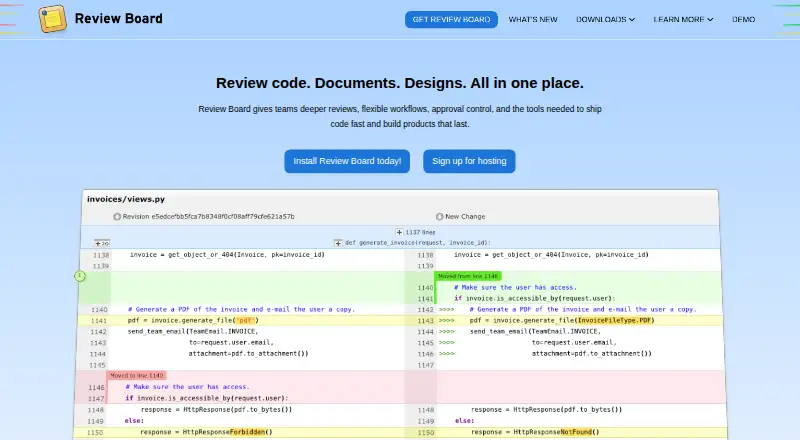
Review Board is a web-based tool for reviewing code and a range of other project materials, including images, documentation, presentations, and marketing files. Teams can set review workflows, manage approvals, and keep an audit trail of decisions. Review Bot automates checks using lint, static-analysis, compliance, and security tools. A Python extension framework, REST APIs, webhooks, and RBTools support workflow and integration customization. Review Board can be self-hosted on compatible Linux systems, macOS, or WSL for Windows, including Docker deployments. It can run on private networks and in air-gapped environments; self-hosted servers do not send data to outside services unless administrators configure them to. The product supports multiple code hosts and CI or collaboration integrations. Review Board is open source under the MIT license, and Community is free. Basic costs $6 a month, billed month-to-month. Power Pack can be tried for 60 days for unlimited users; afterward, two users can continue using it free.
Who it suits
Review Board suits teams reviewing code and other project materials, especially those needing on-premises or air-gapped operation, audit tracking, and multiple source-control systems. It offers options for solo users through enterprise teams.
What it does well
- Reviews cover code, images, documents, and presentations.
- Review Bot can automate static-analysis and security checks.
- Self-hosting supports private and air-gapped environments.
- Community plan is free and open source under MIT.
- Basic costs $6 a month, billed month-to-month.
What to know first
- AI review is not available.
- Basic lists two integrations.
- Enterprise costs $1,518 a month.
Limits
Community covers code, image, and Markdown review; document review is listed in Business, Plus, and Enterprise. Basic includes 2 integrations, while Business includes 50. Power Pack’s free trial lasts 60 days for unlimited users, after which two users can continue using it free.
Plans
| Plan | Billed and limits | Price |
|---|---|---|
| Community | Code, image, and Markdown review · automated code review · REST API · LDAP, Active Directory, and SAML SSO · wide repository support · CI and collaboration integrations | Free |
| Business | month-to-month · Everything in Basic · 50 integrations · document review · code review reports · Azure DevOps · ClearCase · GitHub Enterprise · Keysight SOS | $12 a month |
| Plus | annual or monthly · Everything in Community · basic dedicated support · document review · code review reports · enterprise repository integrations · improved server scalability | $1,215 a month |
| Enterprise | annual or monthly · Everything in Plus · 24/7 premium support · priority fixes and features · urgent-fix backports · custom builds · deployment assistance · video chat support | $1,518 a month |
| Basic | month-to-month · Unlimited linked repositories · 2 integrations · code, image, and Markdown review · REST API · CI and collaboration integrations | $6 a month |
As reviewboard.org lists them, read 1 Oct 2026. The maker's own page has the final word.
Getting started
- Visit https://www.reviewboard.org/.
- Choose the free Community plan or a paid plan; Basic and Business are billed month-to-month.
- Choose cloud or self-hosted deployment.
- For self-hosting, use a compatible Linux system, macOS, or WSL for Windows; Docker deployments are supported.
- Connect a supported source-control system and configure integrations or workflow customizations as needed.
- Try Power Pack free for 60 days for unlimited users; afterward, two users can continue using it free.
Overview
Review Board is a web-based platform for reviewing code and project files, suited to teams that need review workflows across varied repositories or controlled deployment. Its strongest case is flexibility: teams can tailor approvals, automate checks, and keep review data on private infrastructure, though document review and dedicated support push buyers toward higher-priced plans.
Key features
Review Board handles more than code: teams can review images, Markdown, documentation, presentations, marketing materials, and other project files. That breadth is useful when approvals extend beyond software changes, but document review is limited to Business and higher tiers.
Flexible workflows, approval controls, and an audit trail help teams manage sign-offs and retain decisions. Review Bot connects reviews with linting, static-analysis, compliance, and security-checking tools. Custom rules and review analytics add control; there is no AI review, so teams seeking AI-generated feedback should look elsewhere.
Repository support spans Git, GitHub, GitLab, Bitbucket, Perforce, Mercurial, Subversion, Breezy, CVS, Azure DevOps, ClearCase, and Keysight SOS. A Python extension framework, REST APIs, webhooks, and RBTools give teams ways to adapt workflows and integrations. This is a strong fit for varied toolchains, though configuring a tailored process may demand more technical ownership than a narrower, ready-made workflow.
Teams can run Review Board on compatible Linux systems, macOS, or WSL for Windows, including through Docker. It supports private-network and air-gapped deployments; self-hosted servers do not send data outside unless administrators configure them to. Releases are signed with the project's official PGP key, and the product site says customer data is not used for training.
Pricing
Review Board is freemium, with a free plan and a 60-day Power Pack trial for unlimited users. After the trial, two users can continue using Power Pack free forever. Paid plans start at $6/user/mo.
- Community — free: Includes code, image, and Markdown review, automated code review, REST API, LDAP, Active Directory, and SAML SSO, wide repository support, and CI and collaboration integrations. It is the sensible starting point for teams that can work without paid-plan additions; its scope excludes document review and dedicated support.
- Basic — $6 a month, billed month-to-month: Adds unlimited linked repositories and includes two integrations, code, image, and Markdown review, REST API, and CI and collaboration integrations. It suits teams wanting the broader repository allowance, but the two-integration cap can constrain teams with more connected tools.
- Business — $12 a month, billed month-to-month: Adds 50 integrations, document review, code review reports, and support for Azure DevOps, ClearCase, GitHub Enterprise, and Keysight SOS over Basic. It fits teams that need those review materials or integrations without moving to a support-focused tier.
- Plus — $1,215 a month, billed annual or monthly: Includes everything in Community, basic dedicated support, document review, code review reports, enterprise repository integrations, and improved server scalability. It is aimed at organizations that need dedicated assistance and scale; its monthly price is a substantial step up from Business.
- Enterprise — $1,518 a month, billed annual or monthly: Adds 24/7 premium support, priority fixes and features, urgent-fix backports, custom builds, deployment assistance, and video chat support over Plus. It makes sense where urgent support and deployment help justify the premium; smaller teams are unlikely to need that service level.
Platforms
Review Board supports API, Linux, macOS, self-hosted, web, and Windows platforms, with cloud and self-hosted deployment options. Air-gapped operation and the choice to keep data on a privately administered server make it a particularly relevant option for teams with strict infrastructure requirements.
Who it's for
Review Board is best for teams that need on-premises or air-gapped review, repository-independent workflows, an audit trail, or support across multiple source-control systems. Its fit spans solo users through enterprise teams, but organizations should match the plan to integration counts, document review, and support requirements. Its extension and deployment flexibility are less compelling for teams that only need AI-led review or a simple hosted pull-request workflow.
Pros and cons
- Pros: Supports many code hosts and non-code review materials, making one review process practical across different repositories and deliverables.
- Pros: Self-hosting, private-network operation, and configurable outbound data give teams control over deployment and data flow.
- Pros: Review Bot, custom rules, review analytics, and an audit trail combine automation with decision oversight.
- Cons: Basic allows only two integrations, so connected-tool needs can require Business or a different setup.
- Cons: Document review is not in Community or Basic, limiting the free and entry-level plans for teams reviewing broader project materials.
- Cons: Plus and Enterprise cost $1,215 a month and $1,518 a month respectively, which is difficult to justify without their support, scalability, or deployment services.
- Cons: No AI review is offered, so teams prioritizing AI-generated review feedback need another option.
Alternatives
CodeRabbit offers a free plan for public repositories and is worth comparing for teams focused on that free public-repository use case.
Graphite has a free Hobby plan with personal-account repositories, notifications, CLI, MCP, and a VS Code extension; choose it if those tools and a personal workflow are the priority.
CodeAnt AI has a 14-day free trial with no credit card required; consider it if a time-limited evaluation of a paid product suits your buying process.
Gitar has a no-cost plan for qualifying public GitHub or GitLab repositories with an OSI-approved license; it may suit eligible open-source projects.
Greptile offers a free Starter plan with 50 credits per month, one active developer, and unlimited repositories; it suits a single developer willing to work within that credit allowance.
P4 Code Review offers a free plan for up to five users and 20 workspaces, so it is an alternative for teams that fit those caps.
Revue gives unlimited use for 30 days, then 10 reviews a month free; it suits occasional review needs that fit that monthly allowance.
Sourcery offers a free Open Source plan for public repositories with AI reviews, summaries, diagrams, one-click fixes, and custom review rules; consider it if those AI features are central.
Browse more options in Code review software.
Verdict
Review Board is a strong choice for teams that need repository flexibility, auditable approvals, automated checks, and the option to run reviews on private or air-gapped infrastructure. Its Community plan provides a substantial free starting point, but document review requires Business or above and premium support comes at a sharp price; teams without those requirements should compare simpler or AI-focused alternatives.
Verdict
Review Board combines flexible review workflows with automated checks and self-hosting options. It is worth considering for teams that need repository flexibility or controlled deployment; compare plan limits and support needs.
Questions
Is Review Board free or open source?
Yes. Review Board is open source under the MIT license, and its Community plan is free.
How much does Review Board cost?
Basic is $6 a month and Business is $12 a month, both billed month-to-month. Plus is $1,215 a month and Enterprise is $1,518 a month, with annual or monthly billing.
Can Review Board be self-hosted?
Yes. It can run on compatible Linux systems, macOS, or WSL for Windows, including Docker deployments. It can also run on private networks and in air-gapped environments.
Which source-control systems does it support?
Listed systems include Git, GitHub, GitLab, Bitbucket, Perforce, Mercurial, Subversion, Breezy, CVS, Azure DevOps, ClearCase, and Keysight SOS.
Is there a free trial?
Power Pack can be tried free for 60 days for unlimited users. After the trial, two users can continue using it free.
Which integrations are listed?
They include Asana, CircleCI, Discord, GitLab CI/CD, I Done This, Jenkins CI, Matrix, Mattermost, Microsoft Teams, Slack, Travis CI, and Trello.
Facts from Review Board's own pages
- Air-gapped use
- Review Board can run on private networks and in air-gapped environments. · reviewboard.org, 1 Oct 2026
- Automation
- Review Bot provides automated reviews through lint, static-analysis, compliance, and security-checking tools. · reviewboard.org, 1 Oct 2026
- Best suited for
- It is particularly suited to teams needing on-premises or air-gapped review, repository-independent workflows, audit tracking, and support for multiple source-control systems. · reviewboard.org, 1 Oct 2026
- Company size fit
- solo, small, mid market, enterprise · reviewboard.org, 22 Sept 2026
- Compliance
- sso saml · reviewboard.org, 22 Sept 2026
- Customization
- A Python extension framework, REST APIs, webhooks, and RBTools can be used to customize workflows and integrations. · reviewboard.org, 1 Oct 2026
- Data control
- Self-hosted servers do not send data to outside services unless administrators configure them to do so. · reviewboard.org, 1 Oct 2026
- Deployment
- cloud, self hosted · reviewboard.org, 22 Sept 2026
- Founded
- 2006 · reviewboard.org, 28 Sept 2026
- Headquarters
- Palo Alto, California, United States · reviewboard.org, 28 Sept 2026
- Integrations
- The integrations directory lists 10 version-control, 13 hosting-service, 6 authentication, 4 continuous-integration, and 8 collaboration-tool integrations. · reviewboard.org, 1 Oct 2026
- Open source
- Review Board is open source under the MIT license, and its Community plan is free. · reviewboard.org, 1 Oct 2026
- Power Pack trial
- Power Pack can be tried free for 60 days for unlimited users, after which two users can continue using it free forever. · reviewboard.org, 1 Oct 2026
- Privacy
- The product site states that Review Board does not train on customer data. · reviewboard.org, 1 Oct 2026
- Purpose
- Review Board is a web-based tool for code and document review. · reviewboard.org, 1 Oct 2026
- Review scope
- Teams can review code, images, documentation, presentations, marketing materials, and other project files. · reviewboard.org, 1 Oct 2026
- Security
- Review Board releases are signed with the project’s official PGP key so downloads can be verified as genuine and untampered. · reviewboard.org, 1 Oct 2026
- Self-hosting
- Review Board can run on compatible Linux systems, macOS, or WSL for Windows, including Docker deployments. · reviewboard.org, 1 Oct 2026
- Support
- Plus includes basic dedicated support, while Enterprise includes same-day premium support seven days a week, emergency repairs, priority fixes, older-version support, and custom builds. · reviewboard.org, 1 Oct 2026
- Support channels
- email, chat, phone, ticket, docs · reviewboard.org, 22 Sept 2026
- Workflow
- Review Board provides flexible workflows, approval control, and an audit trail of review decisions. · reviewboard.org, 1 Oct 2026
Where Review Board stands on Freedom251
- Code review software#22 of 51