Freedom251 › Reverse Proxy Software
Redbird
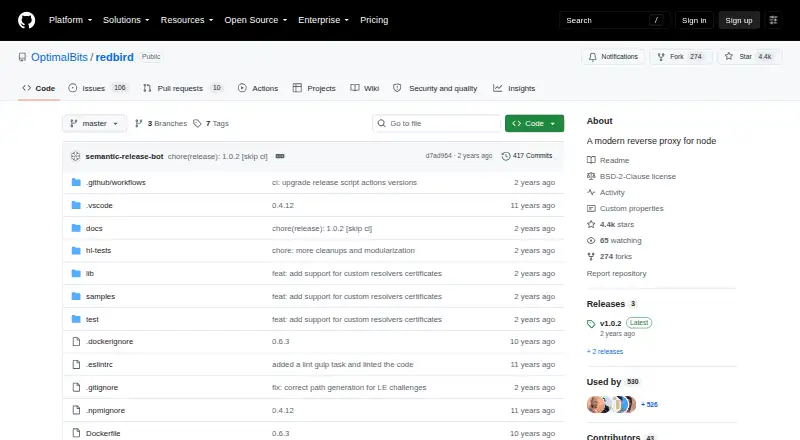
What Redbird is
Redbird is a free, self-hosted reverse proxy for Node. It routes traffic by hostname and path, and routes can be added or removed while the proxy is running. Custom resolvers can also make routing decisions using paths, headers, wildcard domains, or upstream availability. Redbird supports WebSocket proxying, HTTPS-to-HTTP proxying, and automatic redirects from HTTP to HTTPS. It can generate and renew Let’s Encrypt certificates automatically, and supports HTTP/2 when configured with SSL. Registering multiple targets for one hostname enables round-robin load balancing. Its Docker integration can register routes when containers start and unregister them when they stop; it can also create proxy records from an etcd cluster through node-etcd. Redbird can automatically create Node cluster setups and restart crashed worker threads. Logging is optional, but enabled logging can reduce performance by about an order of magnitude per request. Generated certificates are copied to a configured disk path, and users are responsible for backing them up and protecting them from malicious access. Redbird is installable with npm and is licensed under BSD-2-Clause. The latest GitHub release shown is v1.0.2, dated 2024-09-30.
Who it suits
Redbird suits Node developers who want a free reverse proxy they can host themselves and configure for hostname- or path-based routing. It may also suit deployments that need Docker route registration, etcd records, or automatic Node cluster management.
What it does well
- Free to use under the BSD-2-Clause license.
- Routes can be changed while the proxy is running.
- Supports WebSockets, TLS redirects, and HTTP/2 with SSL.
- Multiple targets for a hostname enable round-robin load balancing.
- Docker integration adds and removes routes with container lifecycle.
What to know first
- Enabling logging can reduce performance by about an order of magnitude per request.
- Users are responsible for certificate backups and protection.
- Redbird does not include rate limiting.
Plans
| Plan | Billed and limits | Price |
|---|---|---|
| Redbird | BSD-2-Clause license · install with npm | Free |
As github.com lists them, read 9 Oct 2026. The maker's own page has the final word.
Getting started
- Visit the Redbird GitHub page.
- Install Redbird with npm.
- Deploy it as a self-hosted service on Linux or another supported Node environment.
- Configure hostname or path routes and, if needed, SSL for HTTP/2.
Verdict
Pick Redbird if you want a no-cost, self-hosted Node reverse proxy with flexible routing, WebSocket support, and automatic certificate generation. Look elsewhere if rate limiting is required, or account for the performance and certificate responsibilities associated with logging and certificate storage.
Questions
Does Redbird cost anything?
Redbird is listed as free under the BSD-2-Clause license.
How do I install Redbird?
The listed installation route is npm.
Can Redbird handle WebSockets and HTTPS?
Yes. It supports WebSocket proxying, HTTPS-to-HTTP proxying, automatic HTTP-to-HTTPS redirects, and automatic Let’s Encrypt certificate generation and renewal.
Does Redbird support HTTP/2?
Yes, when configured with SSL.
Who is Redbird's author?
The package metadata names Manuel Astudillo as the author.
What should users know about logging and certificates?
The documentation warns that enabled logging can reduce performance by about an order of magnitude per request. Users are responsible for backing up certificates and protecting them from malicious access.
Facts from Redbird's own pages
- Certificate handling
- Let’s Encrypt certificates are copied to the configured disk path, and the documentation says users are responsible for backing them up and protecting them from malicious access. · github.com, 9 Oct 2026
- Cluster mode
- It supports automatic Node cluster generation and says it automatically restarts crashed worker threads. · github.com, 9 Oct 2026
- Custom routing
- Custom resolvers can route based on paths, headers, wildcard domains, or upstream availability. · github.com, 9 Oct 2026
- Docker
- Its Docker integration can register routes when containers start and unregister them when they stop. · github.com, 9 Oct 2026
- etcd
- Redbird can use node-etcd to create proxy records from an etcd cluster. · github.com, 9 Oct 2026
- HTTP/2
- Redbird supports HTTP/2 when configured with SSL. · github.com, 9 Oct 2026
- License
- The repository page identifies the project license as BSD-2-Clause. · github.com, 9 Oct 2026
- Load balancing
- Registering multiple targets for the same hostname enables round-robin load balancing. · github.com, 9 Oct 2026
- Logging
- Logging is optional; the documentation warns that enabled logging can reduce performance by about an order of magnitude per request. · github.com, 9 Oct 2026
- Maker
- The package metadata names Manuel Astudillo as the author. · github.com, 9 Oct 2026
- Product
- Redbird describes itself as a modern reverse proxy for Node. · github.com, 9 Oct 2026
- Release
- The latest GitHub release shown is v1.0.2, dated 2024-09-30. · github.com, 9 Oct 2026
- Routing
- It supports routing by hostname and path, including routes that can be registered or removed while the proxy is running. · github.com, 9 Oct 2026
- WebSockets and TLS
- Features include WebSocket proxying, HTTPS-to-HTTP proxying, automatic HTTP-to-HTTPS redirects, and automatic Let’s Encrypt certificate generation and renewal. · github.com, 9 Oct 2026
Where Redbird stands on Freedom251
- Reverse Proxy Software#16 of 33
- Debuggers#14 of 27