Freedom251 › Data recovery software
RAID Reconstructor
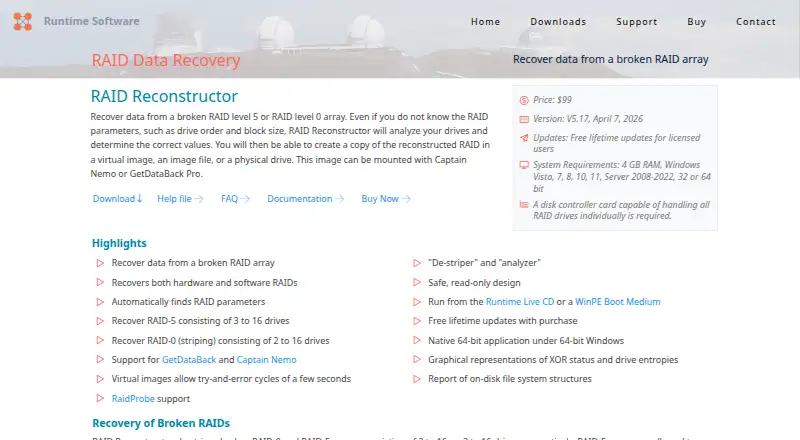
What RAID Reconstructor is
RAID Reconstructor analyzes broken RAID-0 and RAID-5 arrays to help recover their data. It can work from physical drives or image files, determine unknown settings such as drive order, start sector, block size, and rotation direction, and save a reconstructed copy as a virtual image, image file, or to a physical drive. RAID-0 recovery supports 2–16 drives and requires all of them; RAID-5 supports 3–16 drives and can proceed with one drive missing. The software handles hardware and software RAID, including broken Windows Dynamic Disk sets. It reads sectors from the source drives and writes them in order to a designated destination rather than trying to repair the array. Analysis tools include drive imaging, entropy, MFT and file-system reports, XOR tests, and a RAID calculator. Reports can find NTFS, EXT, and XFS structures. Created images can be mounted with Captain Nemo or processed with GetDataBack Pro. The calculator supports RAID-6 schemes, but the product’s array recovery is described for RAID-0 and RAID-5. It runs on listed Windows versions from Vista through 11 and Server 2008–2022, in 32-bit or 64-bit configurations, and requires 4 GB RAM and a controller card that presents drives individually. The listed starting price is $99 one-time.
Who it suits
RAID Reconstructor suits Windows users trying to recover data from supported RAID-0 or RAID-5 arrays, including setups supplied as drive images. It may also suit those who need to analyze array parameters before creating a reconstructed copy.
What it does well
- Works from physical drives or drive image files.
- Can identify unknown RAID parameters.
- RAID-5 recovery can proceed with one drive missing.
- Supports hardware and software RAID.
- Licensed users receive free lifetime updates.
What to know first
- RAID-0 recovery requires all drives.
- Array recovery is described for RAID-0 and RAID-5 only.
- Requires a controller card that handles drives individually.
- Windows only; requires 4 GB RAM.
Limits
RAID-0 arrays must have all drives present, while RAID-5 recovery allows one missing drive. The listed requirements include 4 GB RAM and a controller that handles every RAID drive individually.
Plans
| Plan | Billed and limits | Price |
|---|---|---|
| RAID Reconstructor | RAID-0: 2–16 drives · RAID-5: 3–16 drives, with one drive missing · Windows · Disk controller must handle all RAID drives individually | $99, paid once |
As runtime.org lists them, read 9 Oct 2026. The maker's own page has the final word.
Getting started
- Download the free version from the Runtime website
- Use a supported Windows Vista through 11 or Server 2008–2022 system
- Connect a controller that handles each RAID drive individually
- Provide physical drives or drive image files
- Analyze the array and determine its parameters
- Write the reconstructed result to an image or physical destination
- Enter a license key to turn the free version into the full version
Verdict
RAID Reconstructor focuses on reading and reconstructing RAID-0 and RAID-5 data rather than repairing arrays. Check the required Windows environment and controller setup, and note that RAID-0 recovery requires every drive.
Questions
How much does RAID Reconstructor cost?
The listed starting price is $99 one-time. Licensed users receive free lifetime updates.
Is there a free trial?
Yes. Entering a license key in the free version transforms it into the full version.
Which RAID arrays can it recover?
The product describes recovery for RAID-0 and RAID-5. RAID-0 supports 2–16 drives, and RAID-5 supports 3–16 drives with one drive missing.
Which operating systems are supported?
Supported systems are Windows Vista, 7, 8, 10, 11, and Server 2008–2022, in 32-bit or 64-bit versions.
Does it repair the RAID?
No. It reads sectors from source drives and writes them in order to a designated destination.
Can it recover memory cards or preview files?
Memory card recovery and file preview are not provided.
Facts from RAID Reconstructor's own pages
- Analysis tools
- The analysis toolbox includes drive imaging, entropy, MFT and file system reports, XOR tests, and a RAID calculator. · runtime.org, 9 Oct 2026
- Bootable recovery
- Yes · runtime.org, 23 Sept 2026
- File systems
- Its file system report can find structures for NTFS, EXT, and XFS. · runtime.org, 9 Oct 2026
- Free plan
- No · runtime.org, 23 Sept 2026
- Headquarters
- Holualoa, Hawaii, USA · runtime.org, 28 Sept 2026
- Operating systems
- Windows (Vista,7,8,10,11,Server 2008–2022; 32-bit or 64-bit) · runtime.org, 23 Sept 2026
- Output
- It can create a reconstructed array copy as a virtual image, an image file, or on a physical drive. · runtime.org, 9 Oct 2026
- Purpose
- RAID Reconstructor analyzes and reconstructs broken RAID-0 and RAID-5 arrays so users can recover data. · runtime.org, 9 Oct 2026
- RAID-6 utility
- The RAID calculator supports RAID-0, RAID-5, RAID-6, and delayed RAID-5 schemes, while the product page describes array recovery for RAID-0 and RAID-5. · runtime.org, 9 Oct 2026
- RAID parameters
- It can determine unknown RAID parameters, including start sector, drive order, block size, and rotation direction. · runtime.org, 9 Oct 2026
- RAID recovery
- Yes · runtime.org, 23 Sept 2026
- RAID types
- It recovers both hardware and software RAID, including broken Windows Dynamic Disk sets. · runtime.org, 9 Oct 2026
- Read-only design
- The software does not try to fix the RAID; it reads sectors from the source drives and writes them in order to a designated destination. · runtime.org, 9 Oct 2026
- Recovery workflow
- Created images can be mounted with Captain Nemo or processed further with GetDataBack Pro. · runtime.org, 9 Oct 2026
- Requirements
- The listed requirements are 4 GB RAM and Windows Vista, 7, 8, 10, 11, or Server 2008–2022, 32- or 64-bit; a controller card that handles all RAID drives individually is required. · runtime.org, 9 Oct 2026
- Recovery sources
- RAID-0 and RAID-5 arrays; physical drives and drive image files · runtime.org, 23 Sept 2026
- Support
- Technical support is provided by email, with a usual response time of less than 24 hours. · runtime.org, 9 Oct 2026
- Supported arrays
- It supports RAID-0 arrays with 2–16 drives and RAID-5 arrays with 3–16 drives; RAID-5 can have one drive missing, while RAID-0 requires all drives. · runtime.org, 9 Oct 2026
- Trial
- The purchase page says entering a license key in the free version transforms it into the full version. · runtime.org, 9 Oct 2026
- Updates
- Licensed users receive free lifetime updates. · runtime.org, 9 Oct 2026
Where RAID Reconstructor stands on Freedom251
- Data recovery software#85 of 128
- RAID Data Recovery Software#18 of 27