Freedom251 › Deep Learning Software
PyTorch
What PyTorch is
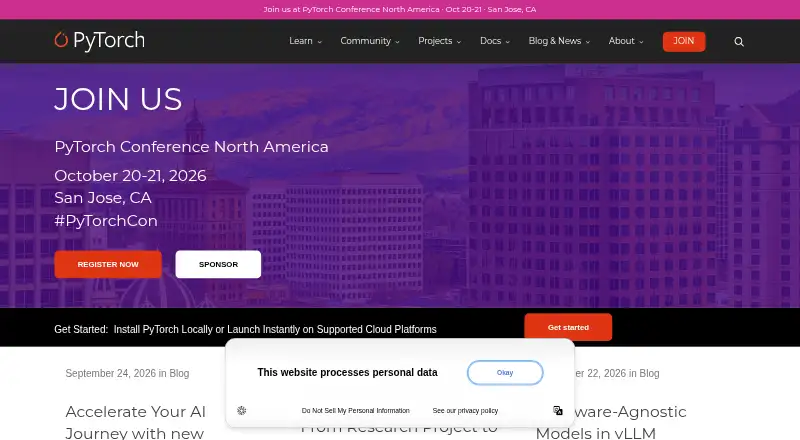
PyTorch is a free, end-to-end machine learning framework for experimentation and production. It provides Python and C++ front ends, distributed training with asynchronous collective operations and peer-to-peer communication, and tools for moving models into deployment. TorchScript can transition models from eager execution to graph mode for C++ runtime environments. TorchServe supports multi-model serving, logging, metrics, and REST endpoints. Models can be exported in ONNX format for compatible platforms, runtimes, and visualizers. The site describes an experimental path for deploying models from Python to iOS and Android, plus cloud quick starts for AWS, Google Cloud Platform, Microsoft Azure, Lightning Studios, and Alibaba Cloud. Installation options cover Linux, Mac, and Windows, with CPU, CUDA, and ROCm choices. The latest stable release requires Python 3.10 or later.
Who it suits
PyTorch suits developers, researchers, and enterprises building or deploying AI across desktop, cloud, mobile, API, and self-hosted environments. It supports both experimentation and production workflows.
What it does well
- Free plan with broad platform coverage
- Python and C++ front ends
- Distributed training support
- TorchServe deployment and REST endpoints
- ONNX and TorchScript model formats
What to know first
- Latest stable release requires Python 3.10 or later
- Preview builds are not fully tested or supported
- Mobile deployment workflow is described as experimental
- No free trial is offered
Verdict
PyTorch covers model development, distributed training, export, and serving in one framework. Its many deployment targets and hardware choices suit teams that need control across research and production.
Facts from PyTorch's own pages
- Build maturity
- Stable builds are described as the most tested and supported, while preview builds are nightly and not fully tested or supported. · pytorch.org, 30 Sept 2026
- C++ frontend
- The C++ frontend is intended for research in high-performance, low-latency, and bare-metal C++ applications. · pytorch.org, 30 Sept 2026
- Cloud integrations
- The site lists AWS, Google Cloud, Microsoft Azure, Lightning Studios, and Alibaba Cloud as cloud options. · pytorch.org, 30 Sept 2026
- Distributed training
- PyTorch provides asynchronous collective operations and peer-to-peer communication through Python and C++ interfaces. · pytorch.org, 30 Sept 2026
- Ecosystem
- The site identifies Captum, PyTorch Geometric, and skorch as ecosystem projects or tools. · pytorch.org, 30 Sept 2026
- Governance
- The PyTorch Foundation is hosted by the Linux Foundation and describes itself as a vendor-neutral home for open-source AI projects. · pytorch.org, 30 Sept 2026
- Hardware
- The installer lists CPU, CUDA, and ROCm compute platform options. · pytorch.org, 30 Sept 2026
- Installation platforms
- The local installer offers Linux, Mac, and Windows options and lists CPU, CUDA, and ROCm compute choices. · pytorch.org, 30 Sept 2026
- Install requirement
- The Get Started page says the latest stable PyTorch requires Python 3.10 or later. · pytorch.org, 30 Sept 2026
- Languages
- PyTorch offers Python and C++ front ends, and the installer lists Python and C++/Java language choices. · pytorch.org, 30 Sept 2026
- Mobile
- The site describes an experimental workflow for deploying PyTorch models from Python to iOS and Android. · pytorch.org, 30 Sept 2026
- Model deployment
- TorchServe supports multi-model serving, logging, metrics, and REST endpoints for deploying PyTorch models. · pytorch.org, 30 Sept 2026
- Model export
- PyTorch supports exporting models in the ONNX format for use with compatible platforms and runtimes. · pytorch.org, 30 Sept 2026
- Model serving
- TorchServe supports deploying PyTorch models at scale, including multi-model serving, logging, metrics, and REST endpoints. · pytorch.org, 30 Sept 2026
- ONNX
- PyTorch can export models in ONNX format for use with ONNX-compatible platforms, runtimes, and visualizers. · pytorch.org, 30 Sept 2026
- Organization
- The PyTorch Foundation is hosted by the Linux Foundation and describes itself as a vendor-neutral home for open-source AI projects. · pytorch.org, 30 Sept 2026
- Production
- TorchScript supports transitioning from eager mode to graph mode for speed, optimization, and functionality in C++ runtime environments. · pytorch.org, 30 Sept 2026
- Purpose
- PyTorch enables fast, flexible experimentation and efficient production through a user-friendly front end, distributed training, and an ecosystem of tools and libraries. · pytorch.org, 30 Sept 2026
- Requirements
- The site says the latest stable PyTorch requires Python 3.10 or later. · pytorch.org, 30 Sept 2026
- Security governance
- The Foundation says its Governing Board oversees Foundation activities and links to a Foundation Code of Conduct. · pytorch.org, 30 Sept 2026
- Support
- The Foundation directs users with technical questions to the PyTorch discussion community. · pytorch.org, 30 Sept 2026
- What it does
- PyTorch is an end-to-end machine learning framework for fast experimentation and production. · pytorch.org, 30 Sept 2026
- Who it is for
- The Foundation says its open-source projects serve developers, researchers, and enterprises building and deploying AI. · pytorch.org, 30 Sept 2026
Where PyTorch stands on Freedom251
- Deep Learning Software#28 of 35