Freedom251 › AI LLM Evaluation Tools
Pydantic Evals
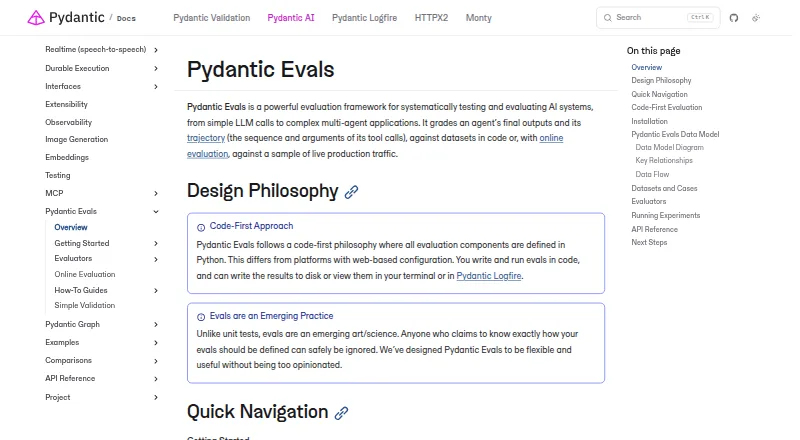
What Pydantic Evals is
Pydantic Evals is a free, self-hosted Python framework for evaluating AI systems, from individual language-model calls to multi-agent applications. It grades final outputs and tool-call trajectories against datasets or sampled live production traffic. Datasets can group cases with inputs, expected outputs, metadata, and case-specific evaluators. Evaluation components can be defined in Python or loaded as serialized data, and reports can be printed, stored, serialized, or sent to other applications. The framework includes deterministic evaluators and supports custom evaluators, LLM judges, and checks that return assertions, scores, or labels. Built-in examples cover tool and argument correctness, trajectory matching, and limits on tool calls or model requests. Evaluators can run in the background on every production or staging call, or on a sample. Optional Logfire integration supports visualization and comparison, and OpenTelemetry traces can be used in evaluations. Ragas and DeepEval adapters are optional dependencies. Installation uses pip or uv; the package does not depend on pydantic-ai. LLM judges can take seconds, cost money, and produce non-deterministic results, while deterministic evaluators are described as having no cost.
Who it suits
Pydantic Evals suits Python users who want to evaluate model outputs or agent tool-use paths against datasets or production traffic. It can also suit teams that need background evaluation on production or staging calls.
What it does well
- Free and self-hosted.
- Evaluates final outputs and tool-call trajectories.
- Supports deterministic checks, custom evaluators, and LLM judges.
- Can grade every production call or a sampled subset.
What to know first
- LLM judges can take seconds and cost money.
- LLM judge results can be non-deterministic.
- Ragas and DeepEval adapters require optional dependencies.
Verdict
Pydantic Evals provides a code-first way to check AI outputs and agent behavior, including against live traffic. Deterministic checks avoid the stated cost of LLM judges, which can be slower and non-deterministic.
Facts from Pydantic Evals's own pages
- Agent behavior checks
- Built-in evaluator examples cover tool correctness, trajectory matching, argument correctness, maximum tool calls, and maximum model requests. · pydantic.dev, 29 Sept 2026
- Code-first workflow
- Evaluation components are defined in Python, and experiment reports can be printed, serialized, or viewed in Pydantic Logfire. · pydantic.dev, 30 Sept 2026
- Cost consideration
- LLM-as-a-judge evaluations can take seconds, cost money, and produce non-deterministic results; deterministic evaluators are described as having no cost. · pydantic.dev, 29 Sept 2026
- Costs and tradeoffs
- LLM judges can be slower, cost money, be non-deterministic, and have biases. · pydantic.dev, 30 Sept 2026
- Datasets and cases
- Datasets group test cases, which can include inputs, expected outputs, metadata, and case-specific evaluators. · pydantic.dev, 30 Sept 2026
- Dependencies
- Pydantic Evals does not depend on pydantic-ai, and Logfire is optional. · pydantic.dev, 29 Sept 2026
- Evaluators
- It includes built-in deterministic evaluators and supports custom evaluators, LLM judges, and evaluators that return assertions, scores, or labels. · pydantic.dev, 29 Sept 2026
- Evaluator types
- Evaluators include deterministic checks, LLM judges, span-based and agentic evaluators, and custom evaluators. · pydantic.dev, 30 Sept 2026
- Installation
- The package installs with `pip install pydantic-evals` or `uv add pydantic-evals`. · pydantic.dev, 30 Sept 2026
- Logfire integration
- Logfire is an optional dependency for using OpenTelemetry traces in evaluations or sending evaluation results to Logfire. · pydantic.dev, 30 Sept 2026
- Maker
- Pydantic describes itself as a remote-first company. · pydantic.dev, 30 Sept 2026
- Online evaluation
- Evaluators can run in the background on every production or staging call, or on a sampled subset of traffic. · pydantic.dev, 30 Sept 2026
- Production evaluation
- Online evaluation can attach evaluators to production or staging traffic so every call or a sampled subset is graded in the background. · pydantic.dev, 29 Sept 2026
- Purpose
- Pydantic Evals tests and evaluates AI systems, from simple LLM calls to complex multi-agent applications. · pydantic.dev, 30 Sept 2026
- Related service security
- Pydantic says Logfire is SOC 2 Type 2 audited, GDPR aligned, and can support HIPAA workloads under a signed Business Associate Agreement. · pydantic.dev, 30 Sept 2026
- Security
- Pydantic’s Logfire security page states that it has SOC 2 Type 2 audited controls, GDPR compliance, and HIPAA support under a signed Business Associate Agreement. · pydantic.dev, 29 Sept 2026
- Third-party integrations
- The documentation shows adapters for Ragas and DeepEval, which are optional dependencies and are not installed with Pydantic Evals. · pydantic.dev, 30 Sept 2026
- What it evaluates
- It can grade an agent’s final outputs and tool-call trajectory against datasets or sampled live production traffic. · pydantic.dev, 30 Sept 2026
Where Pydantic Evals stands on Freedom251
- AI LLM Evaluation Tools#27 of 30