Freedom251 › Property-Based Testing Tools
PropCheck
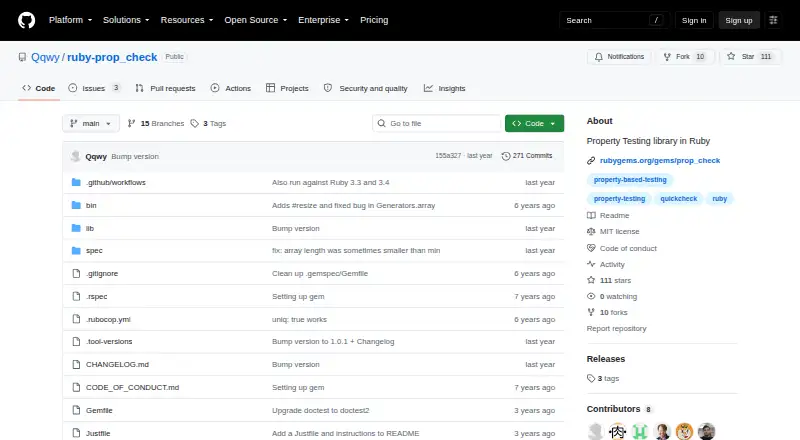
What PropCheck is
PropCheck is a free Ruby library for property-based testing: it generates inputs and checks whether assertions hold across them. When a generated example fails, the library tries to reduce it to a minimal counterexample. Its built-in generators cover integers, floats, strings, symbols, arrays, hashes, sets, dates, times, and datetimes. Developers can define additional generators with a DSL; the API supports mapping, binding, choosing alternatives, and weighted frequency selection. Before, after, and around hooks handle setup and cleanup for generated examples. The README includes usage examples with RSpec, MiniTest, test-unit, and vanilla Ruby, and says the gem has no external dependencies. PropCheck requires Ruby 2.5.1 or later and is released under the MIT License. It is free, with a Community library plan at no cost. Install it through a Gemfile or with `gem install prop_check`. For generated tests involving a database, the README recommends cleaning database state around each example and mentions DatabaseCleaner.
Who it suits
PropCheck suits Ruby developers who want to check assertions against generated inputs in RSpec, MiniTest, test-unit, or vanilla Ruby. It can also suit projects needing custom generators or hooks around generated examples.
What it does well
- Built-in generators cover common Ruby data types.
- Failing cases are reduced to counterexamples.
- Custom generators can be defined with a DSL.
- No external dependencies are required.
- Free under the MIT License.
What to know first
- Requires Ruby 2.5.1 or later.
- Stateful property testing is described as a possible future add-on.
- Several project items are listed as unfinished before v1.0.
Limits
The project lists finalizing the testing DSL, configurable sample counts and filtering generators among items unfinished before v1.0. Stateful property testing is described as a possible future separate add-on library.
Plans
| Plan | Billed and limits | Price |
|---|---|---|
| Community library | MIT licensed Ruby gem · requires Ruby >= 2.5.1 | Free |
As github.com lists them, read 8 Oct 2026. The maker's own page has the final word.
Getting started
- Open the project website on GitHub.
- Make sure your Ruby version is 2.5.1 or later.
- Add `gem 'prop_check'` to your Gemfile, or install it with `gem install prop_check`.
- Use the examples for RSpec, MiniTest, test-unit or vanilla Ruby.
- If generated examples use a database, clean database state around each example.
PropCheck is a free Ruby library for property-based testing, generating inputs and checking whether assertions hold across them. It is best suited to Ruby developers who want this style of testing inside RSpec, MiniTest, test-unit, or plain Ruby. The combination of custom generators, shrinking, and test hooks is useful, but teams should be comfortable with Ruby 2.5.1 or newer and a project whose roadmap still has unfinished items.
Overview
PropCheck exercises properties over many generated cases rather than relying only on hand-picked examples. It runs as a Ruby gem with no external dependencies, and its MIT License permits use in projects that need a permissive open-source component. Installation is either a prop_check Gemfile entry or gem install prop_check.
The practical appeal is focus: Ruby teams can add generated-input checks without moving to another language or test ecosystem. The trade-off is maturity. The README still identifies work such as finalizing the testing DSL, configurable sample counts, and generator filtering as unfinished before version 1.0.2, so it is less compelling for workflows that demand extensive configuration today.
Key features
Generators and custom input design
Built-in generators cover integers, floats, strings, symbols, arrays, hashes, sets, dates, times, and datetimes. That range handles common data-oriented properties without writing every input source yourself. For domain-specific cases, the generator API supports mapping, binding, choosing between alternatives, and weighted frequency selection. These controls let a team shape realistic or deliberately varied inputs, although the usefulness depends on the quality of the generators it defines.
Shrinking and lifecycle hooks
When a generated case fails, PropCheck attempts to simplify it to a minimal counterexample. Smaller failures are generally easier to reproduce and diagnose than a large random value, making shrinking one of the strongest reasons to use the library. Before, after, and around hooks provide setup and cleanup around each generated example. Database-backed tests need careful isolation: the README recommends cleaning database state around every case and mentions DatabaseCleaner.
Framework fit and scope
Examples for RSpec, MiniTest, test-unit, and vanilla Ruby make PropCheck adaptable to several existing test styles. Stateful property testing is described as a possible future separate add-on rather than part of the current scope. That makes PropCheck a good fit for input-focused properties, not a complete answer for state-machine testing.
Pricing
Community library — free
This is a free, MIT-licensed Ruby gem with no paid tiers, seat charges, quotas, or trial expiry to manage. It suits individual developers and teams that want property-based testing without a software budget or subscription commitment. The value is strongest when Ruby is already your language; choosing it does not remove the Ruby 2.5.1-or-later requirement.
Platforms
PropCheck supports Ruby on Linux and is self-hosted. It is not presented as a hosted testing service, so execution remains in your own development or build environment. Supported test runners are RSpec, MiniTest, and test-unit, with vanilla Ruby usage also documented.
Who it's for
Choose PropCheck when a Ruby codebase needs broad generated-input coverage, useful counterexample reduction, and lifecycle hooks around each case. It is particularly suitable for teams already using one of its documented test frameworks and willing to define custom generators for domain data.
Look elsewhere if you need stateful property testing now, a finished highly configurable DSL, or support for a language other than Ruby. Projects pinned below Ruby 2.5.1 are also outside its requirement.
Pros and cons
Pros
- Free and permissively licensed: the MIT License and zero-price plan remove procurement and redistribution friction.
- Useful failure reduction: shrinking aims to turn complicated generated failures into minimal counterexamples.
- Broad Ruby integration: documented RSpec, MiniTest, test-unit, and vanilla Ruby usage avoids forcing a new runner.
- Flexible generator API: mapping, binding, alternatives, and weighted selection support domain-specific input strategies.
- No external dependencies: the library can be added without another dependency stack.
Cons
- Unfinished configuration work: the README still calls out DSL finalization, sample-count configuration, and generator filtering.
- Ruby-only and self-hosted: teams using another language or seeking a hosted service need a different tool.
- No current stateful add-on: stateful property testing is reserved as a possible future separate library.
- Database isolation remains your responsibility: generated database examples require cleanup around each case.
Alternatives
For Ruby teams, PropCheck is the directly relevant choice in this group. Choose Racket QuickCheck instead for Racket on Linux, macOS, or Windows. ScalaCheck fits Scala projects across those desktop platforms, while FsCheck suits .NET users who prefer NuGet packages.
fast-check is the alternative for JavaScript and TypeScript workflows, including web or API use. Gopter is a free Go package for Linux or self-hosted setups. JavaScript teams can also consider JSVerify; OCaml developers should look at QCheck. Scala Hedgehog is another open-source Scala option for Linux.
For a wider comparison before deciding, browse Property-Based Testing Tools.
Verdict
PropCheck is a strong pick for Ruby developers who want free, self-hosted property-based testing with shrinking, customizable generators, and hooks that fit established test runners. Its main reason to look elsewhere is project maturity: unfinished configuration work and the absence of current stateful testing make more settled or language-specific alternatives preferable for advanced workflows.
Verdict
PropCheck combines generated-input testing with shrinking, hooks, and integrations for several Ruby test frameworks. Check its Ruby requirement and the listed unfinished project items before adopting it.
Questions
How much does PropCheck cost?
It is free. The Community library plan is free.
Which Ruby version does it require?
Ruby 2.5.1 or later.
Which test frameworks can use it?
The README gives usage examples with RSpec, MiniTest, test-unit and vanilla Ruby.
Does PropCheck shrink failing cases?
Yes. It attempts to simplify a failing generated case to a minimal counterexample.
Is PropCheck open source?
It is released under the MIT License.
How do I install it?
Add `gem 'prop_check'` to a Gemfile or run `gem install prop_check`.
Facts from PropCheck's own pages
- Current published version
- RubyGems lists version 1.0.2, released March 14, 2025. · rubygems.org, 8 Oct 2026
- Custom generators
- Its generator API includes mapping, binding, choosing among alternatives, and weighted frequency selection. · github.com, 8 Oct 2026
- Database usage
- For generated examples that use a database, the README recommends cleaning database state around each example and mentions the DatabaseCleaner gem. · github.com, 8 Oct 2026
- Dependencies
- The README says PropCheck requires no external dependencies. · github.com, 8 Oct 2026
- Generator coverage
- Listed built-in generators cover integers, floats, strings, symbols, arrays, hashes, sets, dates, times, and datetimes. · github.com, 8 Oct 2026
- Generators
- It includes generators for common Ruby data types and a DSL for defining custom generators. · github.com, 8 Oct 2026
- Hooks
- PropCheck provides before, after, and around hooks for setup and cleanup around generated examples. · github.com, 8 Oct 2026
- Installation
- The README says to add `gem 'prop_check'` to a Gemfile or install it with `gem install prop_check`. · github.com, 8 Oct 2026
- License
- The project is released under the MIT License. · github.com, 8 Oct 2026
- Project status
- The README lists several items as unfinished before v1.0, including finalizing the testing DSL, configurable sample counts, and filtering generators. · github.com, 8 Oct 2026
- Purpose
- PropCheck is a Ruby library for property-based testing that checks assertions against generated inputs. · github.com, 8 Oct 2026
- Ruby requirement
- The gem requires Ruby version 2.5.1 or later. · rubygems.org, 8 Oct 2026
- Shrinking
- When a generated case fails, PropCheck attempts to simplify it to a minimal counterexample. · github.com, 8 Oct 2026
- Stateful testing
- The README lists stateful property testing as a possible future separate add-on library. · github.com, 8 Oct 2026
- Support and contributions
- The README invites bug reports and pull requests on GitHub. · github.com, 8 Oct 2026
- Test framework integrations
- The README gives usage examples with RSpec, MiniTest, test-unit, and vanilla Ruby. · github.com, 8 Oct 2026
- Test hooks
- It provides hooks for setup and cleanup around generated example cases. · github.com, 8 Oct 2026
- What it does
- PropCheck is a Ruby library for property-based testing that generates inputs and checks whether assertions hold across them. · github.com, 8 Oct 2026
Where PropCheck stands on Freedom251
- Property-Based Testing Tools#8 of 28