Freedom251 › Low-Code Development Platforms
Portofino
What Portofino is
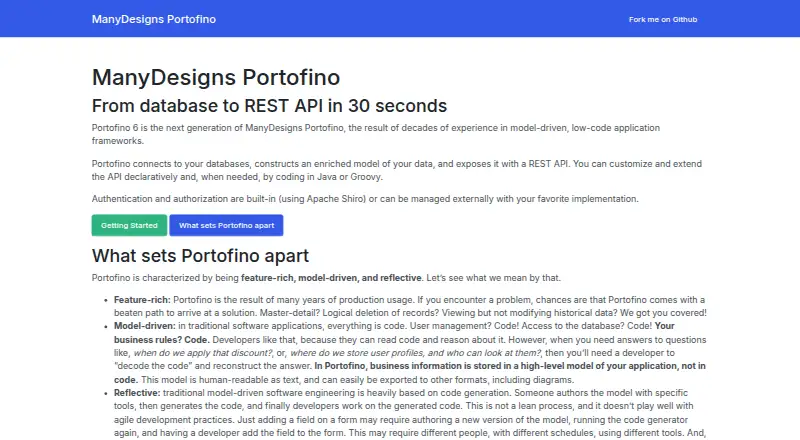
Portofino is a free, open-source framework for developers building database-backed APIs and service-oriented business applications. It connects to databases, creates an enriched data model and exposes data through REST APIs. Built-in access supports multi-field search and create, read, update and delete operations, with validation for changes. Developers can configure APIs declaratively or extend them with Java or Groovy. Its human-readable application model can be authored in the application or through command-line and GUI tools; Portofino reads that model at runtime rather than generating code from it. Authentication and authorization can use Apache Shiro or an external implementation. The framework can expose a legacy database through an API and deploy as a Spring Boot application without modifying the legacy code. Built on Spring and Hibernate, it is designed for microservices environments and supports self-hosting. Portofino 6 has no built-in UI, though the project lists Portofino Angular UI and portofino-react-admin as ready-made options. ManyDesigns creates and maintains the framework; its listed headquarters are in Genova, Italy.
Who it suits
Portofino suits developers building APIs and service-oriented business applications, including those working with legacy databases. It is particularly relevant when a self-hosted framework and Java or Groovy customization fit the project.
What it does well
- Open-source framework available at no cost
- Supports multi-field search and CRUD operations
- Can expose legacy databases without changing legacy code
- API customization supports Java or Groovy
- Self-hosted deployment
What to know first
- Portofino 6 has no built-in UI
- Extending APIs may require Java or Groovy code
Limits
Portofino 6 does not include a built-in UI. The project lists Portofino Angular UI and portofino-react-admin as ready-made UI options.
Plans
| Plan | Billed and limits | Price |
|---|---|---|
| Portofino 6 | Open-source framework | Free |
As manydesigns.github.io lists them, read 11 Oct 2026. The maker's own page has the final word.
Getting started
- Open the Portofino project website
- Use the free Portofino 6 open-source framework
- Author the application model in the app or with command-line and GUI tools
- Connect a database
- Configure REST API behavior declaratively or with Java or Groovy
- Set authentication and authorization with Apache Shiro or an external implementation
- Deploy as a self-hosted Spring Boot application
Verdict
Portofino offers database access, API customization and authentication options in a self-hosted open-source framework. Its lack of a built-in UI means teams should consider the separately listed UI options.
Questions
How much does Portofino cost?
Portofino 6 is listed as free as an open-source framework.
Is Portofino open source?
Yes. ManyDesigns describes Portofino as an open-source web framework it created and maintains.
What databases can Portofino work with?
Portofino connects to databases and can expose a legacy database through a REST API without changing the legacy code.
Does Portofino include a user interface?
Portofino 6 has no built-in UI. Portofino Angular UI and portofino-react-admin are listed as ready-made options.
How are authentication and authorization handled?
They can use built-in Apache Shiro or an external implementation.
Where is Portofino deployed?
Portofino supports self-hosted deployment and can run as a Spring Boot application.
Facts from Portofino's own pages
- Authentication
- Authentication and authorization can use built-in Apache Shiro or an external implementation. · manydesigns.github.io, 11 Oct 2026
- Customization
- You can customize APIs declaratively or extend them with Java or Groovy code. · manydesigns.github.io, 11 Oct 2026
- Database API
- Built-in data access supports multi-field search and create, read, update, and delete operations, with validation for data changes. · manydesigns.github.io, 11 Oct 2026
- Headquarters
- Genova, Italy · manydesigns.github.io, 28 Sept 2026
- Integrations
- Portofino exposes REST APIs that any REST client can consume; the site also lists portofino-commander and portofino-js client libraries. · manydesigns.github.io, 11 Oct 2026
- Legacy systems
- Portofino can expose a legacy database through a REST API and deploy it as a Spring Boot application without changing the legacy code. · manydesigns.github.io, 11 Oct 2026
- Maker
- ManyDesigns says it created and maintains Portofino, an open-source web framework. · manydesigns.com, 11 Oct 2026
- Model
- Its human-readable application model can be authored in the application or through command-line and GUI tools, and is consulted at runtime rather than used for code generation. · manydesigns.github.io, 11 Oct 2026
- Purpose
- Portofino connects to databases, builds an enriched data model, and exposes the data through a REST API. · manydesigns.github.io, 11 Oct 2026
- Security
- The project site says authentication and authorization are built in through Apache Shiro or can be managed with an external implementation. · manydesigns.github.io, 11 Oct 2026
- Support
- The project site provides a mailing list contact at [email protected]. · manydesigns.github.io, 11 Oct 2026
- Target users
- The site describes it as a tool for developers building APIs and service-oriented business applications, including applications based on legacy databases. · manydesigns.github.io, 11 Oct 2026
- Technology
- The framework is built on Spring and Hibernate and is designed for microservices environments. · manydesigns.github.io, 11 Oct 2026
- UI
- Portofino 6 has no built-in UI; the site lists Portofino Angular UI and portofino-react-admin as ready-made options. · manydesigns.github.io, 11 Oct 2026
Where Portofino stands on Freedom251
- Low-Code Development Platforms#25 of 56