Plop
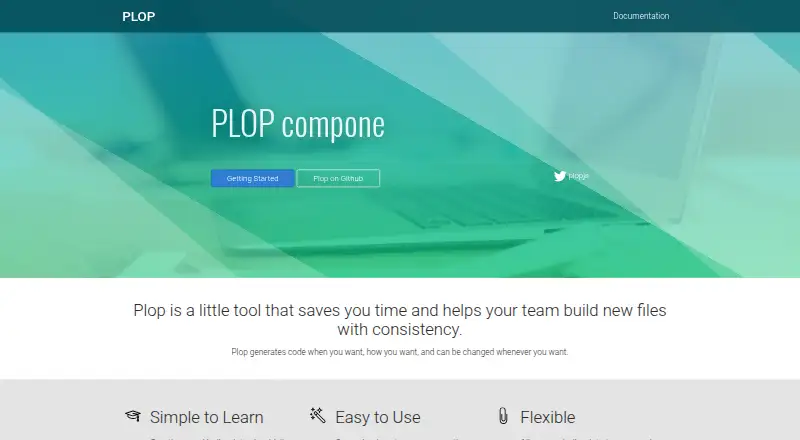
What Plop is
Plop is a free, MIT-licensed micro-generator framework for producing code and other flat text files from repeatable patterns. You define generators in a plopfile, then use the command line to list generators or run one by name with `plop`. Generators can ask questions through Inquirer prompts and apply responses to Handlebars templates. Built-in actions add one or many files, modify existing files, or append content. Developers can register custom action types and supply custom action functions. Helpers include case conversions such as camelCase, snakeCase, dashCase, and titleCase. Plop supports project scaffolding and custom templates, with documented language examples including HTML, CSS, JavaScript, CSharp, and Objective C. TypeScript declarations are bundled, and TypeScript plopfiles are documented. An `add` action fails when its destination exists unless a force option permits overwriting. npm installation is documented for project development dependencies, with global installation optional. The homepage credits Andrew Worcester.
Who it suits
Plop suits development teams that want generators based on shared file patterns and current practices. It also fits developers building command-line scaffolding workflows with custom templates or actions.
What it does well
- Free and open source
- Built-in file creation and modification actions
- Custom actions and templates supported
- TypeScript declarations included
- Command-line generator workflow
What to know first
- Documentation is described as a work in progress
- Global installation is optional, not standard
- Existing files block add actions by default
Verdict
Plop provides a focused way to turn repeatable project patterns into generators. Its prompts, templates, file actions, and extension points cover both simple scaffolding and customized workflows.
Facts from Plop's own pages
- Command line
- Plop runs from the terminal and can list generators or run one by name. · plopjs.com, 10 Oct 2026
- Custom actions
- Developers can register custom action types and use action functions, including asynchronous functions. · plopjs.com, 10 Oct 2026
- Documentation status
- The documentation says it is a work in progress and invites users to share ideas. · plopjs.com, 10 Oct 2026
- File actions
- Built-in actions can add one or many files, modify files, and append content. · plopjs.com, 5 Oct 2026
- Generated files
- A generator can ask questions and perform actions such as adding, modifying, or appending files. · plopjs.com, 10 Oct 2026
- Installation
- The documentation shows installing Plop as a project development dependency or globally with npm. · plopjs.com, 10 Oct 2026
- License
- The project repository identifies its license as MIT. · github.com, 10 Oct 2026
- Maker
- The homepage copyright line credits Andrew Worcester. · plopjs.com, 10 Oct 2026
- Overwrite behavior
- By default, an add action fails instead of overwriting an existing file; a force option can enable overwriting. · plopjs.com, 10 Oct 2026
- Prompts and templates
- Plop connects Inquirer prompts with Handlebars templates. · plopjs.com, 10 Oct 2026
- Purpose
- Plop is a micro-generator framework for generating code and other flat text files consistently. · plopjs.com, 10 Oct 2026
- Team use
- Generators let teams create files using patterns that represent their current best practices. · plopjs.com, 10 Oct 2026
- Template helpers
- Built-in helpers include case conversions such as camelCase, snakeCase, dashCase, and titleCase. · plopjs.com, 10 Oct 2026
- TypeScript
- Plop bundles TypeScript declarations and documents TypeScript plopfiles, with Node.js v22.18+ supporting them without extra setup. · plopjs.com, 10 Oct 2026
- Workflow
- Users define generators in a plopfile and run them from the terminal by typing `plop`. · plopjs.com, 5 Oct 2026
Where Plop stands on Freedom251
- Code Generators#32 of 33