Freedom251 › Product Information Management Software
PIMinto
by PIMinto
What PIMinto is
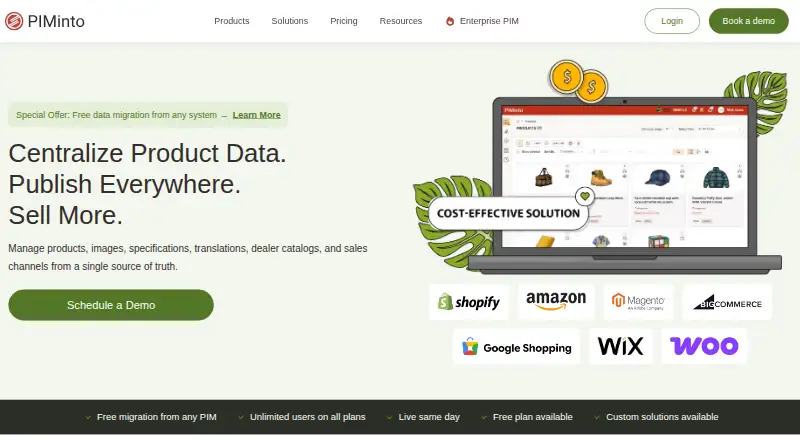
PIMinto is a product information management platform for organizing product data and publishing it to sales channels such as Shopify, WooCommerce, Amazon, Magento, marketplaces, and custom storefronts. It imports data from CSV and Excel files, APIs, ERP systems, supplier feeds, or another PIM. Teams can manage product information with data quality rules, digital asset management, workflows, approvals, and multilingual support. Role-based permissions control who can view, edit, and publish data, while brand portals let dealers, partners, and customers access shared information. Its AI assistant can create descriptions, translate content, and automate repetitive data tasks. Plans include unlimited users and outputs, with capacity and features varying by plan. The free Starter plan includes 1 GB of storage and 1,000 SKUs. Essentials costs $300 a month and includes 10,000 SKUs, 30 GB of storage, and one brand portal. A 30-day trial and free migration are listed; the company says most migrations take one to two weeks with zero downtime. PIMinto is available on web, iOS, and Android.
Who it suits
PIMinto suits businesses managing product information across multiple sales channels, especially teams that need permissions, approvals, or shared brand portals. Its web, iOS, and Android availability may suit teams working across devices.
What it does well
- Publishes to major storefronts and marketplaces.
- Imports from files, APIs, ERP systems, and feeds.
- Role-based permissions and workflows support team controls.
- Includes multilingual support and AI-assisted translations.
- Subscriptions include unlimited users and outputs.
What to know first
- Starter limits storage to 1 GB.
- Starter includes 1,000 SKUs.
- Essentials starts at $300 a month.
Limits
Starter includes 1,000 SKUs and 1 GB of storage. Essentials, the listed $300-per-month paid plan, includes 10,000 SKUs, 30 GB of storage, and one brand portal.
Plans
| Plan | Billed and limits | Price |
|---|---|---|
| Starter | billed monthly · 1,000 SKUs · 1 GB storage | Free |
| Essentials | billed monthly · 10,000 SKUs · 30 GB storage · 1 brand portal | $300 a month |
| Premium | billed monthly · 50,000 SKUs · 100 GB storage · 5 brand portals | $600 a month |
| Super | billed monthly · 120,000 SKUs · 1.2 TB storage · 10 brand portals | $950 a month |
| Extreme | 1,000,000 SKUs | On request |
As piminto.com lists them, read 28 Sept 2026. The maker's own page has the final word.
Getting started
- Open the PIMinto website.
- Choose the Starter plan or review the paid plans by SKU capacity and required features.
- Import product data from CSV, Excel, an API, an ERP system, a supplier feed, or another PIM.
- Set role-based permissions for viewing, editing, and publishing product data.
- Connect publishing destinations, including Shopify, WooCommerce, Amazon, Magento, marketplaces, or a custom storefront.
- Use the web, iOS, or Android platform.
Overview
PIMinto is a product information management platform for organizing catalog data and sending it to commerce channels. It is a strong fit for retail teams that need permissions, approvals, and partner access alongside catalog publishing. Unlimited users and outputs are meaningful advantages; SKU and storage limits, plus paid plans starting at $300 per month, set a clear cost of scaling.
Key features
Product data can be imported from CSV or Excel files, APIs, ERP systems, supplier feeds, or another PIM. Data quality rules, multilingual support, digital asset management, and approval workflows help teams keep product records consistent before publication. Role-based permissions let administrators distinguish who can view, edit, and publish, while brand portals share catalog data with dealers, partners, and customers.
PIMinto publishes to Shopify, WooCommerce, Amazon, Magento, marketplaces, and custom storefronts. Built-in Shopify and BigCommerce connectors and API access give teams several routes to connect their commerce systems. Its AI assistant can draft descriptions, translate content, and automate repetitive data tasks; that can help with routine catalog work, though the plan’s SKU and storage ceilings still determine how much data and media the team can manage.
Free migration covers products, categories, attributes, and images from any system. Most migrations take one to two weeks and are completed with zero downtime, a useful provision for teams moving an established catalog. Systems Online says it has provided corporate eCommerce experience since 1999.
Pricing
Plans are billed monthly and priced by SKU capacity and required features. Every subscription includes unlimited users and outputs, so seat count and channel count do not drive the published tier differences; storage and brand portals do.
| Plan | Price | Included capacity |
|---|---|---|
| Starter | free | 1,000 SKUs, 1 GB storage |
| Essentials | $300 a month | 10,000 SKUs, 30 GB storage, 1 brand portal |
| Premium | $600 a month | 50,000 SKUs, 100 GB storage, 5 brand portals |
| Super | $950 a month | 120,000 SKUs, 1.2 TB storage, 10 brand portals |
| Extreme | Custom pricing | 1,000,000 SKUs, unlimited brand portals, API customization |
Starter is a no-cost way to begin, but its 1,000-SKU and 1 GB storage caps make it a limited home for larger catalogs or media libraries. Essentials raises capacity to 10,000 SKUs and adds a portal, but the jump to $300 a month is substantial. Premium and Super suit progressively larger catalogs and partner networks, with the portal and storage increases explaining much of the higher monthly cost. Extreme is for organizations needing a million SKUs, unlimited portals, or API customization; its price is custom. A 30-day trial is offered.
Platforms
PIMinto is available on web, iOS, and Android. Its publishing destinations include major commerce platforms and marketplaces as well as custom storefronts.
Who it's for
PIMinto suits product teams and retailers coordinating catalog work across channels, languages, and internal or external contributors. It is particularly relevant when approvals, role-based control, partner portals, and migration assistance matter. Teams with small catalogs can start on Starter; those with more than 1,000 SKUs should weigh the paid monthly commitment against their storage and portal needs.
Pros and cons
- Pros: Unlimited users and outputs across subscriptions avoid seat and publishing caps as teams and channels grow.
- Pros: Import options, quality rules, approvals, multilingual support, and asset management cover several stages of catalog operations.
- Pros: Free migration includes product records and images, with most migrations completed in one to two weeks and zero downtime.
- Cons: Starter is capped at 1,000 SKUs and 1 GB of storage, limiting its usefulness for substantial catalogs.
- Cons: The first paid tier costs $300 a month, and higher tiers rise to 600.00 USD and $950 a month.
- Cons: Brand portals are limited to one, five, or ten on the published paid tiers before moving to custom pricing for unlimited portals.
Alternatives
Consider Akeneo PIM if an open-source Community Edition and API, self-hosted, or web deployment better suit your approach. Pimcore offers a free Community Edition for non-production use under EUR/USD 5 million in annual revenue, with a Professional Edition at $9,900 a year. UnoPim is a free option whose Starter Pack supports 10,000 SKUs, 15 GB media storage, three channels, and five locales.
WISEPIM may suit teams seeking a freemium web or extension-based option; its Free plan allows 100 products, 50 AI credits monthly, and three languages. AtroPIM offers a free open-source core that runs on your own infrastructure, making it an alternative for teams that prefer self-hosting. Ergonode has a free plan capped at 1,000 products and two users, with 2 GB DAM storage and 500 AI credits monthly. AesirX PIM is another freemium option. Acquia PIM is another alternative.
Verdict
Choose PIMinto if your retail or product team needs controlled, multilingual catalog publishing, partner portals, and a migration path that preserves continuity. Its unlimited users and outputs make collaboration and channel expansion less constrained, but the 1,000-SKU free ceiling and $300.00 USD monthly entry to paid plans make it a poor fit for teams that need larger capacity on a small budget.
Verdict
PIMinto combines product data management, channel publishing, team controls, and asset handling. The free Starter plan may be a starting point, while higher SKU capacity and added portal features are on paid plans.
Questions
Is there a free plan?
Yes. Starter is free and includes 1,000 SKUs, 1 GB of storage, and unlimited outputs.
How much do paid plans cost?
Essentials is $300 per month, Premium is $600 per month, and Super is $950 per month. Extreme has custom configuration, and its price is not given here.
Is there a free trial?
Yes. PIMinto offers a 30-day trial.
Which platforms does PIMinto support?
PIMinto is available on web, iOS, and Android. It can publish to Shopify, WooCommerce, Amazon, Magento, marketplaces, and custom storefronts.
Can teams control access to product data?
Yes. Role-based permissions control who can view, edit, and publish product data.
What does the migration cover?
Free migration covers products, categories, attributes, and images from any system. Most migrations are completed within one to two weeks with zero downtime.
Facts from PIMinto's own pages
- AI enrichment
- The AI assistant creates descriptions, translates content, and automates repetitive data tasks. · piminto.com, 28 Sept 2026
- Billing basis
- Plans are based on SKU capacity and the features required. · piminto.com, 28 Sept 2026
- Brand portals
- Brand portals let dealers, partners, and customers access shared product data. · piminto.com, 28 Sept 2026
- Company experience
- Systems Online says it has provided corporate eCommerce experience since 1999. · piminto.com, 28 Sept 2026
- Import sources
- Data can be imported from CSV, Excel, APIs, ERP systems, supplier feeds, or another PIM. · piminto.com, 28 Sept 2026
- Data quality rules
- Yes · piminto.com, 22 Sept 2026
- Digital asset management
- PIMinto stores and distributes images, videos, documents, spec sheets, and 3D content. · piminto.com, 28 Sept 2026
- Founded
- 1999 · piminto.com, 28 Sept 2026
- Free plan
- Yes · piminto.com, 22 Sept 2026
- Free plan
- A free Starter plan is available at $0 per month. · piminto.com, 28 Sept 2026
- Free plan limits
- The Starter plan includes 1G storage, unlimited outputs, and 1,000 SKU. · piminto.com, 28 Sept 2026
- Free trial
- PIMinto offers a 30-day free trial with full feature access and no credit card required. · piminto.com, 28 Sept 2026
- Built-in integrations
- The platform provides built-in integrations and API access, including Shopify and BigCommerce connectors. · piminto.com, 28 Sept 2026
- Localization support
- multilingual · piminto.com, 22 Sept 2026
- Free migration
- Free migration covers products, categories, attributes, and images from any system. · piminto.com, 28 Sept 2026
- Migration timeline
- Most migrations are completed within one to two weeks with zero downtime. · piminto.com, 28 Sept 2026
- Supported platforms
- PIMinto can publish to Shopify, WooCommerce, Amazon, Magento, marketplaces, and custom storefronts. · piminto.com, 28 Sept 2026
- Product record limit
- 10000 · piminto.com, 22 Sept 2026
- Paid from
- 300 · piminto.com, 22 Sept 2026
- Team permissions
- Role-based permissions control who can view, edit, and publish product data. · piminto.com, 28 Sept 2026
- Unlimited outputs
- Every subscription plan includes unlimited outputs. · piminto.com, 28 Sept 2026
- Unlimited users
- Every subscription plan includes unlimited users. · piminto.com, 28 Sept 2026
- Workflow and approvals
- Yes · piminto.com, 22 Sept 2026
Where PIMinto stands on Freedom251
- Product Information Management Software#3 of 84
- Catalog Management#5 of 29
- PIM Software#4 of 21