
PATINA
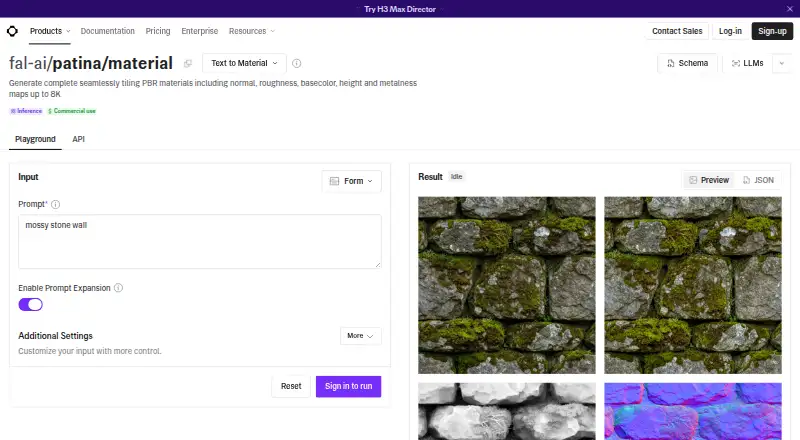
What PATINA is
PATINA is fal.ai’s material-generation model for creating tiling PBR textures from text or image inputs. Text prompts can produce complete materials that upscale to 8K, with basecolor, normal, roughness, metalness, and height maps available. For image-based work, an image URL can be used to make texture variations; an image and mask can instead regenerate white regions while retaining black regions. The endpoint offers tiling in both directions, horizontally, or vertically, and lets you configure tile size and stride. Requests can produce 1–4 texture images and use 1–8 denoising steps. Exports are available as PNG, JPEG, and WebP, and the model listing permits commercial use. The paid service is available through web and API access. Its PATINA material inference plan is billed per request: $0.01 base, plus $0.02 per megapixel and $0.01 per megapixel per map type. Upscaling adds $0.004 or $0.016 per pre-upscaling megapixel per map for 2x or 4x, respectively. fal also offers a related endpoint that extracts material from a photo, flattens it, makes it seamless, and predicts PBR maps.
Who it suits
PATINA suits artists and developers who need tiling materials and PBR maps generated from prompts or image references. Its API examples and commercial-use designation are relevant to teams incorporating generated materials into software or commercial workflows.
What it does well
- Generates materials from text prompts or image URLs.
- Produces five PBR map types.
- Supports configurable seamless tiling directions, size, and stride.
- Upscaling reaches 8K resolution.
- Offers PNG, JPEG, and WebP exports.
- Model listing allows commercial use.
What to know first
- The service is paid per request, with additional map and upscaling charges.
- Prompt expansion is enabled by default and adds approximately $0.0025.
Limits
Each request supports 1–4 texture images and 1–8 denoising steps. Inference costs $0.01 base plus $0.02 per megapixel and $0.01 per megapixel per map type; 2x and 4x upscaling add $0.004 and $0.016 per pre-upscaling megapixel per map, respectively.
Plans
| Plan | Billed and limits | Price |
|---|---|---|
| PATINA material inference | Per request; $0.01 base plus $0.02 per megapixel and $0.01 per megapixel per map type. 2x/4x upscaling adds $0.004/$0.016 per pre-upscaling megapixel per map. · 1K material with all 5 maps: $0.08 · 8K material with all 5 maps and 4x upscaling: $0.61 | On request |
As fal.ai lists them, read 7 Oct 2026. The maker's own page has the final word.
Getting started
- Open the PATINA material page on fal.ai.
- Choose web or API access.
- For API use, follow the JavaScript, Python, or cURL example and authenticate with FAL_KEY.
- Submit a text prompt or provide an image URL; for inpainting, provide an image and mask.
- Set tiling options and request 1–4 texture images with 1–8 denoising steps.
- Choose available maps and export as PNG, JPEG, or WebP.
Verdict
Choose PATINA if your workflow needs text- or image-driven tiling textures, PBR maps, and resolution up to 8K. Its API examples and commercial-use designation may suit integration and commercial production. Look elsewhere if the per-request and per-map charges do not fit your workflow.
Questions
How is PATINA priced?
Material inference is billed per request: $0.01 base, plus $0.02 per megapixel and $0.01 per megapixel per map type. 2x and 4x upscaling add $0.004 and $0.016 per pre-upscaling megapixel per map.
What platforms does PATINA support?
The listed platforms are web and API.
Which PBR maps can it generate?
The available maps are basecolor, normal, roughness, metalness, and height.
Can PATINA be used commercially?
The model listing is marked for commercial use.
What formats can I export?
PNG, JPEG, and WebP are listed.
How can developers connect to the API?
The API page provides JavaScript, Python, and cURL examples and uses a FAL_KEY environment variable for authentication.
Facts from PATINA's own pages
- Commercial use
- The model listing is marked for commercial use. · fal.ai, 7 Oct 2026
- Dataset
- fal says PATINA's training dataset was built from CC0 material libraries including AmbientCG, Poly Haven, and other public-domain sources. · blog.fal.ai, 7 Oct 2026
- Developer access
- The API page provides JavaScript, Python, and cURL examples and uses a FAL_KEY environment variable for authentication. · fal.ai, 7 Oct 2026
- Generation limits
- The endpoint supports 1–4 texture images per request and 1–8 denoising steps. · fal.ai, 7 Oct 2026
- Inpainting
- An input image and mask can be used to regenerate white mask regions while preserving black regions. · fal.ai, 7 Oct 2026
- Maker background
- fal says it was founded in 2021 and is headquartered in San Francisco. · fal.ai, 7 Oct 2026
- Output maps
- The five available PBR maps are basecolor, normal, roughness, metalness, and height. · fal.ai, 7 Oct 2026
- Prompt controls
- Prompt expansion is enabled by default and adds approximately $0.0025. · fal.ai, 7 Oct 2026
- Related photo workflow
- The material extraction endpoint isolates a material from a photo, flattens it, makes it seamless, and predicts PBR maps. · fal.ai, 7 Oct 2026
- Safety
- The endpoint has an enabled-by-default safety checker option for filtering outputs. · fal.ai, 7 Oct 2026
- Support
- fal lists [email protected] as its contact address. · fal.ai, 7 Oct 2026
- Text to material
- Generates complete, seamlessly tiling PBR materials from text prompts, with upscaling up to 8K. · fal.ai, 7 Oct 2026
- Texture variations
- With an input image URL, the endpoint can create texture variations through image-to-image generation. · fal.ai, 7 Oct 2026
- Tiling controls
- Tiling can be set to both directions, horizontal, or vertical; tile size and stride are configurable. · fal.ai, 7 Oct 2026
Where PATINA stands on Freedom251
- AI Music APIs#15 of 21
- AI Texture Generators#17 of 19