Freedom251 › Data Transformation Tools
pandas
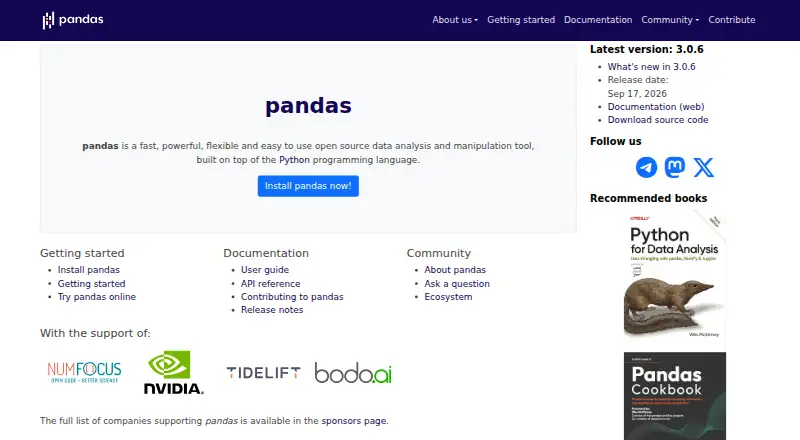
What pandas is
pandas is a free, open-source Python library for data analysis and manipulation. Its DataFrame object supports data work with integrated indexing, while its analysis tools cover filtering, summary statistics, custom aggregation, reshaping, pivoting, joins, and merges. It reads and writes formats including CSV, Excel, SQL, JSON, and Parquet, alongside options such as HDF5, Feather, ORC, and Stata. Time-series features handle dates, times, and time-indexed data, including date ranges and frequency operations. Plotting uses Matplotlib. pandas supports Linux, macOS, and Windows, and can be installed through conda-forge, PyPI, or source code on GitHub. It requires NumPy and python-dateutil; Windows and Pyodide also require tzdata. Some methods need optional dependencies, such as PyTables for HDF5 reading or tabulate for Markdown output. Optional packages can add support for Excel, SQL databases, cloud storage, plotting, and other tasks. Critical code paths use Cython or C. The project is affiliated with the NumFOCUS Foundation and releases its software under a BSD or similar open-source license. Documentation and community tutorials are available, and the site directs questions to Stack Overflow.
Who it suits
pandas suits Python users who need tools to manipulate and analyze data, including tabular and time-series work. It is available on Linux, macOS, and Windows, with some operations requiring optional dependencies.
What it does well
- Free and open source
- DataFrame object includes integrated indexing
- Supports a wide range of formats
- Includes time-series tools and plotting
- Available on Linux, macOS, and Windows
What to know first
- Requires NumPy and python-dateutil
- Windows and Pyodide also require tzdata
- Some methods require optional dependencies
Limits
The library is free and open source. Some methods depend on optional packages; for example, HDF5 reading requires PyTables and Markdown output requires tabulate.
Plans
| Plan | Billed and limits | Price |
|---|---|---|
| pandas | Open-source Python library · Install via conda-forge, PyPI, or source code | Free |
As pandas.pydata.org lists them, read 5 Oct 2026. The maker's own page has the final word.
Getting started
- Visit the pandas website.
- Install pandas through conda-forge or PyPI, or obtain its source code from GitHub.
- Use the library in a Python environment on Linux, macOS, or Windows.
- Install optional dependencies when a method you need requires them.
Verdict
pandas offers a broad set of data manipulation, analysis, and time-series tools as a free Python library. Check its required and optional dependencies for the operations you need.
Questions
How much does pandas cost?
The listed pandas plan costs nothing. The project is open source.
Which operating systems does pandas support?
The documentation describes installation on Linux, macOS, and Windows. The listed platforms also include self-hosted use.
What formats can pandas work with?
It supports formats including CSV, Excel, JSON, Parquet, SQL, HDF5, Feather, ORC, Stata, SAS, and SPSS, among others.
Does pandas support data quality checks?
Yes, data quality checks are listed as supported.
What does pandas require?
It requires NumPy and python-dateutil. tzdata is required on Windows and Pyodide, and some methods need additional optional packages.
Where can I get help with pandas?
The website provides documentation and community tutorials, and directs questions to Stack Overflow.
Facts from pandas's own pages
- Analysis
- It supports filtering, summary statistics, custom aggregation, reshaping, pivoting, joins, and merges. · pandas.pydata.org, 5 Oct 2026
- Data formats
- It reads and writes formats including CSV, Excel, SQL, JSON, and Parquet. · pandas.pydata.org, 5 Oct 2026
- DataFrames
- It provides an efficient DataFrame object for data manipulation with integrated indexing. · pandas.pydata.org, 5 Oct 2026
- Dependencies
- pandas requires NumPy and python-dateutil; tzdata is required on Windows and Pyodide. · pandas.pydata.org, 5 Oct 2026
- Founded
- 2008 · pandas.pydata.org, 28 Sept 2026
- Installation
- The pandas development team distributes it through conda-forge, PyPI, and source code on GitHub. · pandas.pydata.org, 5 Oct 2026
- Integrations
- Optional dependencies add features for Excel, SQL databases, cloud storage such as Amazon S3 and Google Cloud Storage, plotting, and other tasks. · pandas.pydata.org, 5 Oct 2026
- Optional requirements
- Some methods require optional dependencies; for example, reading HDF5 requires PyTables and Markdown output requires tabulate. · pandas.pydata.org, 5 Oct 2026
- Performance
- The library says critical code paths are written in Cython or C. · pandas.pydata.org, 5 Oct 2026
- Project
- The project is affiliated with the NumFOCUS Foundation and releases its software under a BSD or similar open-source license. · pandas.pydata.org, 5 Oct 2026
- Purpose
- pandas is an open-source tool for data analysis and manipulation built on Python. · pandas.pydata.org, 5 Oct 2026
- Support
- The website directs users to ask questions on Stack Overflow and provides documentation and community tutorials. · pandas.pydata.org, 5 Oct 2026
- Supported systems
- The documentation describes installation on Linux, macOS, and Windows. · pandas.pydata.org, 5 Oct 2026
- Time series
- It includes tools for date, time, and time-indexed data, including date-range and frequency operations. · pandas.pydata.org, 5 Oct 2026
- Visualization
- It provides plotting that uses Matplotlib. · pandas.pydata.org, 5 Oct 2026
Where pandas stands on Freedom251
- Data Transformation Tools#20 of 37