Freedom251 › Replenishment Software

pacemaker.ai Replenishment Decision Intelligence
Visit pacemaker.ai Replenishment Decision Intelligence Alternatives
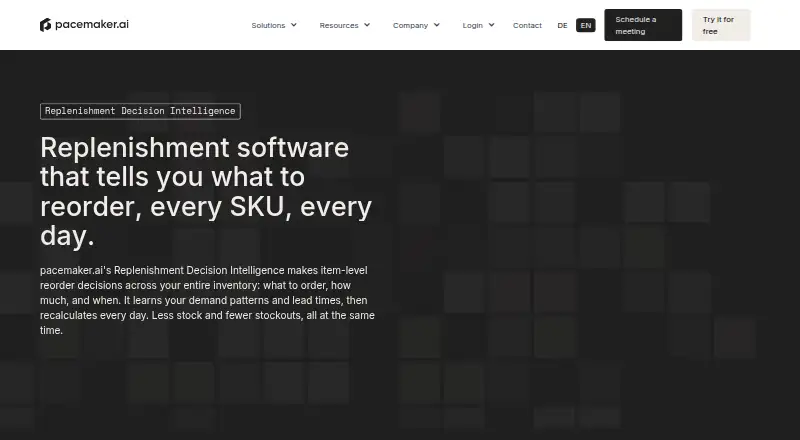
What pacemaker.ai Replenishment Decision Intelligence is
pacemaker.ai Replenishment Decision Intelligence helps manufacturers and other businesses plan replenishment at the item and location level. It produces daily proposals for what to order, in what quantity, and when, then recalculates them as new data arrives. The system uses demand forecasts and order history to plan items and estimate delivery times. Its lead-time forecasts consider supplier, site, and material history, as well as order quantity, port proximity, and holidays. Exception alerts draw attention to items affected by issues such as supplier delays or demand spikes. Planners can examine recommendations in dashboards and simulations, adjust safety stocks or lot sizes, and use the Review Cycle to review materials, edit order quantities, add comments, and move items to a Shopping List. The Review Cycle supports S&OP supply planning. The SaaS service runs in a standard browser and connects through APIs or interfaces to ERP, inventory management, and other enterprise systems. It builds on pacemaker.ai Demand Forecasting. The company says data is processed in the EU and EEA, separated by tenant, and not used to train AI models. A thyssenkrupp Aerospace deployment manages 135,000 sales SKUs and generates more than 550,000 reorder recommendations per day. Pricing is on request, and prospective customers can book a 30-minute demo.
Who it suits
The product is aimed at manufacturers and businesses with complex assortments, seasonal demand, high inventory costs, or critical availability needs. It suits planning teams that want item-level ordering recommendations, lead-time estimates, and controls for reviewing and adjusting proposals.
What it does well
- Generates daily proposals by item and location.
- Forecasts lead times using supplier, site, and material history.
- Alerts planners to supplier delays and demand spikes.
- Lets planners adjust safety stocks and lot sizes.
- Connects to ERP and inventory systems through APIs or interfaces.
- Runs as SaaS in a standard browser.
What to know first
- Pricing is available on request.
- Replenishment decisions build on pacemaker.ai Demand Forecasting.
- The product is listed for API and web platforms.
Getting started
- Visit the pacemaker.ai product page.
- Book a 30-minute product demo or contact the team.
- Use the SaaS service through a standard browser.
- Connect the product to ERP, inventory management, or other enterprise systems through APIs or interfaces.
- Use guided onboarding to begin implementation.
pacemaker.ai Replenishment Decision Intelligence is replenishment planning software for manufacturers managing complex assortments and variable supply. It is best suited to planning teams that need daily item-and-location order proposals and a structured way to review them. Its strength is combining supplier-aware replenishment decisions with planner controls; its main trade-off is dependence on pacemaker.ai Demand Forecasting.
Overview
The service turns demand forecasts into decisions about what to order, how much, and when. It recalculates recommendations daily as new data arrives, with reorder point automation, safety stock planning, and support for multiple locations. That focus makes it a planning layer, not a standalone forecasting choice: buyers need to account for the required pacemaker.ai forecasting input.
It runs as SaaS in a standard browser and needs no customer infrastructure. Guided onboarding and ongoing updates are part of the setup; pacemaker.ai describes go-live as taking weeks rather than months. API connections can link it with ERP, inventory management, and other enterprise systems, making integration fit an important consideration for teams with established workflows.
Key features
Daily proposals and dynamic lead times
Recommendations are generated for individual items and locations. Lead-time forecasts use order history across suppliers, sites, and materials, while also considering order quantity, port proximity, and holidays. This detail can help planners account for changing delivery conditions rather than relying on a fixed lead time. The value of that approach depends on the demand forecasts feeding the ordering decisions.
Exceptions and planner review
Exception-based alerts bring attention to items affected by supplier delays or demand spikes. Dashboards and simulations show the reasoning behind recommendations, and planners can adjust safety stocks or lot sizes. The Review Cycle adds an S&OP supply-planning workflow: teams can review materials, edit quantities, comment, and move items to a Shopping List. These controls make the system more appropriate for organizations that want people to review recommendations, not simply accept automated orders.
Integration, security, and scale
APIs and interfaces connect the service to ERP, inventory management, and other enterprise systems. Pacemaker.ai says data is processed exclusively in the EU and EEA, separated by tenant, and not used to train AI models; it also states that it is ISO 27001 certified. A thyssenkrupp Aerospace deployment manages 135,000 sales SKUs and produces more than 550,000 reorder recommendations per day, a substantial example of the workload the product can support.
Pricing
Pricing is custom, and buyers need to contact pacemaker.ai for a quote. The company offers a 30-minute product demo. There are no published plan tiers or self-serve price points to compare, so this is best approached as an enterprise buying decision rather than a low-commitment software subscription.
Platforms
Pacemaker.ai Replenishment Decision Intelligence is available through the web and API. Its SaaS delivery requires no customer infrastructure, which favors teams seeking browser-based access over a self-hosted deployment.
Who it's for
The clearest fit is manufacturers and businesses with complex assortments, seasonal demand, high inventory costs, or critical availability requirements. Daily item-level recommendations, supplier-sensitive lead times, and review controls address the needs of planners balancing stock investment against service continuity. It is a weaker fit for buyers seeking replenishment planning independent of pacemaker.ai Demand Forecasting or a product with public, self-serve pricing.
Pros and cons
- Pro: Daily proposals cover items and locations, with lead-time forecasts informed by supplier, site, material, and external delivery factors.
- Pro: Alerts, simulations, and the Review Cycle give planners practical ways to investigate, adjust, and document recommendations.
- Pro: SaaS delivery, API connections, and the reported large-scale aerospace deployment make it relevant to complex enterprise environments.
- Con: Replenishment decisions rely on pacemaker.ai Demand Forecasting, so teams need to assess that dependency as part of the purchase.
- Con: Custom pricing requires a sales conversation, which makes direct cost comparison difficult before a demo.
Alternatives
For a wider comparison, start with Replenishment Software. GMDH Streamline is worth considering when a free starting point matters: its Free Edition costs nothing and is capped at US$ 1M in Annual Revenue, 1,000 Planning Items, and 10,000 Annual Sales Quantity. Demandsoft Replenishment Solutions (PRIME One) is another paid web-based option.
LEAFIO AI Replenishment Software may suit buyers seeking a paid web-and-API alternative with custom pricing and a demo-led quote. Retalon Price Management and Optimization is a paid web option with demo-by-request pricing. Blue Ridge Replenishment Optimization is another paid web choice, with buyers directed to book a demo.
Inventory Planner is a paid web-and-API alternative whose custom pricing is based on inventory volume and includes unlimited users at no extra cost. Retano SCM may fit organizations comparing self-hosted and web deployment, with Onprem, SaaS, and subscription purchasing options and component licenses based on item-location, stores, or concurrent workstations. Slimstock Slim4 is a paid self-hosted and web option with a quote based on supply-chain complexity and required functionality.
Verdict
Choose pacemaker.ai Replenishment Decision Intelligence if your team manages complex inventory and needs daily item-level proposals, dynamic delivery estimates, and meaningful planner oversight. Its strongest reason to buy is the combination of supplier-aware recommendations with a formal review workflow. Look elsewhere if you need a replenishment tool independent of pacemaker.ai Demand Forecasting or want to compare published prices before engaging sales.
Verdict
Consider pacemaker.ai Replenishment Decision Intelligence if your planning team needs daily, item-level order proposals and controls for reviewing recommendations. It is designed for complex inventory needs and relies on pacemaker.ai Demand Forecasting as its input. Buyers need to contact the company for pricing and can book a 30-minute demo.
Questions
How much does it cost?
Pricing is on request. The product page directs interested buyers to book a demo.
Which platforms does it support?
The listed platforms are API and web. The SaaS service can be used through a standard browser.
What systems can it connect to?
It connects through APIs or interfaces to ERP systems, inventory management software, and other enterprise systems.
Does it work without demand forecasting?
The product builds on forecasts from pacemaker.ai Demand Forecasting and translates them into ordering and planning decisions.
Where is data processed?
Pacemaker.ai says data is processed exclusively in the EU and EEA, logically separated by tenant, and not used to train AI models.
Who makes the product?
Pacemaker.ai is based in Essen, Germany, and was founded in 2021.
Facts from pacemaker.ai Replenishment Decision Intelligence's own pages
- Alerts
- Exception-based alerts highlight items needing attention, such as those affected by supplier delays or demand spikes. · pacemaker.ai, 7 Oct 2026
- Customer scale
- The thyssenkrupp Aerospace case reports 135,000 sales SKUs managed and more than 550,000 reorder recommendations per day. · pacemaker.ai, 7 Oct 2026
- Daily recommendations
- It generates order proposals by item and location and recalculates them daily, including dynamic delivery times. · pacemaker.ai, 7 Oct 2026
- Data handling
- The company says data is processed exclusively in the EU and EEA, logically separated by tenant, and not used to train AI models. · pacemaker.ai, 7 Oct 2026
- Demand and lead times
- It uses demand forecasts and order history to plan items individually and learn lead times. · pacemaker.ai, 7 Oct 2026
- Deployment
- The company describes its planning software as SaaS and says it can be used through a standard browser. · pacemaker.ai, 7 Oct 2026
- Dynamic lead times
- It forecasts lead times using order history by supplier, site, and material, as well as factors such as order quantity, port proximity, and holidays. · pacemaker.ai, 7 Oct 2026
- ERP integration
- The product can connect via APIs to ERP systems, inventory management software, and other enterprise systems. · pacemaker.ai, 7 Oct 2026
- Founded
- 2021 · pacemaker.ai, 28 Sept 2026
- Headquarters
- Essen, Germany · pacemaker.ai, 28 Sept 2026
- Hosting and setup
- The service runs as SaaS, needs no customer infrastructure, and includes guided onboarding and ongoing updates. · pacemaker.ai, 7 Oct 2026
- Implementation
- The product page says implementation takes place without disrupting ongoing processes and describes go-live as taking weeks rather than months. · pacemaker.ai, 7 Oct 2026
- Integrations
- The product connects through APIs or interfaces to ERP, inventory management, and other enterprise systems. · pacemaker.ai, 7 Oct 2026
- Intended users
- The company identifies manufacturers and businesses with complex assortments, seasonal demand, high inventory costs, or critical availability needs as suitable users. · pacemaker.ai, 7 Oct 2026
- Limits and dependency
- The product builds on forecasts from pacemaker.ai Demand Forecasting and translates them into ordering and planning decisions. · pacemaker.ai, 7 Oct 2026
- Order proposals
- The system generates item-level order proposals and adapts them as new data arrives. · pacemaker.ai, 7 Oct 2026
- Planner controls
- Dashboards and simulations show the reasoning behind recommendations, and planners can adjust safety stocks or lot sizes. · pacemaker.ai, 7 Oct 2026
- Planning controls
- Dashboards and simulation tools show the reasoning behind recommendations, and planners can adjust safety stocks or lot sizes. · pacemaker.ai, 7 Oct 2026
- Pricing
- The product page provides no price and directs interested buyers to book a demo. · pacemaker.ai, 7 Oct 2026
- Purpose
- Replenishment Decision Intelligence makes daily item-level decisions about what to order, how much, and when. · pacemaker.ai, 7 Oct 2026
- Review Cycle
- The Review Cycle supports S&OP supply planning and lets planners review materials, edit order quantities, add comments, and move items to a Shopping List. · pacemaker.ai, 7 Oct 2026
- Scale
- A featured thyssenkrupp Aerospace deployment manages 135,000 sales SKUs and produces more than 550,000 reorder recommendations per day. · pacemaker.ai, 7 Oct 2026
- Security
- Pacemaker.ai states that it is ISO 27001 certified. · pacemaker.ai, 7 Oct 2026
- Support
- The company offers a 30-minute product walkthrough and invites prospective customers to contact its team. · pacemaker.ai, 7 Oct 2026
Where pacemaker.ai Replenishment Decision Intelligence stands on Freedom251
- Replenishment Software#22 of 24