Freedom251 › Release Orchestration Software
Ozone
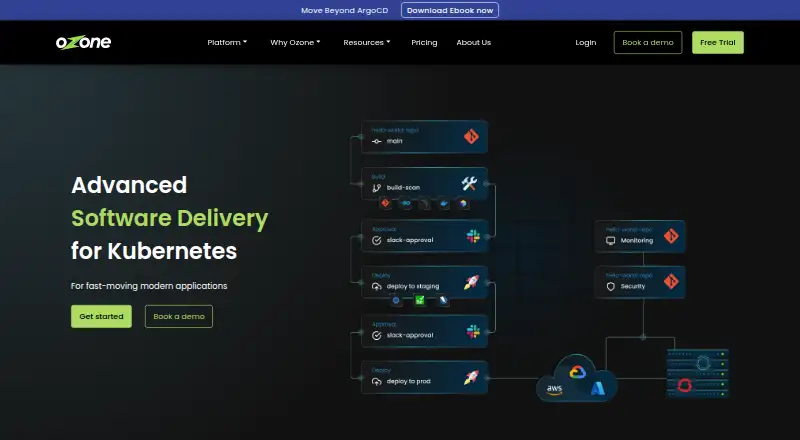
What Ozone is
Ozone is a no-code DevOps platform built on Tekton for continuous integration, delivery, monitoring, security, and governance, with a focus on Kubernetes. Its visual Pipeline Studio lets teams create and manage CI/CD pipelines. Release orchestration includes rollbacks, deployment verification, GitOps, and deployments across multiple environments. Kubernetes workflows support public and private Helm charts, release rollbacks, and live logs and status updates for resources. Listed integrations include GitHub, GitLab, Bitbucket, AWS, GCP, and Azure. Jira, Slack, and Microsoft Teams workflow integrations are listed on paid plans, while Jira is also available as a Free add-on. Ozone documents secure tunnel communications for private clusters using Open Ziti. Pipeline secrets are held in a vault, provided at runtime, then cleaned up when a run ends. Listed security features include RBAC, audit trails, image and code scans, and SSO on higher tiers. The Free plan is free forever for up to 5 users with 7-day cluster monitoring retention. Starter costs $1,000 a month for up to 20 users and 30-day retention; Advanced and Enterprise pricing is by contacting sales.
Who it suits
Ozone suits software engineering teams and enterprises using cloud-first architectures, especially those working with Kubernetes. Its Free plan may fit teams of up to five users with short monitoring retention needs.
What it does well
- Visual studio for creating and managing CI/CD pipelines
- Supports rollbacks and deployments across multiple environments
- Private-cluster tunnels use Open Ziti
- Secrets are removed after pipeline runs
What to know first
- Free plan is limited to 5 users
- Free plan retains cluster monitoring data for 7 days
- Starter costs $1,000 a month
- Advanced and Enterprise pricing requires contacting sales
Limits
The Free plan is limited to five users and seven-day cluster monitoring retention. Starter is listed for up to 20 users and 30-day retention at $1,000 a month; Advanced lists unlimited users, 90-day retention and SSO, with pricing by Contact Sales.
Plans
| Plan | Billed and limits | Price |
|---|---|---|
| Free | Free forever · up to 5 users · 7-day cluster monitoring retention | Free |
| Starter | Up to 20 users · 30-day cluster monitoring retention | $1,000 a month |
| Enterprise | Contact Sales · Self hosted · private cluster management · custom cluster monitoring retention | On request |
| Advanced | Contact Sales · Unlimited users · 90-day cluster monitoring retention · SSO authentication | On request |
As ozone.one lists them, read 30 Sept 2026. The maker's own page has the final word.
Getting started
- Open ozone.one to access the web platform or review self-hosted deployment.
- Choose the Free plan for up to five users, or review paid plan options.
- Connect a listed source control provider such as GitHub, GitLab or Bitbucket.
- Configure a pipeline in Pipeline Studio and connect cloud providers as needed.
- For private clusters, use the documented Open Ziti secure tunnel approach.
Ozone is a no-code DevOps platform for teams building, deploying, and governing Kubernetes-based software. It suits enterprise engineering groups that want visual pipeline management alongside release controls and security safeguards. Its strongest case is a Kubernetes-centered hybrid setup; smaller teams may find user caps and custom-priced tiers restrictive.
Overview
Built on Tekton, Ozone brings continuous integration, delivery, monitoring, security, and governance into one platform. Pipeline Studio provides a visual way to create and manage CI/CD workflows, while pipeline-as-code, approval gates, progressive delivery, automated rollback, and hybrid deployment support cover teams that need repeatable controls rather than ad hoc scripts.
Release orchestration spans multiple environments and includes deployment verification, GitOps workflows, and rollback operations. Kubernetes handling is particularly detailed: Ozone works with public and private Helm charts, shows live logs and resource status, and supports release rollbacks. Secure tunnel communication through Open Ziti lets private clusters connect without being exposed externally. Secrets remain in a vault, enter the pipeline only at runtime, and are removed when the run ends.
Key features
Pipeline and release control
The visual studio lowers the barrier to assembling CI/CD pipelines, while code-based pipelines preserve a versionable workflow for engineering teams that require reviewable configuration. Approval gates and deployment verification add checkpoints before and after releases. Progressive delivery and automated rollback are useful when limiting deployment risk matters, although the platform's clearest advantage is for organizations already standardizing on Kubernetes and Helm.
Integrations and governance
Source-control connections include GitHub, GitLab, and Bitbucket, with AWS, Google Cloud, and Azure integrations for cloud infrastructure. Paid plans list Jira, Slack, and Microsoft Teams workflow integrations; Jira is also offered as a Free-plan add-on. Security capabilities include customizable RBAC roles, audit trails, image and code scanning, and higher-tier SSO. Those controls make Ozone more suitable for governed enterprise delivery than a bare deployment utility.
Private-cluster operations
Open Ziti tunnels address a practical concern for private-cluster operators by avoiding external exposure. Vault-based, run-time secret injection reduces the chance of leaving credentials in pipeline configuration or after execution.
Pricing
Ozone uses a freemium model, with paid access advertised from $19/mo and a 30-day trial. The published plans show a different level of commitment for the main paid tiers, so buyers should match the quoted plan to their required users, retention, and support.
| Plan | Price and limits | Best fit |
|---|---|---|
| Free | free, free forever; up to 5 users; 7-day cluster-monitoring retention | Small teams evaluating the workflow or running a limited Kubernetes operation |
| Starter | $1,000 a month; up to 20 users; 30-day retention | Growing teams needing more seats and longer monitoring history |
| Advanced | Custom pricing; unlimited users; 90-day retention; SSO authentication | Organizations with broad access and formal identity requirements |
| Enterprise | Custom pricing; self-hosted; private-cluster management; custom monitoring retention | Enterprises requiring self-hosting and tailored cluster operations |
Free is genuinely long-term, but five users and seven days of monitoring can constrain collaborative teams and incident review. Starter raises those limits but carries a substantial listed monthly price. Advanced adds unlimited users, longer retention, and SSO, while Enterprise is the better fit when self-hosting and private-cluster management are mandatory; both require a sales conversation. Starter and Advanced include 9x5 web standard support, Advanced adds 24x7 standard coverage, and Enterprise provides 24x7 premium coverage.
Platforms
Ozone is offered as web software and for self-hosted deployment. Its hybrid deployment model accommodates organizations splitting control between hosted services and their own environments.
Who it's for
Ozone is aimed at enterprises and software engineering teams using cloud-first architectures, especially Kubernetes estates. It is a strong match for teams that need Helm-aware releases, private-cluster connectivity, governed approvals, and auditable security controls in one system. It is less compelling for a small group that needs many collaborators on a low budget, or for teams whose delivery stack is not centered on Kubernetes.
Pros and cons
- Pros: Kubernetes-focused Helm releases with live status, logs, and rollback support.
- Pros: Private-cluster tunnels and run-time vault secret handling address common operational security risks.
- Pros: Pipeline Studio, pipeline-as-code, approval gates, progressive delivery, and automated rollback cover both visual and controlled workflows.
- Cons: Free is limited to five users and seven-day monitoring retention.
- Cons: Starter's listed 1000.00 USD monthly price is a significant step up for teams outgrowing Free.
- Cons: SSO, unlimited users, and tailored enterprise capabilities require higher, custom-priced tiers.
Alternatives
For a broader market scan, see Release Orchestration Software and Continuous Delivery Software.
- MidVision RapidDeploy is worth considering if you need broad operating-system and API coverage with a free community tier for up to 10 endpoints.
- HCL Launch fits buyers wanting a 60-day, license-free evaluation with all product features before licensed agents are required.
- Octopus Deploy suits teams preferring machine- and tenant-based add-ons, including a 10-machine default option.
- Copado is a better small-scale starting point when 15 monthly deployments and single-user use are sufficient.
- Devtron Release Orchestration offers a freemium Kubernetes-oriented option capped at 50 vCPUs, 10 users, and one cluster.
- ReleaseOwl is an alternative web service with a free tier aimed at eligible SAP Cloud ALM customers.
- Harness Continuous Delivery is suitable if an open-source-inclusive free plan and community support are priorities.
- Delivr is a free alternative spanning web, self-hosted, desktop, mobile, and API platforms.
Verdict
Choose Ozone if your organization runs Kubernetes and wants release orchestration, private-cluster connectivity, and governed pipeline security in one hybrid platform. Look elsewhere if you need inexpensive collaboration beyond five users or a simpler, non-Kubernetes deployment tool; Ozone's meaningful capacity and identity features sit behind a costly or custom-priced upgrade path.
Verdict
Ozone combines pipeline creation and release management with Kubernetes-focused deployment and security features. The Free plan has user and retention limits, while Starter has a listed monthly price and higher tiers require a sales contact.
Questions
Is Ozone free?
Yes. Its Free plan is free forever for up to five users, with seven-day cluster monitoring retention.
How much does Ozone cost?
Starter is listed at $1,000 a month. Advanced and Enterprise are billed through Contact Sales; the pricing note also says paid plans start from $19/mo.
Which deployment options are listed?
Ozone is available as a web and self-hosted platform. Its deployment model is listed as hybrid.
What integrations are listed?
Source control integrations include GitHub, GitLab and Bitbucket, and cloud providers include AWS, GCP and Azure. Jira, Slack and Microsoft Teams are listed as workflow integrations on paid plans; Jira is also available as a Free add-on.
Does Ozone support private Kubernetes clusters?
Ozone documents secure tunnel communications using Open Ziti, so clusters do not need to be exposed externally.
What are the Advanced and Enterprise plan details?
Advanced lists unlimited users, 90-day cluster monitoring retention and SSO authentication. Enterprise lists self-hosting, private cluster management and custom monitoring retention; both are billed through Contact Sales.
Facts from Ozone's own pages
- Helm deployments
- The platform supports public and private Helm charts, release rollbacks, and live logs and status updates for Kubernetes resources. · ozone.one, 30 Sept 2026
- Integrations
- The pricing page lists source control integrations including GitHub, GitLab, and Bitbucket, plus cloud providers AWS, GCP, and Azure. · ozone.one, 30 Sept 2026
- Intended users
- Ozone describes itself as a platform for enterprises and software engineering teams working with cloud-first architectures, especially Kubernetes. · docs.ozone.one, 30 Sept 2026
- Pipeline studio
- Its visual Pipeline Studio lets teams create and manage CI/CD pipelines. · ozone.one, 30 Sept 2026
- Private clusters
- Ozone documents secure tunnel communications for private clusters using Open Ziti, so clusters need not be exposed externally. · docs.ozone.one, 30 Sept 2026
- Product
- Ozone is a no-code DevOps platform built on Tekton for continuous integration, delivery, monitoring, security, and governance, with a focus on Kubernetes. · docs.ozone.one, 30 Sept 2026
- Release management
- Release orchestration includes rollbacks, deployment verification, GitOps, and deployments across multiple environments. · ozone.one, 30 Sept 2026
- Secret handling
- Secrets are stored in a vault, injected into pipeline runtime on demand, and cleaned up when the pipeline run ends. · docs.ozone.one, 30 Sept 2026
- Security features
- The pricing page lists RBAC, audit trails, image and code scans, and SSO on higher-tier plans; RBAC roles can be customized. · ozone.one, 30 Sept 2026
- Support
- The pricing page lists 9x5 web standard coverage for Starter and Advanced, with 24x7 standard support on Advanced and 24x7 premium coverage on Enterprise. · ozone.one, 30 Sept 2026
- Workflow integrations
- Jira, Slack, and Microsoft Teams are listed as external workflow integrations on paid plans, with Jira also available as an add-on for Free. · ozone.one, 30 Sept 2026
Where Ozone stands on Freedom251
- Release Orchestration Software#7 of 29
- Continuous Delivery Software#22 of 32