Freedom251 › Cloud Development Environments
Orchard
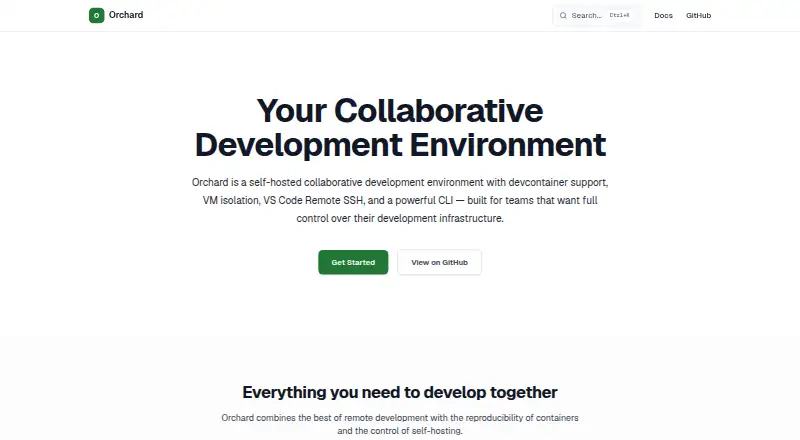
What Orchard is
Orchard is a self-hosted collaborative development environment that creates ready-to-code workspaces, called groves, from Git repositories. Each grove runs in an isolated virtual machine, with QEMU as the default provider. Orchard can use devcontainer.json to define an environment and supports devfile.yaml or devfile.yml as a fallback. Developers connect to a ready grove over SSH, including through VS Code Remote SSH. Canopy is the browser dashboard for managing groves, environments, and team settings, while Trowel is the CLI for planting and managing groves. A REST API allows programmatic grove management, including planting, listing, stopping, and starting. QEMU and AWS EC2 are available VM providers; GCP Compute and Azure VM are planned. The documented stack also includes Docker, Docker Compose, PostgreSQL, Git repositories, and devcontainers. Orchard is open source under the Apache License 2.0. Its self-hosting requirements are at least 2 CPU cores, 4 GB RAM, 20 GB disk, Java 25+, and Docker 24.0+. Linux/amd64 and Linux/arm64 are fully supported; macOS/arm64 is supported when built from source. Authentication is disabled by default, and the maker warns that anyone able to reach the API can act as any cultivator if OAuth2 is disabled.
Who it suits
Orchard suits developers and teams who want to provision isolated workspaces from Git repositories and manage them through a dashboard, CLI, or REST API. It is a fit for self-hosters who can meet its server requirements and configure authentication appropriately for their deployment.
What it does well
- Creates isolated virtual-machine workspaces from Git repositories.
- Supports devcontainer.json and Devfile environment specifications.
- Connects to groves over SSH, including VS Code Remote SSH.
- Offers dashboard, CLI, and REST API management.
- QEMU and AWS EC2 are available VM providers.
What to know first
- Self-hosting requires at least 2 CPU cores, 4 GB RAM, and 20 GB disk.
- Authentication is disabled by default, with an API access caveat.
- CLI commands to stop and start groves are coming soon.
Limits
Self-hosting requires at least 2 CPU cores, 4 GB RAM, 20 GB disk, Java 25+, and Docker 24.0+. CLI commands to stop and start groves are documented as coming soon; the API can perform those actions meanwhile.
Getting started
- Visit the Orchard website and download the server and CLI releases.
- Prepare a self-hosting system with 2 CPU cores, 4 GB RAM, 20 GB disk, Java 25+, and Docker 24.0+.
- Use Docker Compose for PostgreSQL and devcontainer management, and QEMU to provision isolated VMs.
- Configure a Git repository with devcontainer.json, or use devfile.yaml or devfile.yml as the fallback specification.
- Manage groves with Canopy, Trowel, or the REST API, and connect to a ready grove over SSH.
Verdict
Choose Orchard if you want a self-hosted environment for creating and managing isolated development workspaces from Git repositories. Look elsewhere if your deployment needs CLI commands to stop or start groves immediately, or if you cannot address the API access risk when OAuth2 is disabled.
Questions
What does Orchard cost?
Orchard is open source under the Apache License 2.0. No price, subscription plan, or trial offer is stated.
Which platforms and architectures does it support?
The self-hosting guide fully supports Linux/amd64 and Linux/arm64. macOS/arm64 is supported when built from source.
Which VM providers can it use?
QEMU and AWS EC2 are available. GCP Compute and Azure VM are listed as planned.
How do developers connect to a grove?
They can connect over SSH, including through VS Code Remote SSH.
Is authentication enabled by default?
No. Authentication is disabled by default. The maker warns that without OAuth2, anyone who can reach the API can act as any cultivator by sending an arbitrary cultivator ID.
Can the CLI stop and start groves?
Those CLI commands are documented as coming soon. The REST API can stop and start groves meanwhile.
Facts from Orchard's own pages
- Additional environment format
- The site describes Devfile support as an alternative to devcontainers. · orchardcde.org, 9 Oct 2026
- API
- The getting-started guide links to API documentation and says the API server starts on port 8080. · orchardcde.org, 9 Oct 2026
- Authentication
- Authentication is disabled by default; production deployments can enable OAuth2 and validate JWTs from an OAuth2-compatible identity provider. · orchardcde.org, 9 Oct 2026
- CLI
- Trowel is Orchard's command-line tool for planting and managing groves. · orchardcde.org, 9 Oct 2026
- Cloud providers
- QEMU and AWS EC2 are available VM providers; GCP Compute and Azure VM are listed as planned. · orchardcde.org, 9 Oct 2026
- Devcontainers
- It supports devcontainer.json to define reproducible development environments. · orchardcde.org, 9 Oct 2026
- Dev environments
- It supports devcontainer.json and can use devfile.yaml or devfile.yml as a fallback environment specification. · orchardcde.org, 9 Oct 2026
- Downloads
- The guide links to downloadable server and CLI releases and documents Linux amd64 and arm64 binaries. · orchardcde.org, 9 Oct 2026
- Download verification
- The guide instructs users to verify CLI downloads against SHA-256 checksums published on the release page. · orchardcde.org, 9 Oct 2026
- Editor access
- Developers can connect to a ready grove over SSH, including through VS Code Remote SSH. · orchardcde.org, 9 Oct 2026
- Editor connection
- Developers can connect to remote environments using VS Code Remote SSH. · orchardcde.org, 9 Oct 2026
- Infrastructure
- The site lists Docker, Docker Compose, QEMU, and AWS EC2 as supported infrastructure tools or providers. · orchardcde.org, 9 Oct 2026
- Integrations
- The documented stack includes Docker and Docker Compose, PostgreSQL, QEMU, Git repositories, devcontainers, and AWS EC2. · orchardcde.org, 9 Oct 2026
- Isolation
- Each grove runs in an isolated VM, with QEMU as the default provider. · orchardcde.org, 9 Oct 2026
- License
- The project is open source under the Apache License 2.0. · github.com, 9 Oct 2026
- Notable limit
- The CLI commands to stop and start a grove are documented as coming soon; the API can perform those actions meanwhile. · orchardcde.org, 9 Oct 2026
- Operating systems
- The guide gives QEMU installation instructions for Linux and macOS and says macOS uses HVF acceleration. · orchardcde.org, 9 Oct 2026
- Pricing
- The pages reviewed do not state a price, subscription plan, or trial offer. · orchardcde.org, 9 Oct 2026
- Product
- Orchard is a self-hosted collaborative development environment that provisions development workspaces from Git repositories. · orchardcde.org, 9 Oct 2026
- Purpose
- Orchard is a self-hosted cloud development environment that provisions ready-to-code workspaces from Git repositories. · orchardcde.org, 9 Oct 2026
- Requirements
- The listed minimum self-hosting requirements are 2 CPU cores, 4 GB RAM, 20 GB disk, Java 25+, and Docker 24.0+. · orchardcde.org, 9 Oct 2026
- Security caveat
- The maker warns that with OAuth2 disabled, anyone who can reach the API can act as any cultivator by sending an arbitrary cultivator ID. · orchardcde.org, 9 Oct 2026
- Server requirements
- The getting-started guide uses Docker Compose for PostgreSQL and devcontainer management and QEMU to provision isolated VMs. · orchardcde.org, 9 Oct 2026
- Supported architectures
- The self-hosting guide lists linux/amd64 and linux/arm64 as fully supported and macOS/arm64 as supported when built from source. · orchardcde.org, 9 Oct 2026
Where Orchard stands on Freedom251
- Cloud Development Environments#26 of 27