Freedom251 › Financial Planning & Analysis Software

Oracle Fusion Cloud EPM
What Oracle Fusion Cloud EPM is
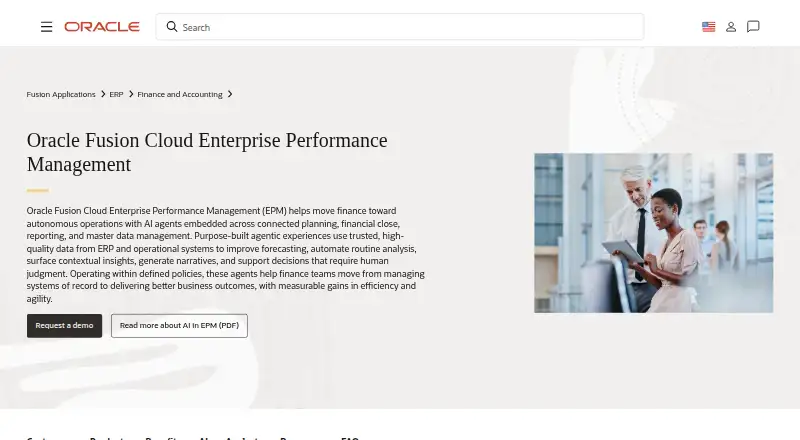
Oracle Fusion Cloud EPM is a cloud platform for connected planning, financial close, reporting, and master data management. Its planning features include budgeting, forecasting, scenario modeling, variance analysis, and workforce planning, alongside financial consolidation. Oracle says embedded AI agents can assist with forecasting, routine analysis, insights, and narratives. Its Planning Agent provides real-time insights, predictions, and what-if modeling to inform forecasts and decisions.
The platform includes Access Control, Data Integration, EPM Automate, Smart View for Office, reports, and REST APIs. Oracle provides integration guidance across processes including Account Reconciliation, Enterprise Data Management, Financial Consolidation and Close, Narrative Reporting, Planning, FreeForm, Profitability and Cost Management, and Tax Reporting. Security controls include TLS communication encryption, data encryption, single sign-on, role-based access, and audit logs. Oracle says EPM data, context, and outputs are not shared with external model providers for training or retention when embedded Oracle GenAI is used. Available processes and features depend on the Standard or Enterprise subscription; AI availability also varies by process, feature, subscription, and release. The listed Standard Cloud Service costs $250 a month with a three-year term and a 10-user minimum. Enterprise Cloud Service costs $500 a month, also with a three-year term and a 25-user minimum.
Who it suits
Oracle Fusion Cloud EPM suits organizations planning budgets, forecasts, workforce needs, and financial close across connected business processes. Buyers should be prepared to choose a subscription whose features and user minimum fit their needs.
What it does well
- Covers budgeting, forecasting, scenario modeling, and variance analysis.
- Includes financial consolidation and workforce planning.
- Offers REST APIs and Smart View for Office.
- Security controls include single sign-on and role-based access.
- Oracle lists 24×7 support among Cloud EPM service features.
What to know first
- There is no free plan.
- Standard subscription has a minimum of 10 hosted named users.
- Enterprise subscription has a minimum of 25 hosted named users.
- Available processes, features, and AI vary by subscription.
Limits
The Standard Cloud Service costs $250 a month, has a three-year subscription term, and requires at least 10 hosted named users. Enterprise costs $500 a month, has a three-year term, and requires at least 25 hosted named users. Features and AI availability vary by subscription and other factors.
Plans
| Plan | Billed and limits | Price |
|---|---|---|
| Oracle Enterprise Performance Management Standard Cloud Serv | 10 hosted named users minimum | On request |
| Oracle Enterprise Performance Management Standard Cloud Serv | 10 hosted named users minimum | On request |
| Oracle Additional Application for Oracle Enterprise Performa | 1 hosted environment minimum | On request |
| Oracle Enterprise Performance Management Enterprise Cloud Se | 25 hosted named users minimum | On request |
| Oracle Enterprise Performance Management Enterprise Cloud Se | 25 hosted named users minimum | On request |
| Oracle Additional Application for Oracle Enterprise Performa | Standard term length for Oracle Cloud Service subscription services is three (3) years · 1 hosted environment minimum | Free |
| Oracle Enterprise Performance Management Standard Cloud Service | Monthly subscription; standard cloud service subscription term is 3 years · Hosted Named User · minimum 10 | $250 a month |
| Oracle Enterprise Performance Management Enterprise Cloud Service | Monthly subscription; standard cloud service subscription term is 3 years · Hosted Named User · minimum 25 | $500 a month |
As oracle.com lists them, read 22 Sept 2026. The maker's own page has the final word.
Getting started
- Visit Oracle's Cloud EPM website.
- Contact Oracle Sales to purchase a subscription.
- Choose Standard or Enterprise based on the business processes and features needed.
- Select the Standard Cloud Service with a 10 hosted named user minimum, or Enterprise Cloud Service with a 25-user minimum.
- Access Cloud EPM through the listed Android, iOS, macOS, web, or Windows platforms, or through its APIs.
Overview
Oracle Fusion Cloud EPM is a cloud platform for coordinating planning, financial close, reporting, and master data management. It suits finance organizations that need these processes under shared controls, with planning that spans budgets, forecasts, and workforce needs. Its breadth is compelling, though the three-year subscription term and minimum user counts call for a substantial, sustained commitment.
Key features
Budgeting, forecasting, scenario modeling, variance analysis, and workforce planning give finance teams a broad planning toolkit. Oracle’s Planning Agent can provide predictions, real-time insights, and what-if modeling; embedded AI agents can also assist with routine analysis and narratives. These capabilities may help teams examine assumptions and communicate results, but availability varies by business process, feature, subscription, and release.
Financial consolidation, close, reporting, and master data management extend EPM beyond planning. The platform includes Access Control, Data Integration, EPM Automate, Smart View for Office, reports, and REST APIs, with integration guidance for processes including Account Reconciliation, Enterprise Data Management, Financial Consolidation and Close, Narrative Reporting, Planning, FreeForm, Profitability and Cost Management, and Tax Reporting. This scope is useful for organizations connecting several finance workflows; buyers should confirm that the Standard or Enterprise subscription they choose includes the business processes and features they need.
Oracle documents TLS communication encryption, data encryption, single sign-on, role-based access, audit logs, and other security controls. Access Control can add business-process roles and permissions. Oracle also says data, context, and outputs used with embedded Oracle GenAI are not shared with external model providers for training or retention. These controls address governance needs in finance teams, while 24×7 support adds a service option for organizations that rely on the platform.
Pricing
Oracle directs buyers to contact Sales to purchase a subscription. The two priced services are billed monthly but carry a three-year subscription term, so the monthly figure should not be mistaken for a short-term commitment.
- Oracle Enterprise Performance Management Standard Cloud Service: $250 a month, billed monthly, with a three-year term and a minimum of 10 hosted named users. It is the lower-priced entry for organizations whose required processes and features fit Standard.
- Oracle Enterprise Performance Management Enterprise Cloud Service: $500 a month, billed monthly, with a three-year term and a minimum of 25 hosted named users. The higher minimum makes it a better fit for larger teams that need Enterprise subscription options.
There is no free plan. Both priced subscriptions set minimum user counts, and the three-year term limits flexibility for smaller teams or buyers seeking a short commitment. Custom pricing applies to Oracle Enterprise Performance Management Standard Cloud Serv with a 10 hosted named user minimum, Oracle Additional Application for Oracle Enterprise Performa with a 1 hosted environment minimum, and Oracle Enterprise Performance Management Enterprise Cloud Se with a 25 hosted named user minimum.
Platforms
Oracle Fusion Cloud EPM supports Android, iOS, macOS, web, and Windows, alongside API access. This range can accommodate teams working across desktop and mobile environments and organizations connecting through APIs.
Who it's for
EPM is best suited to finance organizations that need planning alongside consolidation, close, reporting, or master data management, and can support the applicable user minimums and three-year term. Its access controls and breadth suit teams coordinating governed finance processes. Smaller groups, buyers needing a free option, or organizations unable to commit for three years should look elsewhere.
Pros and cons
- Pros: Planning combines budgeting, forecasting, scenario modeling, variance analysis, and workforce planning, covering several finance needs in one platform.
- Pros: Consolidation, close, reporting, and master data management broaden its usefulness for teams connecting finance processes.
- Pros: Documented encryption, single sign-on, role-based access, and audit logs support organizations with access and governance requirements.
- Cons: The three-year subscription term is a significant commitment for organizations that need flexibility.
- Cons: Minimums of 10 hosted named users for Standard and 25 for Enterprise rule out some smaller teams.
- Cons: There is no free plan, and AI capabilities vary by process, feature, subscription, and release.
Alternatives
For a broader shortlist, compare Corporate Performance Management Software and Financial Planning & Analysis Software.
- OneStream is another paid platform, with pricing discussed by demo request.
- Birst is a paid enterprise analytics platform with no free plan.
- Axiom may suit large teams seeking a per-user price: its Europe example is €17 a month for 500 users.
- Bizview uses pricing by request.
- CCH Tagetik offers pricing by demo or quote request.
- Cube offers custom-priced plans, including Bronze with full platform access, custom roles, unlimited dimensions, users, and dashboards.
- FutureView Systems offers a cloud-based Foundation plan with direct integration and an Excel add-in or third-party viewer; additional user access licenses may be required.
- JustPerform offers pricing by request and a demo.
Verdict
Choose Oracle Fusion Cloud EPM when your finance organization needs connected planning and financial processes, especially consolidation and reporting alongside forecasting. Its broad planning scope and documented controls make it a strong candidate for established teams. Look elsewhere if you need a free plan, a shorter commitment, or fewer than the minimum hosted named users.
Verdict
Choose Oracle Fusion Cloud EPM if your organization needs connected planning and financial processes with forecasting, consolidation, and reporting capabilities. Look elsewhere if you need a free plan or a subscription below the listed minimum user counts.
Questions
Does Oracle Fusion Cloud EPM have a free plan?
No. Its pricing model is paid.
How much does the Standard Cloud Service cost?
It is listed at $250 a month, with a three-year subscription term and a minimum of 10 hosted named users.
How much does the Enterprise Cloud Service cost?
It is listed at $500 a month, with a three-year subscription term and a minimum of 25 hosted named users.
Which platforms does Cloud EPM support?
Listed platforms are Android, API, iOS, macOS, web, and Windows.
Does Oracle Fusion Cloud EPM include AI features?
Oracle describes embedded AI agents for forecasting, routine analysis, insights, and narratives. Availability varies by business process, feature, subscription, and release.
How do customers purchase Cloud EPM?
Oracle directs customers interested in a subscription to contact Oracle Sales.
Facts from Oracle Fusion Cloud EPM's own pages
- Access controls
- Cloud EPM uses single sign-on and role-based access, with additional business-process roles and permissions available through Access Control. · docs.oracle.com, 9 Oct 2026
- AI availability
- Oracle states that availability of EPM AI features varies by business process, feature, subscription, and release. · docs.oracle.com, 9 Oct 2026
- AI data handling
- Oracle says EPM data, context, and outputs are not shared with external model providers for training or retention when using its embedded Oracle GenAI. · oracle.com, 9 Oct 2026
- AI planning
- Oracle says its Planning Agent provides real-time insights, predictions, and what-if modeling to support forecasts and decisions. · oracle.com, 9 Oct 2026
- Budgeting
- Yes · oracle.com, 22 Sept 2026
- Data security
- Oracle documents TLS communication encryption, data encryption, single sign-on, role-based access, audit logs, and other security controls for Cloud EPM. · docs.oracle.com, 9 Oct 2026
- Financial consolidation
- Yes · oracle.com, 22 Sept 2026
- Forecasting
- Yes · oracle.com, 22 Sept 2026
- Founded
- 1977 · oracle.com, 4 Oct 2026
- Free plan
- No · oracle.com, 22 Sept 2026
- Headquarters
- Austin, Texas, United States · oracle.com, 4 Oct 2026
- Integrations
- Oracle provides integration guidance for Account Reconciliation, Enterprise Data Management, Financial Consolidation and Close, Narrative Reporting, Planning, FreeForm, Profitability and Cost Management, and Tax Reporting. · docs.oracle.com, 9 Oct 2026
- Platform components
- The Cloud EPM platform includes Access Control, Data Integration, EPM Automate, Smart View for Office, reports, and REST APIs. · docs.oracle.com, 9 Oct 2026
- Purchase
- Oracle directs customers interested in purchasing a Cloud EPM subscription to contact Oracle Sales. · docs.oracle.com, 9 Oct 2026
- Purpose
- Oracle Fusion Cloud EPM supports connected planning, financial close, reporting, and master data management, using AI agents to help with forecasting, routine analysis, insights, and narratives. · oracle.com, 9 Oct 2026
- Scenario modeling
- Yes · oracle.com, 22 Sept 2026
- Subscription choice
- Available business processes and features depend on whether the customer purchases the Standard or Enterprise Cloud EPM subscription. · docs.oracle.com, 9 Oct 2026
- Support
- Oracle's Cloud EPM security documentation lists 24×7 support among its security and service features. · docs.oracle.com, 9 Oct 2026
- Variance analysis
- Yes · oracle.com, 22 Sept 2026
- Workforce planning
- Yes · oracle.com, 22 Sept 2026