Opsera Unified DevOps Platform
What Opsera Unified DevOps Platform is
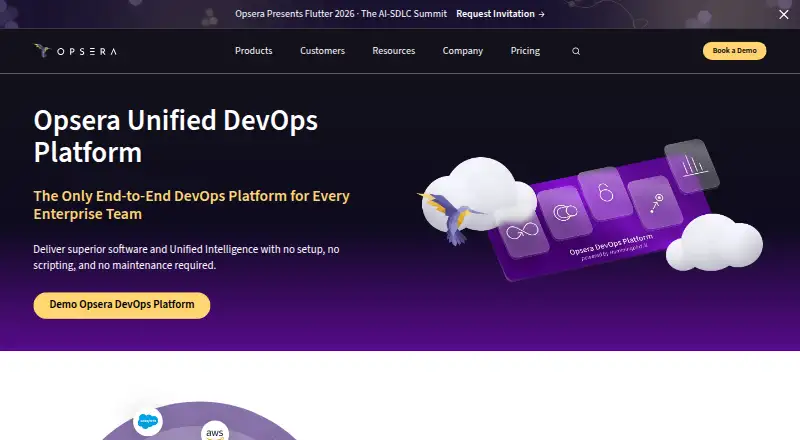
Opsera Unified DevOps Platform is a paid platform for enterprise software teams that automates toolchains and delivery, connects security, and unifies insight across CI/CD tools, SaaS environments, and clouds. Pipeline work can use declarative templates, custom workflows, a visual editor, configurable triggers and thresholds, or JSON configuration stored in Git repositories. Delivery analytics bring lead time, change failure rate, deployment frequency, and time to restore into unified views and persona-based dashboards. Opsera lists more than 100 native integrations, including Octopus Deploy, Jenkins, CircleCI, Slack, GitHub, AWS, and Google GKE. Its catalog also contains tools that are not yet fully integrated. SSO support includes Okta, SAML, and LDAP. Each customer instance has its own AWS VPC, ELK instance, and MongoDB instance, with data kept separate between instances. The platform is available on the web and as self-hosted software, with hybrid deployment in a customer’s VPC; on-premises deployment is in private beta. Pipeline logs show workflow steps and console output, while toolchain infrastructure can be provisioned automatically, updates A/B-tested, and rolled back. Hummingbird AI provides generative AI and pipeline summaries. Pricing is set with sales and may depend on users or pipelines.
Who it suits
It is intended for enterprises and enterprise software teams managing delivery across CI/CD tools, SaaS environments, and clouds. Teams needing pipeline automation, delivery analytics, integrations, SSO, and hybrid deployment will find the listed capabilities relevant.
What it does well
- 100+ native integrations listed
- Declarative and custom pipeline workflows
- Unified delivery analytics and dashboards
- SSO with Okta, SAML, and LDAP
- Separate infrastructure for each customer
- Pipeline logs show workflow details
What to know first
- No free trial is listed
- Pricing is available only by request
- Some catalog tools are not fully integrated
- On-premises deployment is in private beta
Limits
The platform has no listed free trial, and pricing is determined with the sales team based on users or pipelines. On-premises deployment is in private beta, and some tools in the ecosystem catalog are not fully integrated.
Plans
| Plan | Billed and limits | Price |
|---|---|---|
| Enterprise pricing | Options based on number of users or pipelines · Standard or custom legal terms · Email and priority support · Customer success manager | On request |
As opsera.io lists them, read 3 Oct 2026. The maker's own page has the final word.
Getting started
- Open the Opsera platform website
- Request a demo through the pricing process
- Discuss pricing based on users or pipelines with the sales team
- Choose web, self-hosted, or hybrid deployment
- Configure pipeline workflows, integrations, and SSO
Verdict
Pick Opsera if an enterprise team needs unified pipeline automation, analytics, integrations, and hybrid deployment. Look elsewhere if you require a free trial, published pricing, or generally available on-premises deployment.
Questions
Is Opsera free or is there a trial?
Opsera is paid. The listed pricing information does not describe a free trial and directs prospects to request a demo.
How is Opsera priced?
Pricing is determined with the sales team and may be based on users or pipelines. Enterprise pricing has no listed amount.
Which deployment options are available?
Opsera is available on the web and as self-hosted software. Its Hybrid option can run in a customer’s VPC, while on-premises deployment is in private beta.
What integrations does it offer?
The platform page lists more than 100 native integrations, including Octopus Deploy, Jenkins, CircleCI, Slack, GitHub, AWS, and Google GKE.
Does it support SSO?
Yes. Listed SSO protocols include Okta, SAML, and LDAP.
Who is Opsera built for?
Opsera describes the platform as purpose-built for enterprises and enterprise software teams.
Facts from Opsera Unified DevOps Platform's own pages
- Access controls
- The platform supports SSO protocols including Okta, SAML, and LDAP. · opsera.io, 3 Oct 2026
- AI features
- The platform includes Hummingbird AI, which Opsera describes as providing generative AI and pipeline summaries. · opsera.io, 3 Oct 2026
- Analytics
- Opsera aggregates delivery analytics and metrics including lead time, change failure rate, deployment frequency, and time to restore into unified views and persona-based dashboards. · opsera.io, 3 Oct 2026
- Company founding
- Opsera says it was founded in January 2020. · opsera.io, 3 Oct 2026
- Customer isolation
- Opsera says each customer instance has its own AWS VPC, ELK instance, and MongoDB instance, and customer data is not shared across instances. · opsera.io, 3 Oct 2026
- Deployment options
- Opsera says its Hybrid option can be deployed within a customer's own VPC and that on-premises deployment is in private beta. · opsera.io, 3 Oct 2026
- Founded
- 2020 · opsera.io, 28 Sept 2026
- Headquarters
- Palo Alto, California, United States · opsera.io, 28 Sept 2026
- Integration catalog limit
- Opsera says its ecosystem catalog includes tools that are not yet fully integrated. · opsera.io, 3 Oct 2026
- Integrations
- The platform page lists 100+ native integrations, including Octopus Deploy, Jenkins, CircleCI, Slack, GitHub, AWS, and Google GKE. · opsera.io, 3 Oct 2026
- Intended customers
- Opsera describes the platform as purpose-built for enterprises and enterprise software teams. · opsera.ai, 3 Oct 2026
- Pipeline automation
- The platform offers declarative pipeline templates, custom workflows, a visual editor, configurable triggers and thresholds, and JSON configuration that can be stored in Git repositories. · opsera.io, 3 Oct 2026
- Pipeline logs
- Pipelines generate activity logs that include each workflow step and console output, which users can inspect in the UI to diagnose failures. · opsera.io, 3 Oct 2026
- Pricing and support
- Pricing is determined with the sales team and may be based on users or pipelines; listed support options include email, priority queue, and a customer success manager. · opsera.ai, 3 Oct 2026
- Purpose
- Opsera describes its cloud-native platform as helping enterprise software teams automate toolchains and delivery, integrate security, and gain unified insights across CI/CD tools, SaaS environments, and clouds. · opsera.io, 3 Oct 2026
- Toolchain management
- Opsera says it can automatically provision and deploy toolchain infrastructure, and users can A/B test tool updates and roll back if needed. · opsera.io, 3 Oct 2026
- Trial
- The pricing FAQ directs prospective customers to request a demo to see the platform and does not describe a free trial. · opsera.ai, 3 Oct 2026
Where Opsera Unified DevOps Platform stands on Freedom251
- DevOps Platforms#22 of 28