Freedom251 › Time-Series Databases
OpenTSDB
What OpenTSDB is
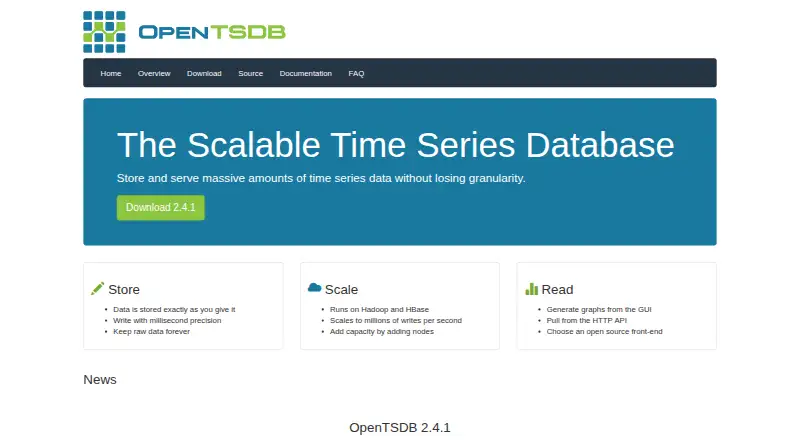
OpenTSDB is a self-hosted system for storing and querying large volumes of time-series data while preserving the granularity supplied at ingestion. It supports millisecond precision, and data can be retained indefinitely. Built on Hadoop and HBase, it can scale horizontally by adding nodes; its homepage describes capacity reaching millions of writes per second. Data can enter through the Telnet API, HTTP API, batch import, or Java library. Engineers can query it through command-line tools or an HTTP API using OpenTSDB query syntax, with options for tag filters, aggregation, downsampling, rate conversion, functions, and expressions. Results can be displayed as GnuPlot graphs, and open-source tools such as Grafana and Bosun can access the data. A plugin framework includes documented types for authentication, search, and real-time publishing. OpenTSDB is free, licensed under GNU LGPL v2.1 or later, and supports Linux, Windows, API, and self-hosted use. Its FAQ describes it as a tool written for engineers and operations staff managing large computer systems, and says it is currently in maintenance mode. The FAQ also notes absent built-in authentication and possible data loss during prolonged HBase outages or TSD crashes.
Who it suits
OpenTSDB suits engineers and operations staff managing large computer systems who need to store and query high-volume time-series data in a self-hosted environment. It is a fit for teams comfortable with Hadoop, HBase, and OpenTSDB query syntax.
What it does well
- Free, open-source software under GNU LGPL v2.1 or later.
- Preserves supplied data granularity with millisecond precision.
- Can scale horizontally by adding nodes.
- Accepts data through Telnet, HTTP, batch import, and Java.
- Offers tag filters, aggregation, downsampling, rate conversion, functions, and expressions.
- Grafana and Bosun can access its data.
What to know first
- The FAQ says it is in maintenance mode.
- It has no built-in authentication and has not undergone a security review.
- Prolonged HBase outages can lead to discarded incoming data points.
- A TSD crash can lose about one second of buffered data by default.
Limits
OpenTSDB is free, with no trial required. The FAQ says a prolonged HBase outage can fill TSD buffers and cause incoming points to be discarded; a TSD crash can lose about one second of buffered data by default.
Plans
| Plan | Billed and limits | Price |
|---|---|---|
| OpenTSDB | Open-source software · self-hosted | Free |
As opentsdb.net lists them, read 8 Oct 2026. The maker's own page has the final word.
Getting started
- Visit the OpenTSDB website.
- Choose the self-hosted deployment.
- Use a supported Linux or Windows environment.
- Send data using the Telnet API, HTTP API, batch import, or Java library.
- Query data with command-line tools or the HTTP API.
Verdict
Choose OpenTSDB if you need free, self-hosted time-series storage that supports fine-grained data, multiple ingestion paths, and horizontal scaling. Its maintenance mode, lack of built-in authentication, and documented data-loss conditions are reasons to consider those operational needs carefully.
Questions
How much does OpenTSDB cost?
Its listed plan is free: free.
Is OpenTSDB open source?
Yes. The FAQ lists the GNU LGPL v2.1 or later license.
Which platforms does it support?
Listed platforms include Linux, Windows, API, and self-hosted deployment.
Can I use SQL to query OpenTSDB?
No. It uses OpenTSDB query syntax.
Which tools can access OpenTSDB data?
The documentation says open-source tools including Grafana and Bosun can access its data.
Does OpenTSDB include authentication?
No. The FAQ says it has no built-in authentication and recommends restricting untrusted access through a secured HTTP proxy.
Facts from OpenTSDB's own pages
- Analysis
- Queries support tag filters, aggregation, downsampling, rate conversion, functions, and expressions. · opentsdb.net, 8 Oct 2026
- Durability
- The FAQ says a TSD crash can lose up to about one second of buffered data by default before it is persisted to HBase. · opentsdb.net, 8 Oct 2026
- Extensibility
- OpenTSDB has a plugin framework with documented plugin types including authentication, search, and real-time publishing. · opentsdb.net, 8 Oct 2026
- Integrations
- The docs say open-source tools including Grafana and Bosun can access OpenTSDB data. · opentsdb.net, 8 Oct 2026
- Intended users
- The FAQ says OpenTSDB was written for internal use by engineers and operations staff managing large computer systems. · opentsdb.net, 8 Oct 2026
- License
- The FAQ says OpenTSDB uses the GNU LGPL v2.1 or later. · opentsdb.net, 8 Oct 2026
- Purpose
- OpenTSDB stores and serves large volumes of time-series data while preserving granularity. · opentsdb.net, 8 Oct 2026
- Querying
- Data can be queried with CLI tools or an HTTP API and viewed as a GnuPlot graph. · opentsdb.net, 8 Oct 2026
- Reliability limit
- The FAQ says prolonged HBase outages can fill TSD buffers, after which incoming data points may be discarded. · opentsdb.net, 8 Oct 2026
- Scale
- The homepage says OpenTSDB runs on Hadoop and HBase, scales by adding nodes, and can scale to millions of writes per second. · opentsdb.net, 8 Oct 2026
- Security
- The FAQ says OpenTSDB has not undergone a security review and does not include authentication, and recommends restricting untrusted access through a secured HTTP proxy. · opentsdb.net, 8 Oct 2026
- Storage
- The homepage says data is stored as provided, supports millisecond precision, and can be kept indefinitely. · opentsdb.net, 8 Oct 2026
- Support status
- The FAQ says Yahoo maintained OpenTSDB until 2021 and that it is currently in maintenance mode. · opentsdb.net, 8 Oct 2026
Where OpenTSDB stands on Freedom251
- Time-Series Databases#16 of 36