Freedom251 › Order Management Software

Openship
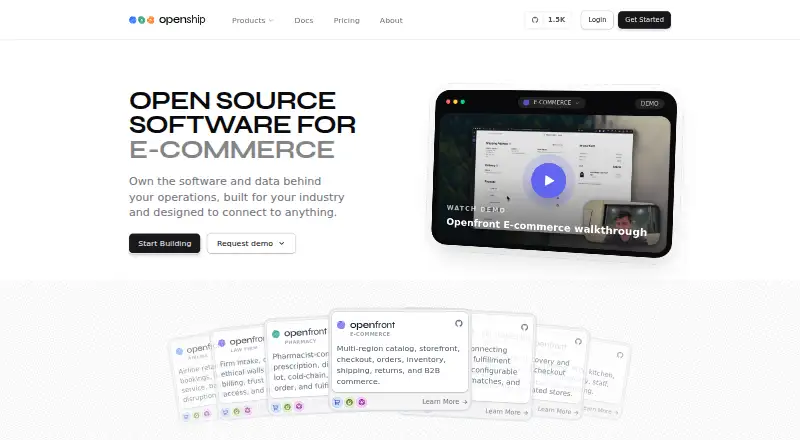
What Openship is
Openship is an open-source order management system that connects sales channels to fulfillment locations. It can split order line items and route them using inventory, shipping costs, and delivery times, with product and inventory matching for multi-channel fulfillment. Users can configure shops, channels, links, and routing rules. Examples of connectable shops include Shopify, WooCommerce, eBay, and Amazon; described workflows connect marketplace sellers, third-party logistics providers, suppliers, and storefronts. Openship is self-hosted, with source code and documentation linked from its product page. Its free self-deployed plan includes unlimited shops, channels, orders, and users, plus community support. Hosted plans are also listed: Starter includes managed infrastructure and automatic updates, while Professional and Enterprise include additional features and support. Starter is limited to 1,000 orders and three users per month; Professional allows up to 10,000 orders and ten users. Enterprise includes unlimited orders, users, shops, and channels, along with custom integrations, onboarding, training, an account manager, advanced audit logs, and an enterprise SLA.
Who it suits
Openship suits sellers and fulfillment operations coordinating orders across sales channels, suppliers, storefronts, or logistics providers. Its free plan is for teams prepared to self-host; hosted plans are available for those seeking managed infrastructure.
What it does well
- Free self-deployed plan has unlimited orders and users
- Routes order items using inventory, costs, and delivery times
- Connects shops including Shopify and WooCommerce
- Source code and documentation are available
What to know first
- Starter is limited to 1,000 orders and three users monthly
- Professional is limited to 10,000 orders and ten users
- Hosted Starter costs $99 a month
Limits
The free self-deployed plan includes unlimited shops, channels, orders, and users. Starter costs $99 a month and is limited to 1,000 orders and 3 users monthly; Professional costs $249 a month and is limited to 10,000 orders and 10 users.
Plans
| Plan | Billed and limits | Price |
|---|---|---|
| Free | Free forever · Self-deploy · unlimited orders · unlimited products · unlimited regions · multi-location inventory · all built-in integrations · custom storefront · white-label ready · community support · full source code | Free |
| Professional | $199/month · Up to 5,000 orders/month · up to 10,000 products · up to 5 regions · multi-location inventory · advanced integrations · advanced analytics · priority support · SLA guarantee | $199 a month |
| Enterprise | $399/month · Unlimited orders · unlimited products · unlimited regions · multi-location inventory · custom integrations · custom analytics · dedicated account manager · onboarding and training · enterprise SLA | $399 a month |
| Starter | $49/month · Up to 500 orders/month · up to 1,000 products · 1 region · single-location inventory · standard integrations · managed infrastructure · automatic updates · email support | $49 a month |
As openship.org lists them, read 15 Oct 2026. The maker's own page has the final word.
Getting started
- Visit the Openship website and review its linked source code and documentation.
- Choose the free self-deployed plan or a hosted plan.
- For self-deployment, set up shops, channels, links, and routing rules.
- Connect shops such as Shopify, WooCommerce, eBay, or Amazon.
- Use product and inventory matching to configure multi-channel fulfillment.
Openship is an open-source order management system for connecting sales channels to fulfillment locations. It suits marketplace sellers and operations teams that need to match products and route orders across stores, suppliers or third-party logistics providers. Its strongest case is flexible routing with a self-hosted free plan; hosted plans add managed infrastructure but impose monthly order and user caps.
Overview
Openship connects channels such as Shopify, WooCommerce, eBay and Amazon with fulfillment locations. It can split an order’s line items and route them according to inventory, shipping costs and delivery times, so it is aimed at coordinating fulfillment rather than simply collecting orders in one place.
Product and inventory matching help align listings across channels and fulfillment partners. Users can configure shops, channels, links and routing rules around their operations. That flexibility is useful when the same catalog is sold through multiple storefronts or fulfilled by different partners; teams seeking a preconfigured, narrowly scoped workflow may find the configuration burden less appealing.
Key features
- Order routing: Split line items and direct them using inventory, shipping cost and delivery time. This gives multi-location operations control over fulfillment decisions, but the value depends on having routing rules that reflect how the business actually works.
- Product matching: Match products and inventory across channels and fulfillment partners, addressing a key coordination problem for sellers with overlapping catalogs.
- Configurable workflows: Set up shops, channels, links and routing rules to suit the operation rather than relying on a single fixed path.
- Open source and self-hosting: The free plan includes full source code and unlimited shops, channels, orders and users. That removes plan quotas for self-deploying teams, while leaving deployment in their hands.
- Managed hosting: Paid hosted plans include managed infrastructure; Starter also includes automatic updates. This trades self-deployment control for a hosted service, with order and seat ceilings on the lower tiers.
Pricing
Openship is freemium, with a self-deployed free plan and paid plans shown at $99/month, $249/month and $499/month. A 30-day trial is offered. The pricing summary also gives a starting figure of $49/mo, which differs from the plan prices shown below.
| Plan | Price | What it includes | Best fit |
|---|---|---|---|
| Free | 0.00 USD, free forever | Self-deployment; unlimited shops, channels, orders and users; all built-in integrations; community support; full source code. | Teams able to host and maintain the software themselves, especially those that need uncapped usage. |
| Starter | $99 a month | Up to 1,000 orders and 3 users per month; unlimited shops and channels; managed infrastructure; automatic updates; email support. | Smaller operations that want hosted service and fit within the order and seat limits. |
| Professional | $249 a month | Up to 10,000 orders and 10 users; advanced integrations and analytics; priority support; custom webhooks; SLA guarantee. | Growing teams that need more volume, more users and the additional integration and support provisions. |
| Enterprise | $499 a month | Unlimited orders, users, shops and channels; custom integrations; dedicated account manager; onboarding and training; advanced audit logs; enterprise SLA. | Organizations needing uncapped hosted usage and the listed implementation and account services. |
The trade-off is clearest between Free and Starter: Free has no stated order or user cap but requires self-deployment, while Starter supplies managed infrastructure and updates at a limit of 1,000 orders and 3 users monthly. Professional raises those ceilings to 10,000 orders and 10 users, but still caps both. Enterprise removes those caps and adds onboarding, training and an account manager. Community support is limited to Free; hosted support rises from email on Starter to priority on Professional.
Platforms
Openship is available as self-hosted software and on the web. Self-hosting is the route to the free plan’s unlimited usage; hosted plans suit teams that prefer Openship to manage infrastructure.
Who it's for
Openship is a good fit for sellers coordinating fulfillment across several channels and locations, particularly when orders may need to be split or routed among suppliers and logistics providers. The free self-hosted tier is compelling for teams able to manage deployment and wanting broad usage without order or user caps. Teams preferring hosted operations should compare their monthly order volume and seat count against the paid plan limits before choosing.
It is less suitable for a small team that wants hosted service without monitoring quotas, or for organizations that need capabilities beyond the stated routing, matching and workflow configuration. Enterprise is the clearest fit when unlimited hosted usage, custom integrations and account-level support matter.
Pros and cons
- Pro: The free self-hosted plan includes unlimited orders, users, shops and channels, plus all built-in integrations and full source code, making it a substantial option for teams comfortable managing deployment.
- Pro: Routing by inventory, shipping costs and delivery times, together with line-item splitting, supports more involved fulfillment arrangements.
- Pro: Hosted tiers include managed infrastructure, and Starter adds automatic updates.
- Con: Hosted Starter is limited to 1,000 monthly orders and 3 users; Professional still caps usage at 10,000 orders and 10 users.
- Con: Free is self-deployed and includes community support, so teams wanting managed hosting and direct email support must move to a paid tier.
Alternatives
For a broader comparison, see Order Management Software.
- Kiero OMS is another freemium option, with a free plan offering 100 monthly orders and 500 products; consider it if those limits and its macOS, web or Windows platforms suit your operation.
- Ordoro has a free plan and trial, with an Essential tier covering 100 orders, one sales channel, one ship-from location and one user; its Advanced plan is $59 a month for up to 3,000 orders. It is worth comparing if those stated order and channel limits align better with your needs.
- Pickgro offers a free tier for 100 orders and 999 catalog products, and a Business tier priced at 149.00 PLN a month plus PLN 0.14 per processed order. Consider it if those catalog and order terms or its mobile and desktop platforms are a better match.
- Sellbrite has a Forever Free plan capped at 30 orders per month, with unlimited integrated sales channels, SKUs and users. It is a candidate for very low order volumes where those channel and user allowances matter.
- EMERGE offers a free plan for one user and four quotations, sales and purchases a month, making it relevant if those small-scale allowances fit your work.
- Manhattan Active Inventory Replenishment is a paid alternative.
- ChannelEngine uses tailored pricing based on GMV and integration requirements, including a monthly license fee and a success-based fee on incremental marketplace GMV growth; consider it if that pricing basis fits your marketplace operation.
- Extensiv Order Manager offers Core with one external 3PL warehouse, unlimited sales channels, inventory and order management, business analytics and integrations; consider it if that combination fits your fulfillment setup.
Verdict
Choose Openship if you need configurable, multi-channel fulfillment routing and can either manage a self-hosted deployment or stay within a hosted tier’s order and user limits. Its combination of line-item routing, product matching and an uncapped free self-hosted plan is the strongest reason to choose it. Look elsewhere if you need hosted service without quotas at a lower tier, or do not want to take responsibility for self-deployment.
Verdict
Openship combines channel connections, product matching, and configurable fulfillment routing, with a free self-hosted option and paid hosted tiers. Review the monthly order and user limits when choosing between hosted plans.
Questions
Is Openship open source?
Yes. Openship is open source, and its source code and documentation are linked from its product page.
Can I use it for free?
Yes. The Free plan is billed Free forever and includes self-deployment, unlimited shops, channels, orders, and users, all built-in integrations, and community support.
What do hosted plans cost?
Starter costs $99 a month, Professional costs $249 a month, and Enterprise costs $499 a month.
Which shops can it connect?
Examples named on the product page are Shopify, WooCommerce, eBay, and Amazon.
What are the Starter and Professional limits?
Starter allows up to 1,000 orders and 3 users per month. Professional allows up to 10,000 orders and 10 users.
Who founded Openship?
The About page identifies Junaid Kabani as founder and CEO and says he started building Openship in 2019.
Facts from Openship's own pages
- API
- A GraphQL API exposes the generated contract for the deployed source revision. · docs.openship.org, 15 Oct 2026
- Architecture
- The application uses Next.js, Keystone, GraphQL, Prisma and PostgreSQL, with routing-specific users, API keys, shops, channels, orders, matches and tracking records. · docs.openship.org, 15 Oct 2026
- Built-in adapters
- The integration guide lists Shopify, BigCommerce, WooCommerce and Demo templates, with Medusa, Magento and Stripe marked as coming soon. · docs.openship.org, 15 Oct 2026
- Channel links
- Links connect multiple sales shops with fulfillment channels through routing rules. · openship.org, 15 Oct 2026
- Company founder
- The About page identifies Junaid Kabani as founder and CEO and says development began in 2019. · openship.org, 15 Oct 2026
- Company headquarters
- LinkedIn lists the company headquarters as Remote, US. · linkedin.com, 15 Oct 2026
- Company size
- LinkedIn lists Openship as a privately held Internet Publishing company with 2–10 employees. · linkedin.com, 15 Oct 2026
- Custom integrations
- Custom shop integrations can be implemented with TypeScript functions or custom HTTP endpoints. · docs.openship.org, 15 Oct 2026
- Dashboard
- The dashboard provides order, shop, channel, match and API-key workspaces. · docs.openship.org, 15 Oct 2026
- Developer setup
- The repository setup requires Node.js 20 or newer, PostgreSQL, Git and npm, plus a database URL and session secret. · github.com, 15 Oct 2026
- Documentation depth
- Documentation covers architecture, dashboard routes, GraphQL usage, integration functions, OAuth, webhooks and custom HTTP adapters. · docs.openship.org, 15 Oct 2026
- Enterprise services
- Enterprise includes custom integrations, onboarding and training, an account manager, advanced audit logs, and an enterprise SLA. · openship.org, 30 Sept 2026
- Founded
- 2019 · openship.org, 28 Sept 2026
- Fulfillment channels
- A channel can be a supplier store, a 3PL service, a Google Sheet row or an email workflow. · github.com, 15 Oct 2026
- Fulfillment use cases
- The page describes connecting marketplace sellers, third-party logistics providers, suppliers, and storefronts for fulfillment. · openship.org, 30 Sept 2026
- GitHub community
- The openshiporg GitHub account lists 132 followers and 27 public repositories. · github.com, 15 Oct 2026
- Hosting option
- Paid plans are hosted by Openship and include managed infrastructure and automatic updates on Starter. · openship.org, 30 Sept 2026
- Independent ecosystem description
- GitHub describes Openship as part of an open-source ecosystem alongside Openfront commerce and restaurant products. · github.com, 15 Oct 2026
- Integrations
- The product page names Shopify, WooCommerce, eBay, and Amazon as examples of shops that can be connected. · openship.org, 30 Sept 2026
- License
- The public Openship repository is released under the AGPL-3.0 license. · github.com, 15 Oct 2026
- Limit: manual onboarding
- The dashboard documentation says there is currently no onboarding wizard or demo seed, so shop, channel, link and match setup is manual. · docs.openship.org, 15 Oct 2026
- Limit: production hardening
- Documentation warns that idempotency, signature verification, credential isolation, retries and reconciliation must be proven for each adapter before production use. · docs.openship.org, 15 Oct 2026
- Maker and history
- The About page identifies Junaid Kabani as founder and CEO and says he started building Openship in 2019. · openship.org, 30 Sept 2026
- Notable limits
- Starter is limited to 1,000 orders and 3 users per month, while Professional is limited to 10,000 orders and 10 users. · openship.org, 30 Sept 2026
Where Openship stands on Freedom251
- Order Management Software#1 of 68