Freedom251 › Key Management Software

OpenKCM (Open Key Chain Manager)
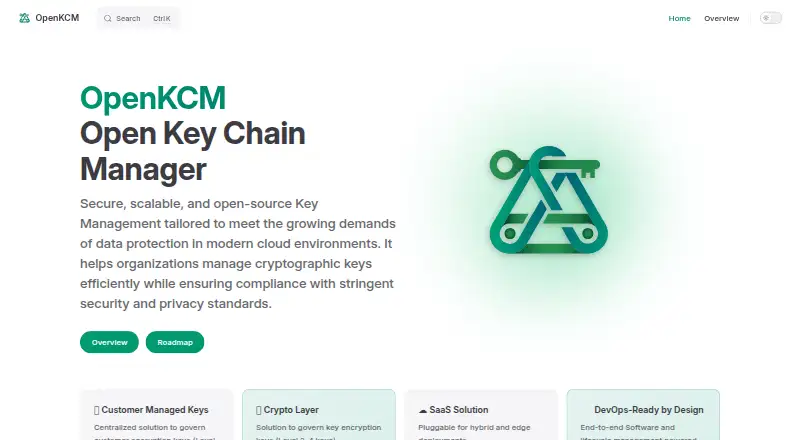
What OpenKCM (Open Key Chain Manager) is
OpenKCM (Open Key Chain Manager) is an open-source key management service for governing encryption keys and protecting data at rest. It supports importing customer keys through BYOK and keeping master keys in the customer’s infrastructure through HYOK. Its recursive L1–L4 hierarchy makes lower-level data keys depend on higher-level keys. The architecture separates governance and policy control in CMK from cryptographic execution in Krypton; applications request key operations through the KMIP API. The Gateway is designed to run near applications, such as in Kubernetes or a cloud VPC, and the same software can run across AWS, Azure, and on-premise environments. Customer root keys can remain in AWS, Azure, or GCP key services, or on-premise Thales or Entrust HSMs, while OpenKCM keeps a reference to the L1 key. A kill switch can halt downstream key use by deleting that pointer or revoking the root key. CMK connects with corporate identity providers and outputs audit logs to SIEM systems. The project is actively developing CMK and Krypton, and its repositories use the Apache-2.0 license.
Who it suits
The project identifies regulated-data organizations, enterprises with regional key-management needs, SaaS platforms seeking BYOK or HYOK, and developers of encrypted storage solutions as intended users. It may suit teams prepared to work with a self-hosted or hybrid key-management system that is still under active development.
What it does well
- Supports customer key import through BYOK and master-key HYOK.
- Customer root keys can remain in external KMS or HSM.
- KMIP API lets applications request key operations.
- CMK connects to identity providers and outputs audit logs.
- Apache-2.0 licensed and open source.
What to know first
- CMK and Krypton are actively being developed.
- Encryption and decryption operations are listed as in progress.
- High availability and disaster recovery are planned for 2027.
- Requires deployment near applications or in customer infrastructure.
Limits
The project is actively developing CMK and Krypton, and encryption and decryption operations are listed as in progress. Audit export, high availability, and disaster recovery are planned for 2027.
Getting started
- Visit the OpenKCM website and documentation.
- Use the repository instructions to try the CMK layer.
- Deploy the Krypton Gateway near applications in a Kubernetes cluster or cloud VPC.
- Connect the customer root key through an external KMS service or on-premise HSM.
- Have applications request key operations through KMIP.
Verdict
OpenKCM separates key governance from cryptographic execution and supports customer-controlled root keys across cloud and on-premise environments. Its project status matters: core components remain in development, and several roadmap items are planned rather than complete.
Questions
Is OpenKCM free and open source?
Yes. It is listed as free and open source, and the CMK and Krypton repositories use the Apache-2.0 license.
What deployment options does it support?
It uses a hybrid deployment model. The Gateway is intended to run near applications in Kubernetes or a cloud VPC, and the same software can run across AWS, Azure, and on-premise environments.
Does it support BYOK and HYOK?
Yes. BYOK lets organizations import customer keys, while HYOK keeps master keys in the customer’s infrastructure.
Which external key stores can hold customer root keys?
The trust model names AWS, Azure, and GCP key services, plus on-premise Thales or Entrust HSMs.
What API do applications use?
OpenKCM describes KMIP as its standard API for applications to request key operations.
Who is developing OpenKCM?
OpenKCM is a project of Linux Foundation Europe. Its CMK and Krypton components are actively being developed.
Facts from OpenKCM (Open Key Chain Manager)'s own pages
- Architecture
- OpenKCM separates governance and policy control in CMK from cryptographic execution in Krypton. · openkcm.io, 4 Oct 2026
- BYOK and HYOK
- It supports importing customer keys (BYOK) and keeping master keys in the customer’s own infrastructure (HYOK). · openkcm.io, 5 Oct 2026
- Cryptographic operations
- The Krypton execution plane wraps and unwraps keys using keys temporarily loaded into secure memory. · openkcm.io, 5 Oct 2026
- Deployment
- The documentation describes deploying the Gateway near applications in a Kubernetes cluster or cloud VPC, and says the same Gateway software can run across AWS, Azure, and on-premise environments. · openkcm.io, 4 Oct 2026
- Development status
- The project documentation says the CMK layer can be tried through its repository instructions and Krypton is in active progress. · github.com, 5 Oct 2026
- Edge deployment
- The Krypton Gateway is described as running in an application environment such as Kubernetes or a VPC. · openkcm.io, 5 Oct 2026
- External key stores
- The trust model names AWS, Azure, and GCP key services and on-premise HSMs as locations for customer root keys. · openkcm.io, 5 Oct 2026
- Governance and execution
- The trust model separates the CMK governance plane from the Krypton cryptographic execution plane. · openkcm.io, 5 Oct 2026
- Identity and audit
- The CMK component connects to a corporate identity provider and outputs audit logs to SIEM systems. · openkcm.io, 5 Oct 2026
- Integrations
- The trust model names AWS, Azure, and GCP external KMS services and on-premise Thales or Entrust HSMs as locations for customer root keys. · openkcm.io, 4 Oct 2026
- Intended users
- The maker identifies cloud-native organizations, enterprises with regional key lifecycle needs, SaaS platforms, and developers of encrypted storage as intended users. · openkcm.io, 5 Oct 2026
- Key hierarchy
- It organizes keys in a recursive L1–L4 hierarchy and describes data keys as dependent on higher-level keys. · openkcm.io, 5 Oct 2026
- Key management
- It supports key hierarchies, importing customer keys through BYOK, and keeping master keys in the customer’s infrastructure through HYOK. · openkcm.io, 4 Oct 2026
- Key security
- The trust model says the customer’s L1 root key remains in the customer’s external KMS or HSM, while OpenKCM holds a reference to it. · openkcm.io, 4 Oct 2026
- License
- The OpenKCM GitHub organization lists its CMK and Krypton repositories under the Apache-2.0 license. · github.com, 5 Oct 2026
- Planned work
- The project roadmap lists encryption and decryption operations as in progress, while audit export, high availability, and disaster recovery are planned for 2027. · github.com, 5 Oct 2026
- Project home
- OpenKCM says it is a project of Linux Foundation Europe. · openkcm.io, 5 Oct 2026
- Project status
- The project’s GitHub page says its CMK control plane and Krypton crypto layer are actively being developed and links to documentation and a roadmap. · github.com, 4 Oct 2026
- Protocol
- OpenKCM describes KMIP as its standard API for applications to request key operations. · openkcm.io, 4 Oct 2026
- Purpose
- OpenKCM is an open-source key management service for managing cryptographic keys across services and regions. · openkcm.io, 5 Oct 2026
- Revocation
- OpenKCM describes a kill switch that can stop downstream key use by deleting the root-key pointer or revoking the root key. · openkcm.io, 4 Oct 2026
Where OpenKCM (Open Key Chain Manager) stands on Freedom251
- Key Management Software#16 of 25
- Encryption Key Management Software#16 of 24