Freedom251 › Legal Research Software
OpenJurist
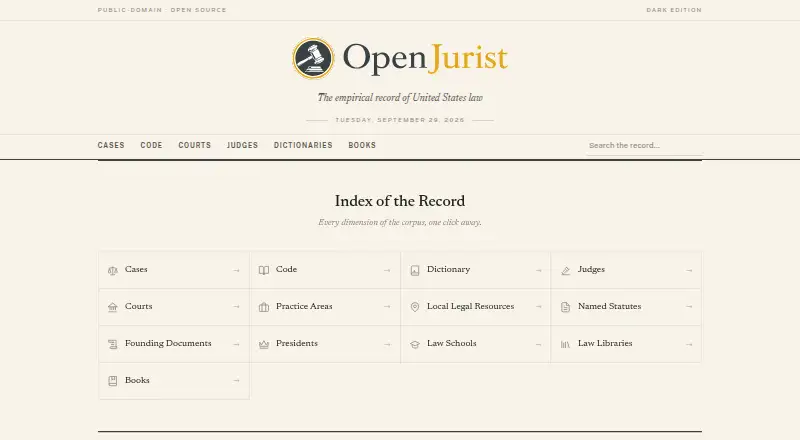
What OpenJurist is
OpenJurist is a free legal research portal covering United States federal, state, and tribal law, including the District of Columbia, Puerto Rico, and U.S. territories. Its collection brings together court opinions, the U.S. Code, a legal dictionary drawing on multiple sources, information about judges, courts, and law schools, founding documents, and 304 curated landmark decisions. Case pages show citation profiles, citation activity over time, appellate history, and passages later courts have relied on. A free citation checker can check whether a case exists, remains good law, and contains a quotation. The site also presents circuit splits by issue, judge records, case status, and comparisons of state statutes with federal law. OpenJurist says quotations are checked against source opinions and labels machine-derived analysis with links to its methodology. Readers can browse without an account. Developers can retrieve JSON through a read-only API covering opinions, statutes, dictionary entries, judges, courts, and search. OpenJurist describes itself as a public research resource, not legal advice, and says its content is not guaranteed to be accurate, complete, or adequate.
Who it suits
OpenJurist suits people researching United States law who need case opinions, statutes, citation tools, or related legal reference material. Developers seeking a read-only API for legal data may also find it useful.
What it does well
- Free access to case law and statute searches
- Covers federal, state, and tribal jurisdictions
- Citation checker reviews case status and quotations
- Case pages include appellate history and citation profiles
- Read-only API provides JSON for several legal resources
What to know first
- Docket search is unavailable
- Research alerts are unavailable
- API access is described as intended for low-volume use
Limits
The free API access is intended for low-volume use.
Plans
| Plan | Billed and limits | Price |
|---|---|---|
| Free access | Free for low-volume use | Free |
As openjurist.org lists them, read 8 Oct 2026. The maker's own page has the final word.
Getting started
- Open the OpenJurist website
- Search case law or statutes, or use the citation checker
- For programmatic access, retrieve JSON through the read-only API
Verdict
Choose OpenJurist for free United States legal research, citation checking, and low-volume API access. Look elsewhere if docket search or research alerts are essential. Its content is not legal advice and is not guaranteed to be accurate, complete, or adequate.
Questions
Is OpenJurist free?
Yes. Its Free access plan costs nothing, and the citation checker is free.
What law does OpenJurist cover?
It covers United States federal, state, and tribal jurisdictions, including the District of Columbia, Puerto Rico, and U.S. territories.
Can I use OpenJurist without an account?
Yes. The site can be read without an account.
Does OpenJurist provide an API?
Yes. Developers can retrieve JSON through a read-only API for opinions, statutes, dictionary entries, judges, courts, and search. Low-volume use is free.
Does OpenJurist offer docket search or research alerts?
No. Docket search and research alerts are unavailable.
Is OpenJurist legal advice?
No. OpenJurist describes itself as a public legal-research resource, not legal advice.
Facts from OpenJurist's own pages
- Accessibility
- The site aims to conform to WCAG 2.1 Level AA and lists unaudited areas including bulk data tables, older scanned material, and admin tools. · openjurist.org, 8 Oct 2026
- API
- Developers can pull JSON from a read-only API with endpoints for opinions, statutes, dictionary entries, judges, courts, and search. · openjurist.org, 8 Oct 2026
- API usage limit
- The API is free of charge for low-volume use; the page does not state a numeric request limit. · openjurist.org, 8 Oct 2026
- Audience and disclaimer
- OpenJurist describes itself as a public legal-research resource and says its content is not legal advice and is not guaranteed to be accurate, complete, or adequate. · openjurist.org, 8 Oct 2026
- Case analytics
- Case pages provide citation profiles, citations over time, appellate history, and passages later courts rely on. · openjurist.org, 8 Oct 2026
- Data sharing
- OpenJurist says it does not sell personal information or share it for advertising, and identifies Google Analytics and Cloudflare as service providers. · openjurist.org, 8 Oct 2026
- Integrations
- An MCP endpoint for connecting assistants such as Claude Desktop, ChatGPT, Cursor, and Perplexity is listed as coming post-launch. · openjurist.org, 8 Oct 2026
- Other analysis
- The site describes circuit splits organized by issue, judge records, case status, and comparisons of state statutes with federal law. · openjurist.org, 8 Oct 2026
- Planned availability
- Bulk data downloads and interactive OpenAPI documentation are listed as coming post-launch. · openjurist.org, 8 Oct 2026
- Privacy
- The site can be read without an account; administrator-only sign-in is available at launch, and server logs include request IP addresses retained as needed for security, error diagnosis, and abuse prevention. · openjurist.org, 8 Oct 2026
- Quote verification
- The citation checker verifies whether a case exists, whether it is still good law, and whether a quotation appears in it; the checker is free. · openjurist.org, 8 Oct 2026
- Research corpus
- The portal includes court opinions, the U.S. Code, a multi-source legal dictionary, judges, courts, law schools, founding documents, and 304 curated landmark decisions. · openjurist.org, 8 Oct 2026
- Verification method
- OpenJurist says quotations are checked against source opinions and machine-derived analysis is labeled and linked to its methodology. · openjurist.org, 8 Oct 2026
- What it does
- OpenJurist is a free legal-research portal for federal, state, and tribal United States law. · openjurist.org, 8 Oct 2026
Where OpenJurist stands on Freedom251
- Legal Research Software#17 of 31