Freedom251 › Building Management Software
OpenBMS
What OpenBMS is
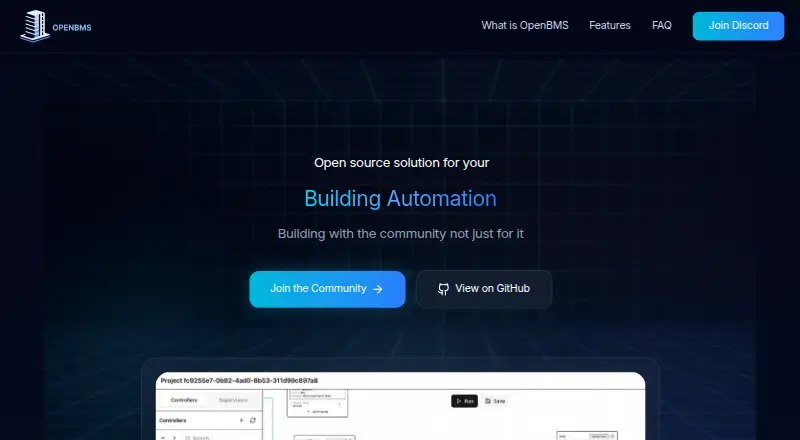
OpenBMS is a community-driven, vendor-neutral Building Management System for connecting BACnet, MQTT, and modern IoT protocols. It is designed for web use and on-premise deployment, and says it can work with BACnet- or MQTT-speaking equipment from manufacturers including Honeywell, Johnson Controls, and Siemens. A visual no-code/low-code interface is intended to help configure control logic, while FMU export with the LBNL Modelica Buildings Library can be used to test sequences virtually before deployment. OpenBMS says it aligns with ASHRAE 223P, BACnet/IP, and 231P. It is open source under AGPL-3.0, with zero licensing fees, no per-point charges, and no annual contracts; users retain ownership of their infrastructure and data. The project is marked Pre-Release and is in Phase 6 of 8, with real BACnet device discovery and integration planned for Phase 7. Native semantic modeling, BuildingMOTIF validation, an AI copilot, and G36 demand-limiting sequences are all marked Coming Soon. OpenBMS directs community discussion and support to Discord, code contributions to GitHub, and participation to its documentation.
Who it suits
OpenBMS is aimed at building automation experts, developers, facility managers, and independent integrators working with BACnet or MQTT equipment. Its open-source model, on-premise deployment, and visual control-logic interface may suit teams that want to own and customize their building-management infrastructure.
What it does well
- Open source under the AGPL-3.0 license.
- No licensing fees, per-point charges, or annual contracts.
- Designed for BACnet- and MQTT-speaking devices from multiple manufacturers.
- Offers a visual no-code/low-code interface for control logic.
- Supports virtual sequence testing through FMU export.
What to know first
- The project is marked Pre-Release.
- Real BACnet device discovery and integration are planned for Phase 7.
- Several described features are marked Coming Soon.
- The available platform is web, with on-premise deployment.
Limits
OpenBMS is marked Pre-Release and is in Phase 6 of 8; real BACnet device discovery and integration are planned for Phase 7. Native ASHRAE 223P semantic modeling, BuildingMOTIF integration, the AI copilot, and G36 demand-limiting sequences are marked Coming Soon.
Getting started
- Visit the OpenBMS website and review its documentation.
- Use the early-access invitation to explore the pre-release project.
- Deploy the web-based system on-premise.
- Connect compatible BACnet- or MQTT-speaking devices.
- Use Discord for discussion and support, or GitHub to contribute code.
Verdict
Consider OpenBMS if you want an open-source, on-premise building management system for BACnet- or MQTT-speaking devices, with control logic configured through a visual interface. Look elsewhere if you need real BACnet device discovery now or require semantic modeling, BuildingMOTIF validation, the AI copilot, or G36 demand limiting before those capabilities are available.
Questions
How much does OpenBMS cost?
OpenBMS says it has zero licensing fees, with no per-point charges or annual contracts.
Is OpenBMS open source?
Yes. The project’s GitHub README says it is licensed under AGPL-3.0.
Which devices can OpenBMS connect to?
It is designed for BACnet- and MQTT-speaking devices, including equipment from Honeywell, Johnson Controls, and Siemens.
Which standards does OpenBMS align with?
The site says it aligns with ASHRAE 223P, BACnet/IP, and 231P.
Is OpenBMS ready for use?
It is labeled Pre-Release and is in Phase 6 of 8. Real BACnet device discovery and integration are planned for Phase 7.
Where can users get support or contribute?
OpenBMS directs users to Discord for discussion and support, GitHub for code contributions, and its documentation for participation.
Facts from OpenBMS's own pages
- AI feature
- The site describes an AI copilot for mapping BACnet points to ASHRAE 223P and suggesting configurations, marked “Coming Soon.” · openbms.io, 4 Oct 2026
- Availability
- The site labels OpenBMS as pre-release and invites users to get early access. · openbms.io, 9 Oct 2026
- Building models
- The site says BuildingMOTIF integration validates building models against standards automatically. · openbms.io, 9 Oct 2026
- Control programming
- The site describes a no-code/low-code visual interface for integrators to configure control logic. · openbms.io, 9 Oct 2026
- Data ownership
- The site says users own their infrastructure and data and can move their semantic model between contractors, vendors or platforms. · openbms.io, 4 Oct 2026
- Demand response
- The site describes G36 Demand Limiting sequences that respond to grid signals and price spikes while maintaining comfort, marked “Coming Soon.” · openbms.io, 4 Oct 2026
- Development status
- The project’s GitHub README says it is in Phase 6 of 8, with real BACnet device discovery and integration planned for Phase 7. · github.com, 4 Oct 2026
- Energy management
- The site says pre-integrated ASHRAE G36 sequences deliver 30–50% HVAC energy savings. · openbms.io, 9 Oct 2026
- Hardware compatibility
- OpenBMS says it is hardware-agnostic and can integrate devices that speak BACnet or MQTT, including equipment from Honeywell, Johnson Controls and Siemens. · openbms.io, 4 Oct 2026
- Hardware support
- The FAQ names Honeywell, Johnson Controls, and Siemens among supported device manufacturers. · openbms.io, 9 Oct 2026
- Intended users
- The site describes the community as including building automation experts, developers and facility managers, and highlights independent integrators. · openbms.io, 4 Oct 2026
- Interoperability
- OpenBMS says it bridges legacy systems with modern IoT infrastructure and is designed to work with BACnet- and MQTT-speaking devices. · openbms.io, 9 Oct 2026
- License
- The project’s GitHub README says it is licensed under AGPL-3.0. · github.com, 4 Oct 2026
- Licensing
- The site advertises zero licensing fees, with no per-point charges or annual contracts. · openbms.io, 9 Oct 2026
- Ownership
- The FAQ says users own their infrastructure and data and can customize the open-source system. · openbms.io, 9 Oct 2026
- Product
- OpenBMS describes itself as a community-driven, vendor-neutral Building Management System that connects BACnet, MQTT, and modern IoT protocols. · openbms.io, 9 Oct 2026
- Programming
- The site describes a no-code/low-code visual programming interface for configuring control logic. · openbms.io, 4 Oct 2026
- Release status
- The site labels OpenBMS “Pre-Release” and invites users to get early access and help shape the product. · openbms.io, 4 Oct 2026
- Semantic modeling
- The site describes native ASHRAE 223P semantic modeling and BuildingMOTIF integration for validating building models, with both marked “Coming Soon.” · openbms.io, 4 Oct 2026
- Simulation
- The site says FMU export with the LBNL Modelica Buildings Library can test control sequences virtually before deployment. · openbms.io, 9 Oct 2026
- Standards
- The site says OpenBMS aligns with ASHRAE 223P, BACnet/IP, and 231P. · openbms.io, 9 Oct 2026
- Support
- The site directs users to Discord for real-time discussions, GitHub for code contributions, and its documentation for participation and support. · openbms.io, 9 Oct 2026
Where OpenBMS stands on Freedom251
- Building Management Software#4 of 26