Freedom251 › API Mocking Tools
OpenAPI Server
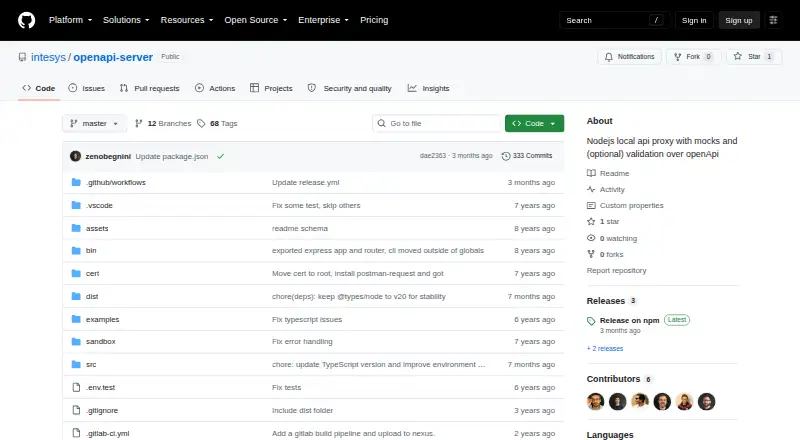
What OpenAPI Server is
OpenAPI Server is a local mock server for API development, useful when an application needs service responses before its backend is ready. It can provide predictable responses for end-to-end tests and validate OpenAPI 3 and Swagger/OpenAPI 2 YAML specifications. Multiple specification files or directories are supported, with checks for conflicting paths and methods. Mocks may be JSON files, JavaScript modules, or Express middleware; matching mocks take precedence over proxying by default. When proxying is enabled, valid requests without a matching mock can go to a configured backend, and response validation is optional. The server also supports static files, HTTP and HTTPS, watch mode, and configuration through CLI options, environment variables, or environment files. As an Express web server, it can run as an application or router and accept custom Express middleware. It is open source under the ISC license and requires Node.js 18 or later. Installation is through npm from its GitHub repository. JavaScript mocks run at runtime, so TypeScript mock files are not supported.
Who it suits
It suits developers prototyping an application against an API before the backend is available, as well as teams needing predictable API responses for end-to-end tests. Express projects can also use it as an application or router.
What it does well
- Validates OpenAPI 3 and Swagger/OpenAPI 2 specifications.
- Supports JSON, JavaScript, and Express middleware mocks.
- Can proxy requests and optionally validate responses.
- Includes HTTP, HTTPS, static files, and watch mode.
What to know first
- Requires Node.js 18 or later.
- TypeScript mock files are not supported.
- JavaScript mocks must run at runtime.
Limits
The package requires Node.js 18 or later. TypeScript mock files are not allowed because they cannot be transpiled at runtime; JavaScript mocks must execute at runtime.
Getting started
- Install the package from its GitHub repository with npm
- Prepare OpenAPI 3 or Swagger/OpenAPI 2 YAML specifications
- Create JSON, JavaScript, or Express middleware mocks
- Configure paths, proxying, and options with CLI settings, environment variables, or environment files
- Start the server and use the API at localhost:3000/api
Verdict
OpenAPI Server covers local mocking, specification validation, and optional backend proxying. Its runtime requirement and lack of TypeScript mock support are important considerations.
Questions
Is OpenAPI Server free?
Yes. It is free and open source under the ISC license.
Where can it run?
It runs locally as a self-hosted API service and supports HTTP and HTTPS.
What specifications does it validate?
It validates OpenAPI 3 and Swagger/OpenAPI 2 YAML specifications.
Can it proxy to a backend?
Yes. When proxying is enabled, valid requests without a matching mock are forwarded to the configured backend, and responses can optionally be validated.
How are mocks defined?
Mocks may be JSON files, JavaScript modules, or Express middleware, and matching mocks are enabled by default.
What license and runtime are required?
The project uses the ISC license and declares Node.js version 18 or later.
Facts from OpenAPI Server's own pages
- Additional features
- It supports serving static files, HTTP and HTTPS, watch mode, and custom Express middleware. · github.com, 5 Oct 2026
- Configuration
- Configuration is available through command-line options, environment variables, and environment files. · github.com, 5 Oct 2026
- Default behavior
- Mocks are enabled by default and take precedence over proxying when a matching mock exists. · github.com, 4 Oct 2026
- End-to-end testing
- Mocks can provide predictable API responses for end-to-end tests. · github.com, 4 Oct 2026
- Install
- The README instructs users to install it from its GitHub repository with npm. · github.com, 4 Oct 2026
- Installation
- The README gives a GitHub-based npm install command and a quick start that serves the API at localhost:3000/api. · github.com, 5 Oct 2026
- Integration
- The project can run as a command-line server or be imported programmatically as an application or Express router. · github.com, 5 Oct 2026
- Intended use
- The README describes using it to mock services while prototyping a single-page application without a working backend. · github.com, 4 Oct 2026
- License
- The package declares the ISC license. · github.com, 5 Oct 2026
- Maker location
- The Intesys GitHub organization profile lists Italy as its location. · github.com, 4 Oct 2026
- Mock formats
- Mocks can be JSON files, JavaScript modules, or Express middleware. · github.com, 4 Oct 2026
- Mocking
- Mocks can be JSON files, JavaScript modules, or Express middleware, and mocks are enabled by default. · github.com, 5 Oct 2026
- Multiple specifications
- It supports multiple specification files and directories and checks paths and methods for conflicts. · github.com, 4 Oct 2026
- Notable limits
- JavaScript mocks must run at runtime; the README says TypeScript mock files are not allowed because they cannot be transpiled at runtime. · github.com, 4 Oct 2026
- OpenAPI support
- It validates OpenAPI version 3 and Swagger version 2 specifications in YAML format. · github.com, 5 Oct 2026
- Other features
- The README lists a static file server, HTTP and HTTPS support, watch mode, and configuration through environment variables, files, or CLI parameters. · github.com, 4 Oct 2026
- Proxy
- When proxying is enabled, valid requests without a matching mock are forwarded to the configured backend. · github.com, 5 Oct 2026
- Proxy and validation
- It can proxy requests to another server and optionally validate responses. · github.com, 4 Oct 2026
- Publishing security
- The README says releases use npm Trusted Publishing with GitHub Actions OIDC and provenance. · github.com, 5 Oct 2026
- Purpose
- OpenAPI Server is a local mock server for development that can proxy requests to a real backend. · github.com, 5 Oct 2026
- Response validation
- The server can optionally validate responses. · github.com, 5 Oct 2026
- Runtime requirement
- The package declares Node.js version 18 or later as its engine requirement. · github.com, 5 Oct 2026
- Use case
- The README describes using it to develop a single-page application before its backend is ready and to run end-to-end tests with predictable API responses. · github.com, 5 Oct 2026
Where OpenAPI Server stands on Freedom251
- API Mocking Tools#22 of 26