Freedom251 › Game Audio Middleware
OpenAL
What OpenAL is
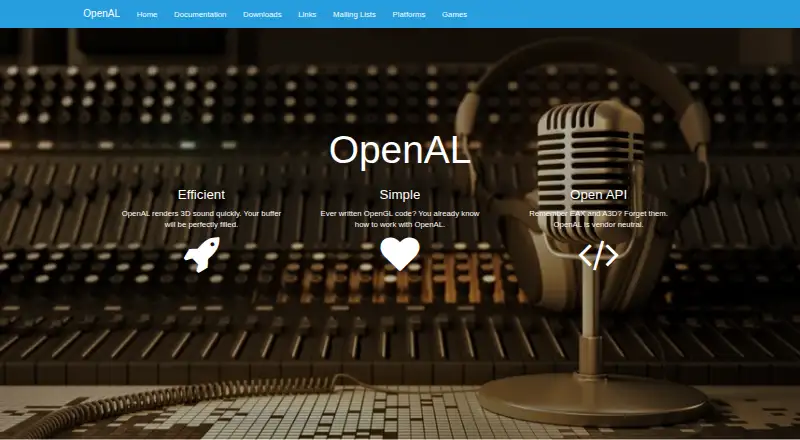
OpenAL is a cross-platform 3D audio API for games and other audio applications. It represents sound sources in three-dimensional space and renders them from a listener’s position, so developers can build audio that responds to movement and listening position. The site describes OpenAL as efficient, simple to use, and vendor neutral, and says developers familiar with OpenGL code will already know how to work with it.
The site lists Linux, macOS, and Windows, with runtime platforms also including BSD, IRIX, Solaris, Macintosh OS 8/9, Microsoft Xbox, and Xbox 360. Audio streaming is supported. Documented extensions include device enumeration and audio capture, plus MP3, Ogg Vorbis, WAVE, and multi-channel audio formats. Linux and standard extensions cover playback position and volume settings; macOS extensions include Apple Spatial Audio and static buffer support; Windows extensions include EAX 2.0 through 5.0 and an effects extension. Documentation links to the OpenAL 1.1 specification and Programmers Guide as PDFs. The downloads page offers the OpenAL 1.1 Core SDK and a Windows installer as ZIP files.
Who it suits
OpenAL suits developers building games or other audio applications that need 3D spatial sound or audio streaming. Its stated familiarity for developers who know OpenGL may also make it a fit for those working with that API.
What it does well
- Models moving audio sources in 3D space from a listener’s position.
- Supports audio streaming.
- Extensions include device enumeration and audio capture.
- Listed formats include MP3, Ogg Vorbis, WAVE, and multi-channel audio.
- Documentation links to the 1.1 specification and Programmers Guide.
- Available as the Core SDK and a Windows installer ZIP.
What to know first
- The listed primary platforms are Linux, macOS, and Windows.
- Downloads are offered as ZIP files.
- Some implementations are associated with Apple or Creative Labs.
Getting started
- Visit the OpenAL website.
- Review the specification or Programmers Guide PDFs.
- Choose the OpenAL 1.1 Core SDK or Windows installer from the downloads page.
- Use the mailing list for platform questions.
Verdict
Choose OpenAL for game or audio development that calls for spatial sound, streaming, or its documented platform extensions. Developers seeking a particular implementation should review the platform details, since implementations have different licensing associations.
Questions
Is OpenAL free?
Yes. Its pricing model is free, and the site describes it as open source.
Which platforms are listed?
Linux, macOS, and Windows are listed. Runtime platforms also include BSD, IRIX, Solaris, Macintosh OS 8/9, Xbox, and Xbox 360.
Does OpenAL support audio streaming?
Yes, audio streaming is supported.
What audio formats do its extensions cover?
Listed formats include MP3, Ogg Vorbis, WAVE, and multi-channel formats.
Where can developers find documentation?
The documentation page links to the OpenAL 1.1 specification and OpenAL Programmers Guide PDFs.
Are all implementations open source?
Some implementations are identified as open source under LGPL, while others are associated with Apple or Creative Labs.
Facts from OpenAL's own pages
- Audio formats
- Listed extensions include MP3, Ogg Vorbis, WAVE, and multi-channel format support. · openal.org, 4 Oct 2026
- Company information
- The maker pages opened do not state a company headquarters or founding date. · openal.org, 8 Oct 2026
- Design
- The site describes OpenAL as efficient, simple to use, and vendor neutral. · openal.org, 8 Oct 2026
- Device extensions
- Listed multi-platform extensions include device enumeration and audio capture. · openal.org, 4 Oct 2026
- Documentation
- The documentation page links to the OpenAL 1.1 specification and OpenAL Programmers Guide as PDFs. · openal.org, 8 Oct 2026
- Downloads
- The downloads page offers the OpenAL 1.1 Core SDK and a Windows Installer from Creative Labs. · openal.org, 8 Oct 2026
- Efficiency
- The site says OpenAL renders 3D sound quickly. · openal.org, 4 Oct 2026
- Extensions
- The documentation lists extensions for device enumeration, audio capture, MP3 support, and platform-specific audio features. · openal.org, 8 Oct 2026
- Familiarity
- The site says developers familiar with OpenGL code already know how to work with OpenAL. · openal.org, 4 Oct 2026
- Licensing
- The platforms page identifies some implementations as open source under LGPL, while others are associated with Apple or Creative Labs. · openal.org, 8 Oct 2026
- Linux extensions
- The documentation lists Linux/standard extensions for playback position, volume settings, and audio formats including WAVE and Ogg Vorbis. · openal.org, 4 Oct 2026
- macOS features
- Listed macOS extensions include Apple Spatial Audio and static buffer support. · openal.org, 4 Oct 2026
- Platforms
- The platforms page lists implementations for BSD, IRIX, Solaris, Linux, Macintosh OS 8/9, Mac OS X, Windows, Xbox, and Xbox 360. · openal.org, 8 Oct 2026
- Product
- OpenAL is a cross-platform 3D audio API for gaming and other audio applications. · openal.org, 8 Oct 2026
- Security
- The maker pages opened provide no security or compliance claims. · openal.org, 8 Oct 2026
- Spatial audio
- The API models audio sources moving in 3D space and heard from the position of a listener. · openal.org, 8 Oct 2026
- Support
- The maker site links developers to documentation and an OpenAL mailing list for platform questions. · openal.org, 8 Oct 2026
- Vendor neutrality
- The site describes OpenAL as vendor neutral. · openal.org, 4 Oct 2026
- Windows features
- Listed Windows extensions include EAX 2.0 through 5.0 and an effects extension. · openal.org, 4 Oct 2026
Where OpenAL stands on Freedom251
- Game Audio Middleware#23 of 24