Freedom251 › Music Theory Software
Open Music Theory
What Open Music Theory is
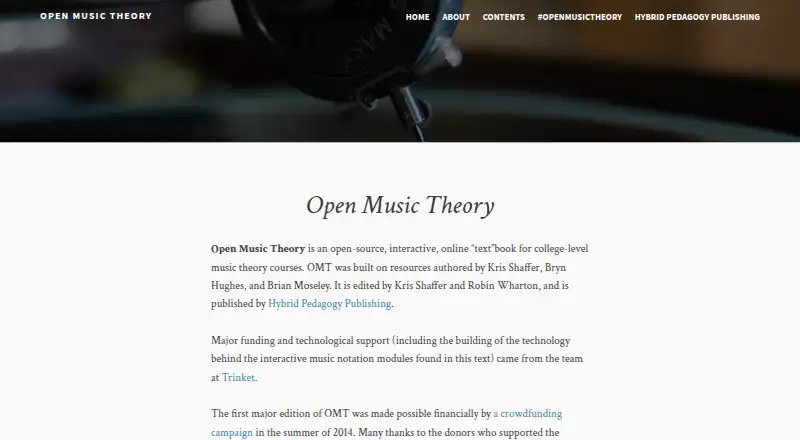
Open Music Theory is a free, open-source online textbook for college-level music theory courses. Its contents range from fundamentals and voice-leading to harmony, form, post-tonal music, pop and rock music, and text and music. The material is intended to work as a quick reference alongside musical activity, with relatively few graphical and audio examples. Interactive exercises and harmony tools accompany the web-based text, including notation modules built with technology supported by Trinket. The textbook’s teaching approach emphasizes active student engagement; its original authors use it in flipped courses. The CC BY-SA 4.0 license allows people to use, modify, distribute, and sell the work with attribution, while derivatives must use the same licensing terms. Users can fork the GitHub project and edit or remove text, graphics, videos, and the HTML and CSS theme. Individual files can also be downloaded for conversion into classroom handouts. Trinket notation has a limited feature set, and its applied-chords page describes support for only one layer of lyrics or harmonic analysis. Hybrid Pedagogy Publishing publishes the book, edited by Robin Wharton and Kris Shaffer.
Who it suits
It suits college-level students and instructors seeking a web-based music theory reference with interactive exercises and notation. Its open license and editable project may also suit educators who want to adapt material or make classroom handouts.
What it does well
- Covers fundamentals, harmony, form, and several other music theory topics.
- Interactive exercises and harmony tools support study.
- CC BY-SA 4.0 permits use, adaptation, distribution, and sale with attribution.
- Users can edit the project or download individual files for handouts.
What to know first
- Trinket notation supports a limited set of musical features.
- Applied-chord analysis supports only one lyrics or analysis layer.
- Its pages use minimal graphical and audio examples.
Limits
The plan is free, with no pricing or usage limits stated. Trinket notation supports a limited feature set, including only one lyrics or harmonic-analysis layer on the applied-chords page.
Plans
| Plan | Billed and limits | Price |
|---|---|---|
| Open Music Theory | No pricing or usage limits stated on the pages opened | Free |
As openmusictheory.github.io lists them, read 9 Oct 2026. The maker's own page has the final word.
Getting started
- Open the Open Music Theory website in a web browser.
- Use the textbook’s contents to navigate its music theory topics.
- For a customized version, fork the GitHub project and edit its materials.
- Download individual files if you want to convert them into classroom handouts.
Verdict
Choose Open Music Theory for a free, adaptable college-level resource with broad topic coverage and interactive notation. Its notation tools have defined limits, and readers looking for extensive graphical or audio examples may prefer another format.
Questions
Is Open Music Theory free?
Yes. Its pricing model is free, and the plan is listed as free.
What platforms does it support?
It is available on the web.
Can I adapt or redistribute the textbook?
Yes. CC BY-SA 4.0 permits use, modification, distribution, and sale with attribution and the same licensing terms for derivatives.
Who publishes and edits it?
Hybrid Pedagogy Publishing publishes it, with Robin Wharton and Kris Shaffer as editors.
What topics does it cover?
Topics include fundamentals, voice-leading, harmony, form, post-tonal music, pop and rock music, and text and music.
Can I make classroom handouts from it?
The about page says individual files can be downloaded for conversion into classroom handouts.
Facts from Open Music Theory's own pages
- Analysis layer limit
- A page on applied chords states that Trinket supports only one layer of lyrics or harmonic analysis. · openmusictheory.github.io, 9 Oct 2026
- Audience
- The site describes the textbook as intended for college-level music theory courses. · openmusictheory.github.io, 9 Oct 2026
- Customization
- The about page says users can fork the GitHub project and edit, add, or remove text, graphics, videos, and the HTML and CSS theme. · openmusictheory.github.io, 9 Oct 2026
- Download option
- The about page says individual files can be downloaded for conversion into classroom handouts. · openmusictheory.github.io, 9 Oct 2026
- Founded
- 2014 · openmusictheory.github.io, 28 Sept 2026
- Interactive notation
- The book includes interactive music notation modules built with technology supported by Trinket. · openmusictheory.github.io, 9 Oct 2026
- Notation limits
- The Trinket guide says the tool supports a limited set of musical features to keep notation simple. · openmusictheory.github.io, 9 Oct 2026
- Open license
- The textbook is licensed under CC BY-SA 4.0, which permits use, modification, distribution, and sale with attribution and the same licensing terms for derivatives. · openmusictheory.github.io, 9 Oct 2026
- Publisher and editors
- The textbook is published by Hybrid Pedagogy Publishing under editors Robin Wharton and Kris Shaffer. · openmusictheory.github.io, 9 Oct 2026
- Reference style
- The pages are intended as a quick reference alongside musical activity, with minimal graphical and audio examples. · openmusictheory.github.io, 9 Oct 2026
- Teaching approach
- The textbook is designed to support active student engagement and is used by its original authors in flipped courses. · openmusictheory.github.io, 9 Oct 2026
- Topics
- The table of contents includes fundamentals, voice-leading, harmony, form, post-tonal music, pop and rock music, and text and music. · openmusictheory.github.io, 9 Oct 2026
- Trinket embedding
- The site says Trinkets can be added to websites that support iFrames and that several are embedded in Open Music Theory. · openmusictheory.github.io, 9 Oct 2026
- What it is
- Open Music Theory is an open-source, interactive online textbook for college-level music theory courses. · openmusictheory.github.io, 9 Oct 2026
Where Open Music Theory stands on Freedom251
- Music Theory Software#17 of 27