Freedom251 › Open Educational Resource Platforms
OERSI
What OERSI is
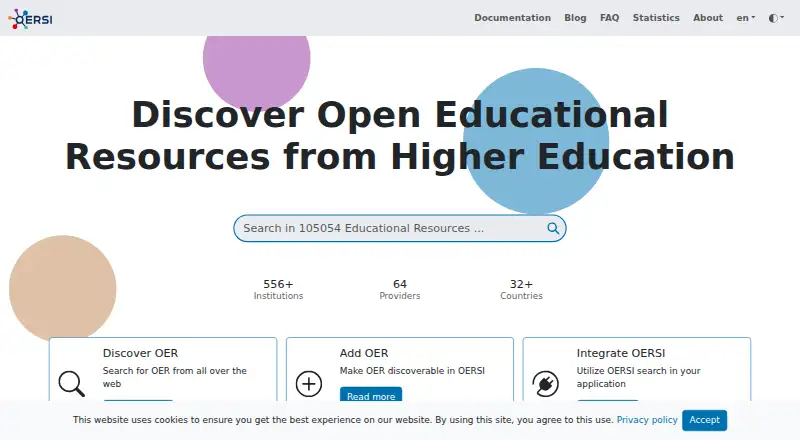
OERSI is a search service for open educational resources related to higher education, jointly provided by hbz and TIB since 2020. It gathers and standardizes metadata from national and international providers, then makes those records searchable through a central interface with filters. OERSI does not store the learning materials themselves; users find metadata that points to resources hosted by providers. Resources considered for inclusion must be relevant to higher education teaching or learning, accessible on the web, at least partly openly licensed and accompanied by acceptable basic metadata. Developers can query a JSON-based Elasticsearch API and use point-in-time searches for bulk access; regular metadata downloads are also available. Search requests should target the oer_data index, since the generic endpoint can return records from multiple indexes and create duplicates. The project accepts collection metadata through formats including schema.org markup with a sitemap, JSON over HTTP, OAI-PMH XML, structured HTML and metadata dumps. Its code is MIT-licensed, and the reusable software is called SIDRE. OERSI reported indexing over 90,000 resources from 45 collections in its fifth-anniversary post.
Who it suits
OERSI suits students, educators and others searching for openly licensed learning materials in higher education. Its API and metadata downloads are also relevant to developers and platforms that want to reuse or integrate the records.
What it does well
- Central search across national and international collections
- Filters help narrow educational resource results
- JSON Elasticsearch API supports bulk access
- Metadata downloads are available
- Code is MIT-licensed
What to know first
- Does not host learning materials
- Listed resources must meet higher education criteria
- API searches should target the oer_data index
Limits
OERSI stores metadata rather than educational content, so users cannot upload learning materials to the service. API requests must target the oer_data index; the generic endpoint can combine indexes and produce duplicates.
Getting started
- Open the OERSI website
- Search the central index and apply filters
- Use the JSON Elasticsearch API for programmatic queries
- Target the oer_data index in search requests
- Use point-in-time searches or prepared downloads for bulk metadata
- Connect a provider through the listed metadata formats or contact form
Verdict
OERSI provides a centralized way to find higher-education learning resources while leaving the content with its original providers. Its API, downloads and MIT-licensed software also support reuse beyond the search interface.
Questions
Does OERSI cost anything?
OERSI is free and open source. Its code is available under the MIT licence.
Does OERSI host courses or other learning files?
No. OERSI collects and harmonizes metadata, while the educational resources remain with their providers.
What can the API do?
The JSON-based Elasticsearch API supports metadata queries, point-in-time bulk access and integrations. Prepared metadata is also available as downloads.
Which resources can be included?
Resources must be relevant to higher-education teaching or learning, web-accessible, at least partly openly licensed and accompanied by acceptable basic metadata.
How can providers submit metadata?
Accepted methods include schema.org markup with a sitemap, JSON over HTTP, OAI-PMH XML, structured HTML with a sitemap and JSON or CSV metadata dumps.
Which platforms integrate OERSI?
The project names twillo and ORCA.nrw as integrations, and lists reuse in BASE, finc and library search interfaces.
Facts from OERSI's own pages
- API and downloads
- An open API supports integrations, and prepared metadata is also available as regular downloads. · oersi.org, 7 Oct 2026
- API format
- The search API returns JSON and is based on Elasticsearch. · oersi.org, 7 Oct 2026
- API usage
- API users are asked to send a meaningful, recurring User-Agent string with contact information where applicable. · oersi.org, 7 Oct 2026
- API usage guidance
- API users are asked to send a meaningful, recurring User-Agent string with client and contact information where applicable. · oersi.org, 7 Oct 2026
- Bulk access
- The API documentation describes querying metadata directly and downloading it in bulk using point-in-time searches. · oersi.org, 7 Oct 2026
- Collection requirements
- Resources considered for inclusion must be relevant to higher education, accessible on the web, at least partly openly licensed, and have acceptable basic metadata. · oersi.org, 7 Oct 2026
- Deployment
- The OERSI team says it uses Ansible scripts to install the service, and the SIDRE software is available for reuse. · oersi.org, 7 Oct 2026
- Does not host learning materials
- OERSI does not store educational content; it harvests metadata from OER providers. · oersi.org, 7 Oct 2026
- Founded
- 2020 · oersi.org, 28 Sept 2026
- Integrations
- The about page names twillo and ORCA.nrw as platforms integrating OERSI search; it also lists reuse in BASE, finc, and library search interfaces. · oersi.org, 7 Oct 2026
- Limits
- Users cannot upload educational content to OERSI because it does not store the content itself. · oersi.org, 7 Oct 2026
- Metadata formats accepted
- OERSI accepts collection metadata as schema.org markup with a sitemap, JSON over HTTP, XML via OAI-PMH, structured HTML with a sitemap, or metadata dumps such as JSON and CSV. · oersi.org, 7 Oct 2026
- Metadata only
- OERSI does not host educational resources; it collects and harmonizes their metadata for unified search. · oersi.org, 7 Oct 2026
- Metadata search
- OERSI collects and standardizes metadata from distributed national and international providers to offer a central search with filters. · oersi.org, 7 Oct 2026
- Metadata sources
- OERSI accepts collection metadata through schema.org markup and sitemap, JSON HTTP APIs, OAI-PMH, structured HTML, and metadata dumps, among other methods. · oersi.org, 7 Oct 2026
- Metadata standard
- OERSI's internal metadata profile largely matches the General Metadata Profile for Educational Resources (AMB). · oersi.org, 7 Oct 2026
- Notable API limit
- Search requests must target the oer_data index; the FAQ warns that querying the generic search endpoint can return results from multiple indexes and cause duplicates. · oersi.org, 7 Oct 2026
- Open API
- OERSI provides a JSON-based Elasticsearch API for querying metadata and supports bulk access using point-in-time searches. · oersi.org, 7 Oct 2026
- Open development
- OERSI says its planning and development are documented on GitLab and invites feedback, bug reports, and feature requests. · oersi.org, 7 Oct 2026
- Open source
- The OERSI code is available under the MIT licence, and the underlying reusable software is called SIDRE. · oersi.org, 7 Oct 2026
- Purpose
- OERSI is a search engine for open educational resources in higher education, provided jointly by hbz and TIB since 2020. · oersi.org, 7 Oct 2026
- Scale
- In its fifth-anniversary post, OERSI reported indexing over 90,000 educational resources from 45 collections. · oersi.org, 7 Oct 2026
- Search
- It provides a central search across educational resources from national and international providers, with filter options. · oersi.org, 7 Oct 2026
- Single-resource submission
- OER can be listed automatically from GitLab, GitHub, or Codeberg repositories when metadata is provided and the open-educational-resources topic is set. · oersi.org, 7 Oct 2026
Where OERSI stands on Freedom251
- Open Educational Resource Platforms#14 of 27