Freedom251 › No-code app builders
Noodl
What Noodl is
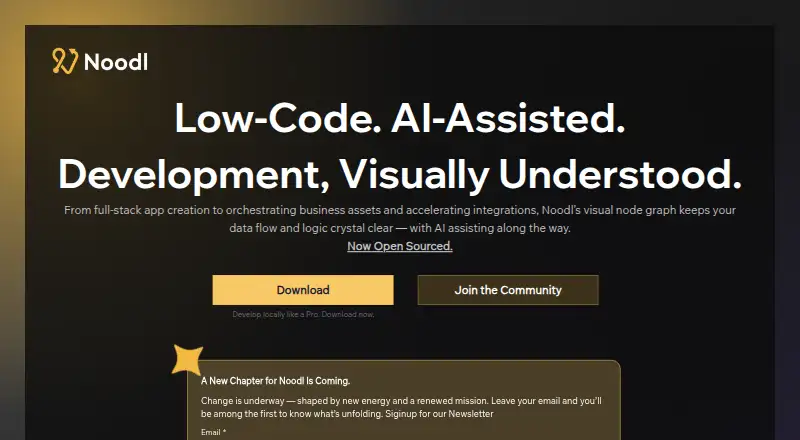
Noodl is a free, open-source, low-code visual platform for building full-stack web applications. Its visual node graph connects interface elements, data, and actions, with customizable controls, reusable reactive components, navigation, visual logic, and JavaScript functions for frontend work. Integrated cloud services provide databases, user management, access control, and cloud functions; these can run on Noodl hosting or user infrastructure. Self-hosting features are unavailable on the free plan. Noodl AI can generate JavaScript logic, API calls, database interactions, and UI elements from prompts. Limited Beta is free but supports only the Function command; Full Beta requires the user’s OpenAI GPT-4 API key, and OpenAI bills usage directly. Documented integrations include Mapbox, Chart.js, Google Sheets, GraphQL, Stripe Checkout, Google Analytics, MQTT, Zapier, and webhooks. Projects can deploy to Noodl hosting, custom domains, user infrastructure, or native iOS and Android apps through Capacitor.
Who it suits
Noodl suits designers, beginners, and developers building full-stack web applications visually. It is useful for teams wanting integrated backend services, AI assistance, self-hosting options, or native mobile deployment.
What it does well
- Free and open source
- Visual node graph connects UI, data, and actions
- Built-in database, users, access control, and cloud functions
- AI generates logic, API calls, and UI elements
- Supports web, mobile, API, and self-hosted deployments
What to know first
- Self-hosting unavailable on free plan
- Full Beta requires a GPT-4 API key
- OpenAI bills AI usage directly
- Limited Beta supports only the Function command
Verdict
Noodl combines visual low-code development, integrated backend services, and prompt-based AI assistance in an open-source package. Deployment spans hosted, self-managed, and native mobile targets, with restrictions around free-plan self-hosting and AI usage.
Facts from Noodl's own pages
- AI assistance
- Noodl AI can generate JavaScript logic, API calls, database interactions, and UI elements from text prompts. · docs.noodl.net, 12 Oct 2026
- AI features
- Noodl AI can generate JavaScript logic, API calls, database interactions, and UI elements from text prompts. · docs.noodl.net, 13 Oct 2026
- AI limits
- The documented Limited Beta is free and supports only the Function command; Full Beta requires a user-provided GPT-4 API key, and OpenAI bills for its API usage. · docs.noodl.net, 13 Oct 2026
- AI usage limit
- The documentation says full beta mode requires the user’s OpenAI GPT-4 API key, and OpenAI bills usage directly. · docs.noodl.net, 12 Oct 2026
- API integrations
- Yes · noodl.net, 21 Sept 2026
- App types
- web · noodl.net, 21 Sept 2026
- Backend
- Noodl’s cloud services provide database storage, user management, access control, and cloud functions. · docs.noodl.net, 13 Oct 2026
- Backend foundation
- The cloud services are based on the open-source Parse project. · docs.noodl.net, 12 Oct 2026
- Built-in database
- Yes · noodl.net, 21 Sept 2026
- Cloud services
- Integrated cloud services include a database, user management, access control, and cloud functions; the services can be hosted by Noodl or self-hosted. · docs.noodl.net, 12 Oct 2026
- Deployments
- Noodl projects are stored in Git repositories and can use the Build CLI to trigger deployments from a pushed branch. · docs.noodl.net, 13 Oct 2026
- External services
- Noodl documentation describes integrations with third-party services through Zapier and webhooks. · docs.noodl.net, 12 Oct 2026
- Frontend
- Noodl provides customizable UI controls, reusable components, and navigation features for building web app frontends. · docs.noodl.net, 13 Oct 2026
- Hosting
- Apps can be deployed on Noodl hosting with a custom domain, or their frontend and/or backend can be hosted on the user's infrastructure. · docs.noodl.net, 12 Oct 2026
- Integrations
- Noodl can connect to third-party services through Zapier and webhooks. · docs.noodl.net, 13 Oct 2026
- Intended users
- Noodl describes its visual development environment as suitable for designers, beginners, and developers who can add JavaScript when needed. · docs.noodl.net, 13 Oct 2026
- Licensing
- The GitHub README says editor components are GPLv3-licensed, while application runtime components and generated application source are MIT-licensed. · github.com, 13 Oct 2026
- Mobile deployment
- The documentation describes deploying projects as native iOS and Android apps using Capacitor. · docs.noodl.net, 12 Oct 2026
- Open source
- Noodl’s homepage says the product is now open sourced. · noodl.net, 13 Oct 2026
- Plan limit
- The documentation says self-hosting features are not available on the free Noodl plan and that users can request a trial. · docs.noodl.net, 12 Oct 2026
- Product
- Noodl describes itself as a low-code, AI-assisted development platform for full-stack app creation, business assets, and integrations. · noodl.net, 13 Oct 2026
- Security
- Noodl’s workflow documentation says access control can restrict which users access data, and cloud functions can perform operations that should not be possible from the client. · docs.noodl.net, 13 Oct 2026
- Self-hosting
- Noodl documentation says users can host the frontend or backend on their own infrastructure. · docs.noodl.net, 13 Oct 2026
- Support
- The project’s GitHub README identifies Discord as its main support channel. · github.com, 13 Oct 2026
Where Noodl stands on Freedom251
- No-code app builders#84 of 177
- Startup App Builder#15 of 30
- Full Stack Generators#17 of 26