Freedom251 › AI Singing Voice Generators
NNSVS
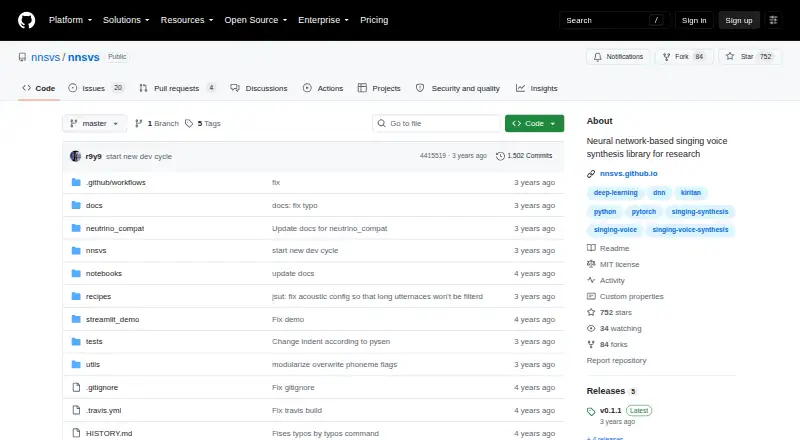
What NNSVS is
NNSVS is an open-source library for building neural network-based singing voice synthesis systems. Designed for research, it lets users create voicebanks from their own datasets and includes reproducible research recipes modeled on Kaldi and ESPnet. The recipes cover data preprocessing, training, and synthesis, and can be adapted to users’ own data and models. With a packed model, users can generate singing voice from MusicXML or UST files, with WAV listed as an export format.
The documented synthesis pipeline includes time-lag, duration, acoustic, post-filter, and vocoder modules. Users can implement custom PyTorch models by inheriting the NNSVS BaseModel interface. Optuna supports hyperparameter optimization, while MLflow visualizes and tracks search results. The documentation describes systems created with NNSVS for eight or more languages. NNSVS runs on Linux, Mac OS X, and Windows; Linux is recommended for development. Installation requires Python 3.7 or later and a C/C++ compiler, and GPU/CUDA is strongly recommended for performance. Google Colab is an option for users without a GPU, though the project does not recommend it for hyperparameter optimization. Acoustic model training can take several hours or a whole day, depending on configuration. The project provides installation guides, tutorials, and API reference documentation.
Who it suits
NNSVS suits researchers and developers building or studying singing voice synthesis systems with their own datasets and models. The project points non-researchers and non-developers toward more user-friendly tools such as ENUNU and Simple-ENUNU.
What it does well
- Open source under the MIT license, with commercial use allowed.
- Includes reproducible recipes for preprocessing, training, and synthesis.
- Accepts MusicXML or UST input with a packed model.
- Supports custom PyTorch models through its BaseModel interface.
- Runs on Linux, Mac OS X, and Windows.
What to know first
- GPU/CUDA is strongly recommended for performance.
- Acoustic model training can take several hours or a whole day.
- The post-filter is currently not recommended.
- Neural-vocoder support is limited.
Getting started
- Visit the NNSVS GitHub repository.
- Use Linux, Mac OS X, or Windows; Linux is recommended for development.
- Install Python 3.7 or later and a C/C++ compiler.
- Use GPU/CUDA for best performance, or run on Google Colab if you do not have a GPU.
- Follow the installation guide and choose a research recipe or adapt one to your data and models.
- Use a packed model with MusicXML or UST input to generate singing voice.
Verdict
Choose NNSVS if you want an open-source research library for creating and customizing singing voice synthesis systems. Look elsewhere if you need a more user-friendly tool or expect short training times without GPU/CUDA.
Questions
Is NNSVS free?
Yes. NNSVS is free and open source under the MIT license.
Can NNSVS be used commercially?
Yes. Commercial use is allowed.
Which operating systems does it support?
The installation guide lists Linux, Mac OS X, and Windows. Linux is recommended for development.
What is required to install NNSVS?
The guide requires Python 3.7 or later and a C/C++ compiler. GPU/CUDA is recommended for best performance.
What files can I use to generate singing voice?
With a packed model, NNSVS accepts MusicXML or UST files. WAV is listed as an export format.
Does NNSVS provide user support?
The project provides installation guides, tutorials, and API reference documentation.
Facts from NNSVS's own pages
- Compute
- GPU/CUDA is strongly recommended for performance, while Google Colab is listed as an option for users without GPUs. · nnsvs.github.io, 8 Oct 2026
- Customization
- Users can implement custom PyTorch models by inheriting NNSVS's BaseModel interface. · nnsvs.github.io, 8 Oct 2026
- Input formats
- Packed models can generate singing voice from MusicXML or UST files. · nnsvs.github.io, 7 Oct 2026
- Inputs and outputs
- With a packed model, users can generate singing voice by inputting MusicXML or UST files. · nnsvs.github.io, 8 Oct 2026
- Integrations
- NNSVS integrates Optuna for hyperparameter optimization and uses MLflow to visualize and track search results. · nnsvs.github.io, 7 Oct 2026
- Intended users
- The project says it was originally designed for research and recommends other tools for users who are neither researchers nor software developers. · nnsvs.github.io, 8 Oct 2026
- Languages
- NNSVS has been used to create singing voice synthesis systems for multiple languages, with the documentation saying 8 or more as far as its author knows. · nnsvs.github.io, 8 Oct 2026
- Licensing
- The project’s GitHub repository lists the MIT license. · github.com, 7 Oct 2026
- Notable limitation
- The documentation says the post-filter is currently not recommended and neural-vocoder support is limited. · nnsvs.github.io, 8 Oct 2026
- Open source
- NNSVS is fully open-source, and users can create their own voicebanks with their dataset. · nnsvs.github.io, 8 Oct 2026
- Optional compute
- Users without a GPU can run NNSVS on Google Colab, though the documentation does not recommend Colab for hyperparameter optimization. · nnsvs.github.io, 7 Oct 2026
- Purpose
- NNSVS is a neural network based singing voice synthesis library designed for research. · nnsvs.github.io, 8 Oct 2026
- Requirements
- The guide specifies Python 3.7 or later and says a C/C++ compiler must be installed in advance. · nnsvs.github.io, 8 Oct 2026
- Research recipes
- It includes reproducible Kaldi and ESPnet style recipes for creating baseline systems in research. · nnsvs.github.io, 7 Oct 2026
- Research workflows
- NNSVS includes reproducible recipes modeled on Kaldi and ESPnet approaches for building baseline systems in research. · nnsvs.github.io, 8 Oct 2026
- Supported operating systems
- The installation guide lists Linux, Mac OS X, and Windows as supported platforms and says Linux is recommended for development. · nnsvs.github.io, 7 Oct 2026
- Supported platforms
- The installation guide lists Linux, Mac OS X, and Windows as supported and says NNSVS is tested on them with GitHub Actions. · nnsvs.github.io, 8 Oct 2026
- Support information
- The opened project pages provide installation guides, tutorials, and API reference documentation; they do not state a dedicated support service. · nnsvs.github.io, 7 Oct 2026
- Synthesis pipeline
- Its documented system includes time-lag, duration, acoustic, post-filter, and vocoder modules. · nnsvs.github.io, 8 Oct 2026
- Training limitation
- The documentation says acoustic model training can take several hours or a whole day depending on configuration. · nnsvs.github.io, 7 Oct 2026
- Workflow
- Recipes cover data preprocessing, training, and synthesis, and can be customized with users’ own data and models. · nnsvs.github.io, 7 Oct 2026
Where NNSVS stands on Freedom251
- AI Singing Voice Generators#11 of 25