Freedom251 › Code Playground Software
NextLeet Playground
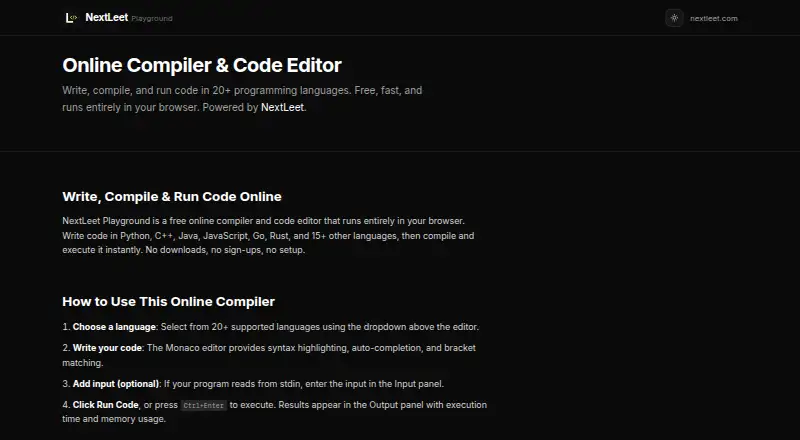
What NextLeet Playground is
NextLeet Playground is a free, browser-based compiler and code editor for writing, compiling and running programs in more than 20 languages. The listed languages include Python, C, C++, Java, JavaScript, TypeScript, Go, Rust, C#, Ruby, PHP, Swift, Kotlin, Scala, R, Perl, Bash, Haskell, Lua, Pascal and SQL. Its Monaco editor provides syntax highlighting, IntelliSense, bracket matching and keyboard shortcuts. Programs run in isolated sandboxed containers, with execution time and memory usage shown in results. Optional standard input can be entered through the Input panel. The site says code is not stored on its servers and results return immediately. Users can run code with the Run Code button or Ctrl+Enter. It works on devices with a modern browser and requires no downloads, sign-up, compiler, IDE or toolchain installation. JavaScript supports require() for built-in Node modules.
Who it suits
It suits learners, developers prototyping or testing snippets, and people practising competitive programming. Anyone with a modern browser can start without local setup.
What it does well
- Free browser-based access
- 20+ programming languages
- Monaco editing features
- Sandboxed execution results
- No downloads or sign-up
What to know first
- Requires a modern browser
- No deployment options listed
- Specific runtime versions are listed
Plans
| Plan | Billed and limits | Price |
|---|---|---|
| Free | Browser-based compiler and code editor · 20+ programming languages · No downloads or sign-up | Free |
| Free online compiler and code editor | 20+ programming languages · runs in browser · no downloads, sign-ups, or setup | Free |
As playground.nextleet.com lists them, read 15 Oct 2026. The maker's own page has the final word.
Verdict
NextLeet Playground offers an immediate, free coding environment with broad language coverage and useful editor support. Sandboxed execution and no local installation make it practical for learning, experiments and short coding tasks.
Facts from NextLeet Playground's own pages
- Code analysis
- The repository says the broader NextLeet platform can test and optimize code, estimate time and space use, suggest improvements and compare solutions. · github.com, 15 Oct 2026
- Code execution
- Code runs in isolated sandboxed containers, and results include execution time and memory usage. · playground.nextleet.com, 12 Oct 2026
- Code retention
- The site states that submitted code is not stored on its servers and results are returned immediately. · playground.nextleet.com, 15 Oct 2026
- Code storage
- The site says user code is never stored on its servers and that results are returned immediately. · playground.nextleet.com, 12 Oct 2026
- C++ runtime
- The C++ guide identifies GCC 9.2.0 as its compiler runtime. · playground.nextleet.com, 15 Oct 2026
- Deployment options
- none · playground.nextleet.com, 22 Sept 2026
- Deployment stack
- The repository lists Vercel and Netlify as deployment targets and mentions prerendering and server-side rendering for SEO. · github.com, 15 Oct 2026
- Device requirement
- The product says it works on any device with a modern web browser. · playground.nextleet.com, 15 Oct 2026
- Device support
- The site says the Playground works on any device with a modern browser. · playground.nextleet.com, 12 Oct 2026
- Editor
- The coding interface uses Monaco and provides syntax highlighting, auto-completion, IntelliSense, bracket matching and keyboard shortcuts. · playground.nextleet.com, 15 Oct 2026
- Execution controls
- Code can be run with the Run Code button or Ctrl+Enter, while Esc exits fullscreen mode. · playground.nextleet.com, 15 Oct 2026
- Execution results
- The output view reports program output together with execution time and memory usage. · playground.nextleet.com, 15 Oct 2026
- Feature requests
- NextLeet's feature-request page currently reports that there are no feature requests yet. · nextleet.com, 15 Oct 2026
- Free plan
- Yes · playground.nextleet.com, 22 Sept 2026
- Input
- Programs can receive optional standard input through an Input panel. · playground.nextleet.com, 15 Oct 2026
- Integrations
- The page says JavaScript execution supports require() for built-in Node modules. · playground.nextleet.com, 12 Oct 2026
- Intended use
- The site describes the Playground as useful for learning, prototyping, testing snippets, and competitive programming practice. · playground.nextleet.com, 12 Oct 2026
- Intended uses
- The maker positions the Playground for learning, prototyping, snippet testing and competitive-programming practice. · playground.nextleet.com, 15 Oct 2026
- Interview practice
- The repository describes company-specific coding problems with difficulty and topic filtering, including examples such as Google, Amazon and Microsoft. · github.com, 15 Oct 2026
- Java runtime
- The Java guide identifies OpenJDK 13 and supplies a ready Main class. · playground.nextleet.com, 15 Oct 2026
- JavaScript runtime
- The JavaScript guide identifies Node.js 12 and supports require() for built-in Node modules. · playground.nextleet.com, 15 Oct 2026
- Language runtimes
- The page identifies GCC 9.2.0 for C++ code, OpenJDK 13 for Java, and Node.js 12 for JavaScript. · playground.nextleet.com, 12 Oct 2026
- Language support
- The editor supports more than 20 languages, including Python, C, C++, Java, JavaScript, TypeScript, Go, Rust, C#, Ruby, PHP, Swift, Kotlin, Scala, R, Perl, Bash, Haskell, Lua, Pascal and SQL. · playground.nextleet.com, 15 Oct 2026
- Limit: deployment
- The Playground page describes browser execution but does not publish an application-deployment workflow. · playground.nextleet.com, 15 Oct 2026
Where NextLeet Playground stands on Freedom251
- Code Playground Software#33 of 58
- Coding Playgrounds#82 of 138