Freedom251 › Interactive Application Security Testing Software

New Relic IAST
What New Relic IAST is
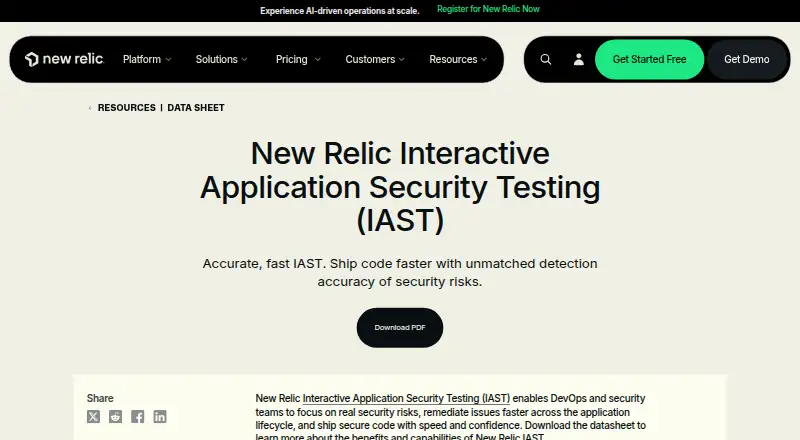
New Relic IAST probes running application code to identify vulnerabilities that could be exploited. Its dynamic assessment simulates attacks and can provide proof of exploit without code changes. New Relic APM agents deliver the capability, which teams can enable through a configuration change; supported languages are Go, Java, Node.js, and Ruby. Guided remediation can identify code locations, stack and HTTP traces, URLs, exploit mechanisms, and parameters. Findings receive CVSS version 3 severity ratings from Low to Critical. IAST is integrated with New Relic Vulnerability Management to find, fix, and verify high-risk vulnerabilities across the software development lifecycle. It supports authenticated and API testing, along with CI/CD and ticketing integrations. The tool is intended for DevOps and security teams seeking continuous application security testing. A free New Relic plan is listed, while IAST analysis is billed through an optional Compute Add On based on Compute Capacity Units consumed. Other pricing is available on request.
Who it suits
New Relic IAST suits DevOps and security teams looking for continuous application security testing across the software development lifecycle. Supported languages are Go, Java, Node.js, and Ruby.
What it does well
- Can show proof of exploit without code changes.
- Guided remediation identifies traces and exploit details.
- Supports authenticated and API testing.
- Integrates with CI/CD pipelines and ticketing systems.
What to know first
- IAST billing depends on Compute Capacity Units consumed.
- Pricing is available on request.
- Supported languages are Go, Java, Node.js, and Ruby.
Limits
The Free plan includes 100 GB of data ingest per month and one free full platform user. IAST analysis is billed through an optional Compute Add On based on Compute Capacity Units consumed; Standard, Pro, and Enterprise plan prices are available on request.
Plans
| Plan | Billed and limits | Price |
|---|---|---|
| Free | 100 GB data ingest/month · 1 free full platform user · unlimited basic users · 50+ capabilities | Free |
| Standard | Up to 5 full platform users · ticketed support · 2 business days support response SLA · SAML single sign-on | On request |
| Enterprise | Unlimited full platform users · FedRAMP Moderate and HIPAA eligibility with Data Plus · priority ticket routing · 1-hour critical initial support response SLA | On request |
| Pro | Unlimited full platform users · 2-hour critical initial support response SLA · Data Plus eligibility | On request |
As newrelic.com lists them, read 30 Sept 2026. The maker's own page has the final word.
Getting started
- Open the New Relic IAST website.
- Use New Relic APM agents for Go, Java, Node.js, or Ruby.
- Enable IAST through a configuration setting change.
- Connect IAST with CI/CD pipelines or ticketing systems as needed.
- Review pricing on request and account for the optional Compute Add On.
New Relic IAST tests running applications for exploitable vulnerabilities and connects findings to remediation workflows. It is aimed at DevOps and security teams building continuous security checks into development. Its core appeal is attack validation with useful runtime context; the narrow language coverage and usage-based add-on billing are important constraints.
Overview
Rather than relying only on static signals, New Relic IAST dynamically assesses running code by simulating real-world attacks. It can provide proof of exploit without code changes, helping teams distinguish actionable weaknesses from findings that may not be exploitable. The product is designed to generate fewer false positives than traditional application security tools.
Findings integrate with New Relic Vulnerability Management to support continuous identification, fixing, and verification of high-risk vulnerabilities across the software development lifecycle. This makes IAST a stronger fit for teams that want security work tied to an ongoing development process than for those seeking a standalone, occasional scan.
Key features
Runtime testing and remediation context
New Relic APM agents deliver IAST, which can be enabled with a configuration setting change. For teams already using those agents, that offers a direct path to runtime security testing. Teams outside the New Relic agent environment have less reason to choose it, and applications must use Go, Java, Node.js, or Ruby; other language stacks are outside its stated coverage.
Guided remediation can provide the code location, stack trace, HTTP trace, URLs encountered, exploit mechanism, and parameters. That context gives developers concrete starting points for investigation rather than leaving security teams with a severity label alone. CVSS version 3 scores findings as Low, Medium, High, or Critical.
Workflow and deployment fit
CI/CD pipeline and ticketing integrations help route findings into development and response workflows. New Relic also offers more than 780 integrations spanning applications, logs, and infrastructure data, a broad ecosystem for teams consolidating operational context. Authenticated and API testing are supported, while the runtime target is web.
Customers can choose New Relic data centers in the United States or European Union. New Relic currently lists FedRAMP, HIPAA-enabled capabilities, ISO 27001, ISO 42001, PCI DSS, SOC 1, SOC 2, and TISAX certifications or attestations. These options matter to organizations with residency or compliance requirements, though the Enterprise plan's stated FedRAMP Moderate and HIPAA eligibility is specifically tied to Data Plus.
Pricing
New Relic IAST is a paid capability with pricing on request. Analysis is billed through an optional Compute Add On according to Compute Capacity Units consumed, so costs depend on analysis usage rather than a published flat IAST price. Teams should account for this variable charge when estimating ongoing testing costs.
New Relic's platform plans provide a free entry point, but the published plan details do not give a separate IAST price:
- Free — free: Includes 100 GB of data ingest per month, one free full platform user, unlimited basic users, and 50+ capabilities. It is the lowest-risk way to start with the platform, but has a single full-user allowance and does not remove IAST's optional Compute Add On billing.
- Standard — custom pricing: Includes up to five full platform users, ticketed support, a two-business-day support response SLA, and SAML single sign-on. It suits smaller teams that need those access and support provisions; the five-user ceiling may constrain broader platform use.
- Pro — custom pricing: Includes unlimited full platform users, a two-hour critical initial support response SLA, and Data Plus eligibility. It fits teams that need broader user access and faster critical support without the Enterprise plan's specified compliance eligibility.
- Enterprise — custom pricing: Includes unlimited full platform users, FedRAMP Moderate and HIPAA eligibility with Data Plus, priority ticket routing, and a one-hour critical initial support response SLA. It is the relevant tier for organizations needing those eligibility and support terms, but comes with custom pricing.
Because IAST analysis uses the optional Compute Add On, the free platform plan should not be mistaken for free IAST analysis.
Platforms
New Relic IAST targets web applications and is delivered through agents for Go, Java, Node.js, and Ruby. It supports API testing, authenticated testing, and CI/CD integration. Agent-based deployment is most convenient for organizations already using New Relic APM; the four-language limit is a material exclusion for teams with other application stacks.
Who it's for
This is a good fit for DevOps and security teams that want continuous application security testing across development, especially when they already use New Relic APM and Vulnerability Management. Teams that need exploit evidence, remediation details, and links to CI/CD or ticketing workflows can get a coherent runtime process from those capabilities.
It is a weaker fit for teams using unsupported languages, organizations unwilling to adopt New Relic agents, or buyers who need a predictable public IAST price. Usage-based Compute Capacity Unit billing may also make it less suitable where a fixed analysis budget is essential.
Pros and cons
- Pro: Attack simulation can produce proof of exploit without code changes, helping teams focus on vulnerabilities with evidence of exploitability.
- Pro: Guided remediation supplies code and request-level context, including stack traces, HTTP traces, URLs, exploit mechanisms, and parameters.
- Pro: Integration with Vulnerability Management, CI/CD pipelines, and ticketing supports continuous workflows from discovery toward remediation and verification.
- Con: Agent support is limited to Go, Java, Node.js, and Ruby, excluding other language stacks.
- Con: IAST analysis incurs optional Compute Add On charges based on consumption, and its price is available on request rather than as a public fixed amount.
Alternatives
Compare interactive application security testing software if you want to consider a wider set of products.
- Aikido CSPM is worth considering if a freemium option across API, desktop, web, and operating-system platforms is a better fit.
- HCL AppScan may suit teams seeking a free CodeSweep download with an on-prem GitHub extension and SAST scanner, or a product with a free trial.
- Waratek IAST is an alternative for buyers who want a free trial of a paid IAST product, with Linux, self-hosted, web, and Windows platform support.
- DongTai IAST is the alternative to consider for a free, open-source self-hosted deployment via Docker Compose or Kubernetes.
- Contrast Assess is another paid application security option.
- Veracode DAST is a paid option for web applications and APIs, with a free trial.
- NowSecure Platform is a paid alternative with pricing by demo or order form.
- Black Duck Seeker is another paid option for Linux, macOS, web, and Windows.
Verdict
Choose New Relic IAST if your team uses New Relic agents with Go, Java, Node.js, or Ruby applications and wants attack validation connected to remediation workflows. Its strongest reason to buy is the combination of exploit evidence and actionable runtime context. Look elsewhere if your language stack is outside its coverage or you need a predictable public price for analysis.
Verdict
New Relic IAST combines attack simulation with remediation details and integration into vulnerability management workflows. Teams should account for its optional Compute Add On billing and check that their application uses a supported language.
Questions
Is New Relic IAST free?
A Free New Relic plan is available free of charge. IAST analysis is billed through an optional Compute Add On based on Compute Capacity Units consumed.
What does IAST cost?
Pricing is available on request. Analysis billing uses Compute Capacity Units consumed through an optional Compute Add On.
Which languages does it support?
New Relic agents provide IAST for Go, Java, Node.js, and Ruby.
Can it test authenticated applications and APIs?
Yes. Authenticated testing and API testing are supported.
Does it integrate with CI/CD tools?
IAST supports CI/CD pipelines and ticketing systems.
Who makes New Relic IAST?
It is a New Relic capability. New Relic was founded in 2008 and is headquartered in San Francisco, California, USA.
Facts from New Relic IAST's own pages
- Audience
- IAST is intended for DevOps and security teams that need continuous application security testing across the software development lifecycle. · newrelic.com, 30 Sept 2026
- Billing
- IAST is billed through an optional Compute Add On based on Compute Capacity Units consumed during analysis. · docs.newrelic.com, 30 Sept 2026
- CI/CD and ticketing
- IAST supports seamless integration with CI/CD pipelines and ticketing systems. · newrelic.com, 30 Sept 2026
- Compliance
- New Relic currently lists FedRAMP, HIPAA-enabled capabilities, ISO 27001, ISO 42001, PCI DSS, SOC 1, SOC 2, and TISAX certifications or attestations. · docs.newrelic.com, 30 Sept 2026
- Data residency
- Customers can choose between New Relic data centers in the United States and European Union. · newrelic.com, 30 Sept 2026
- Deployment
- New Relic APM agents deliver IAST and it can be enabled through a configuration setting change. · docs.newrelic.com, 30 Sept 2026
- Exploit validation
- Dynamic assessment simulates real-world attacks and provides proof of exploit without requiring code changes. · newrelic.com, 30 Sept 2026
- False positives
- IAST is designed to provide fewer false-positive findings than traditional application security tools. · docs.newrelic.com, 30 Sept 2026
- Founded
- 2008 · newrelic.com, 28 Sept 2026
- Guided remediation
- Guided remediation can identify code location, stack trace, HTTP trace, encountered URLs, exploit mechanism, and parameters. · newrelic.com, 30 Sept 2026
- Headquarters
- San Francisco, California, USA · newrelic.com, 28 Sept 2026
- Integrations
- New Relic offers more than 780 integrations across applications, logs, and infrastructure data. · newrelic.com, 30 Sept 2026
- Purpose
- New Relic IAST probes running code for exploitable vulnerabilities to help prevent cyberattacks and breaches. · docs.newrelic.com, 30 Sept 2026
- Severity scoring
- IAST assigns vulnerability severity using CVSS version 3, with Low, Medium, High, and Critical ranges. · docs.newrelic.com, 30 Sept 2026
- Supported languages
- IAST is available through New Relic agents for Go, Java, Node.js, and Ruby. · docs.newrelic.com, 30 Sept 2026
- Vulnerability management
- IAST is fully integrated with New Relic Vulnerability Management for continuously finding, fixing, and verifying high-risk vulnerabilities across the software development lifecycle. · docs.newrelic.com, 30 Sept 2026